
Note: This is an excerpt from ‘The Reluctant Diplomat.’ It was written a decade ago when I was serving in Milan, Italy, as the Public Affairs Officer, long before the Trump Administration and DOGE started their scorched-earth campaign against USAID, randomly selected State Department staff who were in the wrong place at the wrong time, and Federal workers in general. More information about ‘The Reluctant Diplomat’ can be found here.
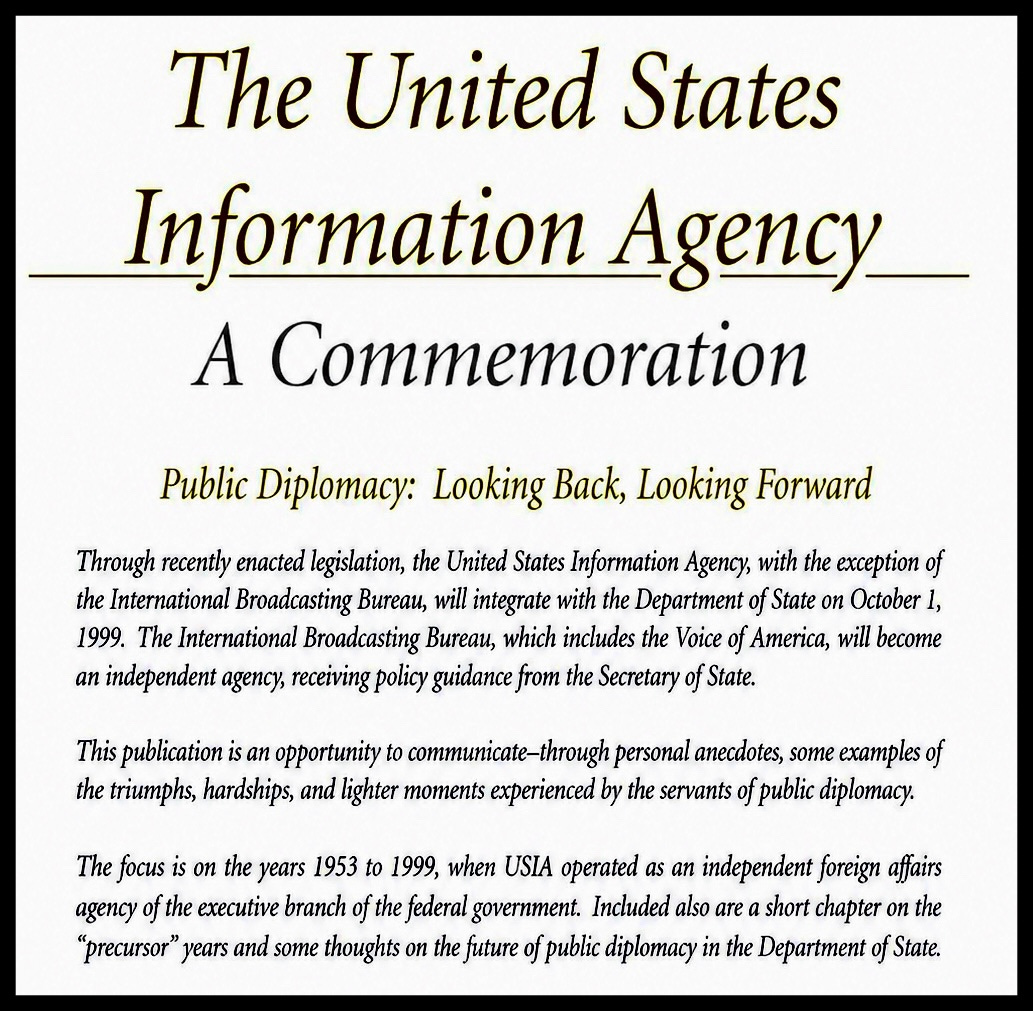
Public diplomacy, which is often mistakenly called “public relations” by many foreigners I meet—or more bluntly, “propaganda”—has a fascinating history. The other day, as part of a mandated clean-up in Milan’s Public Affairs Section, we salvaged a booklet from one of the many forgotten (yet heaving) drawers of [REDACTED]’s desk. United States Information Agency: A Commemoration / Public Diplomacy: Looking Back, Looking Forward was printed by the U.S. Information Agency (USIA) in the waning days before its closure. It is chock-full of remembrances from long-retired USIA officers, and it provides a neat capsule of the agency’s mission, which would be known as public diplomacy after its merger into the State Department. The booklet was created using all of the panache and finesse available on State’s mighty Wang Computers—which had been a huge swing and miss—giving it the look of a small Lutheran church newsletter circa 1970.
Here is a subjective summary—a nostalgic and bemused glimpse at how we got here. [Again, “here” being 2015. Not here as in 2026, when “hearts and minds” were still things we aspired to win, as opposed to cannibalizing.]
In 1999, after 46 years of existence, USIA was subsumed by the U.S. Department of State. The death/takeover/transformation of USIA (depending on who you ask) continues to be a controversial subject, one that splits evenly along the “good old days” school (PD) versus the “it was about time” group (everyone else). All these years later, the event affects budgeting, staffing, and other vital areas of my day-to-day job.
Even though I joined State three years after USIA’s demise, I was often labeled a “throwback to USIA.” This observation was variously offered as high praise or sharp criticism of my PD work. It’s vital, therefore, to know who is doing the referencing. Either way, it is confirmation that my work wasn’t boring.
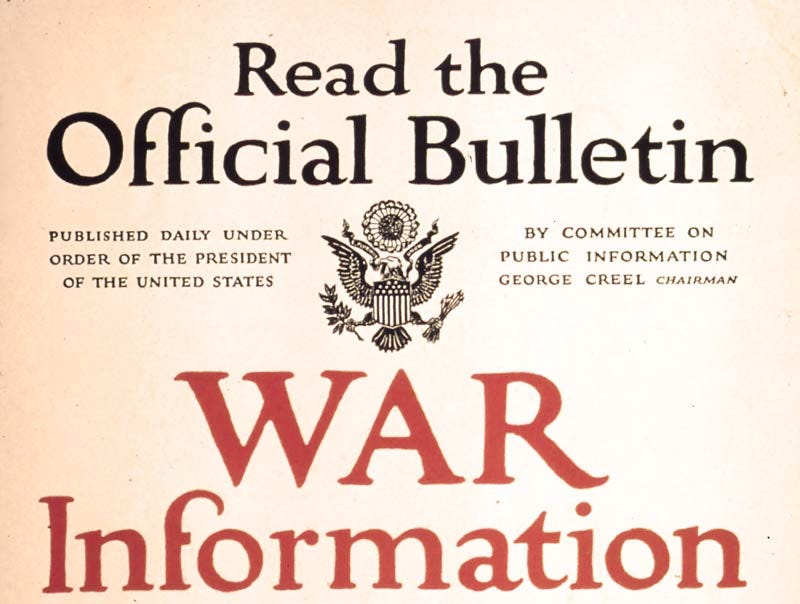
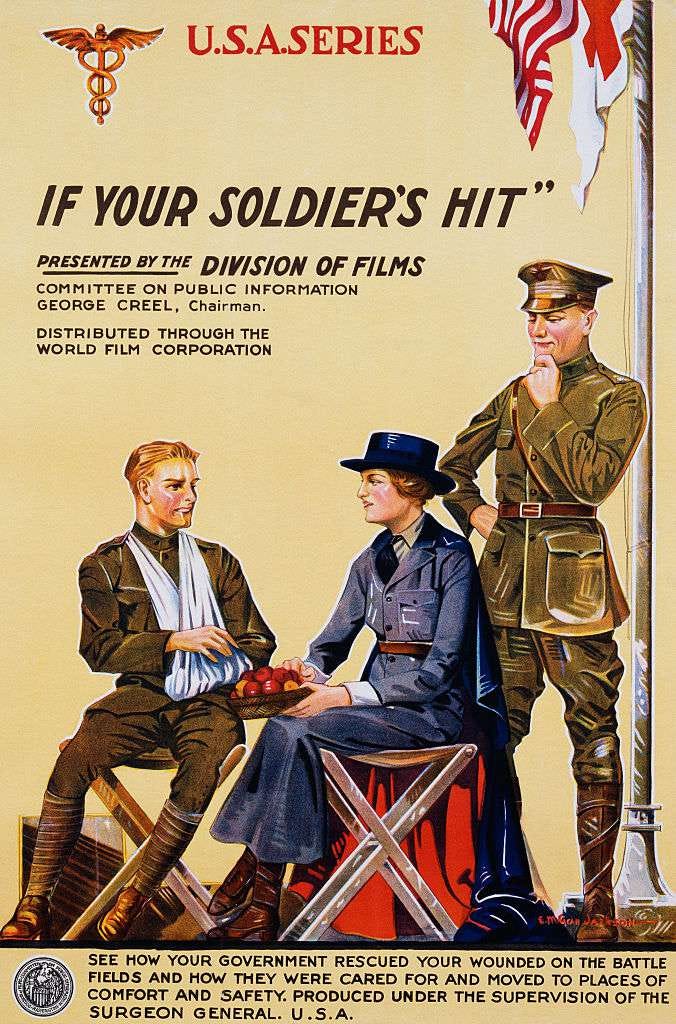
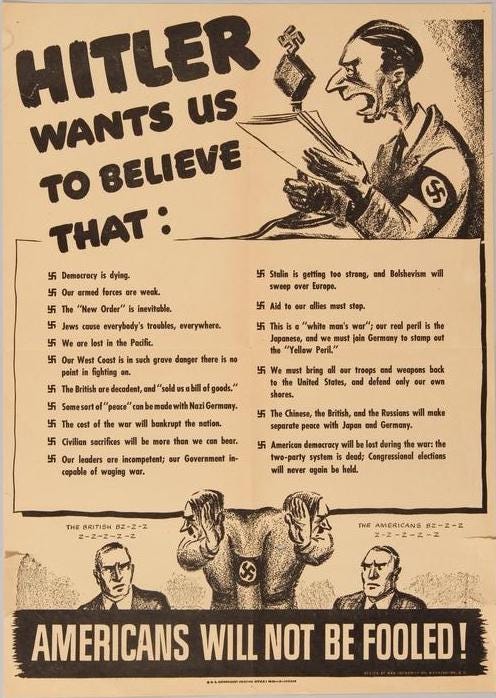
The first diplomatic precursor to USIA, Woodrow Wilson’s Committee on Public Information (CPI), was created during World War I. Led by muckraker journalist George Creel (often referred to as the Creel Committee), its primary concern was domestic public opinion, specifically getting the American public behind the war effort. The CPI was what we would now confidently call a propaganda tool. But Creel wrote, “Our effort was educational and informative throughout, for we had such confidence in our case as to feel that no other argument was needed than the simple, straightforward presentation of facts.” In many ways, that is how we characterize our PD efforts to this day. [Again, “this day” 2015. Not this day today, when the government puts disclaimers up in front of the Smithsonian Museum.]
Just as CPI was formed to respond primarily to German propaganda, similar challenges reemerged during the 1930s, in the lead-up to World War II. In direct reaction to German and Italian propaganda, President Roosevelt opened the first Office of the Coordinator of Inter-American Affairs (CIAA) in Latin America. Like the latter-day USIA, the CIAA model included student and professional exchanges, libraries, and binational centers. Around the same time, agencies like the Office of Government Reports, the Coordinator of Information (COI), and the scintillating-sounding Office of Facts and Figures arose.
It seems to me that if you wanted to punish an unliked colleague, you might get them transferred to the Office of Government Reports or the Office of Facts and Figures. They might never be seen again.
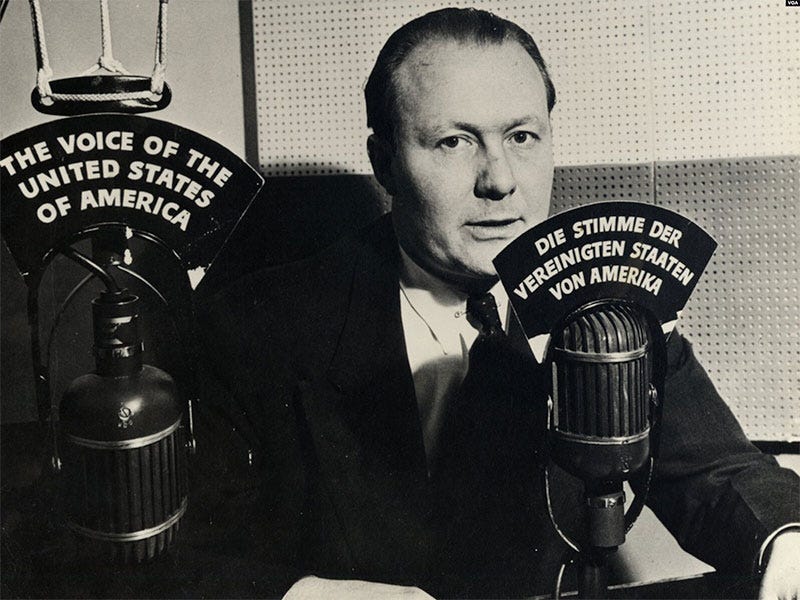
Radio and television became essential tools at this time. The American Broadcasting Station in Europe was established in London. By 1942, the Voice of America (VOA) was transmitting in 27 languages. In 1941, Roosevelt established the U.S. Foreign Information Service (FIS). This morphed into the Office of War Information (OWI) and before long into USIA itself.1
The State Department established the International Visitor Leadership Program (IVLP) that same year. It remains one of our great programs. The notion that bringing foreigners to the United States to see it, taste it, and hear it for themselves would forever impress them with a more sympathetic and nuanced understanding of our country (and, hopefully, our policies) is still a tried-and-true proposition. Even with all of our limits and budget restrictions, the thought that I can still meet someone in a foreign country, identify them as a rising leader in their field, and have the power to get them to the United States on an exchange program remains one of the most powerful aspects of a diplomat’s job.
In 1946, another of our crown jewels, named after its founder, Arkansas Senator J. William Fulbright, was established. The Fulbright Program, where foreign scholars are placed in U.S. universities and U.S. scholars are sent around the globe, was borne from the Senator’s ironclad belief that such firsthand experience was indispensable for two-way understanding and appreciation of other cultures. He nailed it.
Fulbright and IVLP alumni include an international who’s who list of influential government, culture, arts, business, and civil society leaders. I am invariably impressed by my predecessors’ foresight and imagination as I meet dynamic alumni worldwide. Some have become great allies of ours, others not so much, but virtually all are better for the experience. I have zero doubt that by simply shifting a large piece of the military budget to people-to-people exchanges, we would create a better, more stable world, almost instantaneously.
The USIA booklet features a poem by former British Poet Laureate Ted Hughes, describing his first glimpse of his future wife, Sylvia Plath, arriving in Britain as a Fulbright grantee.
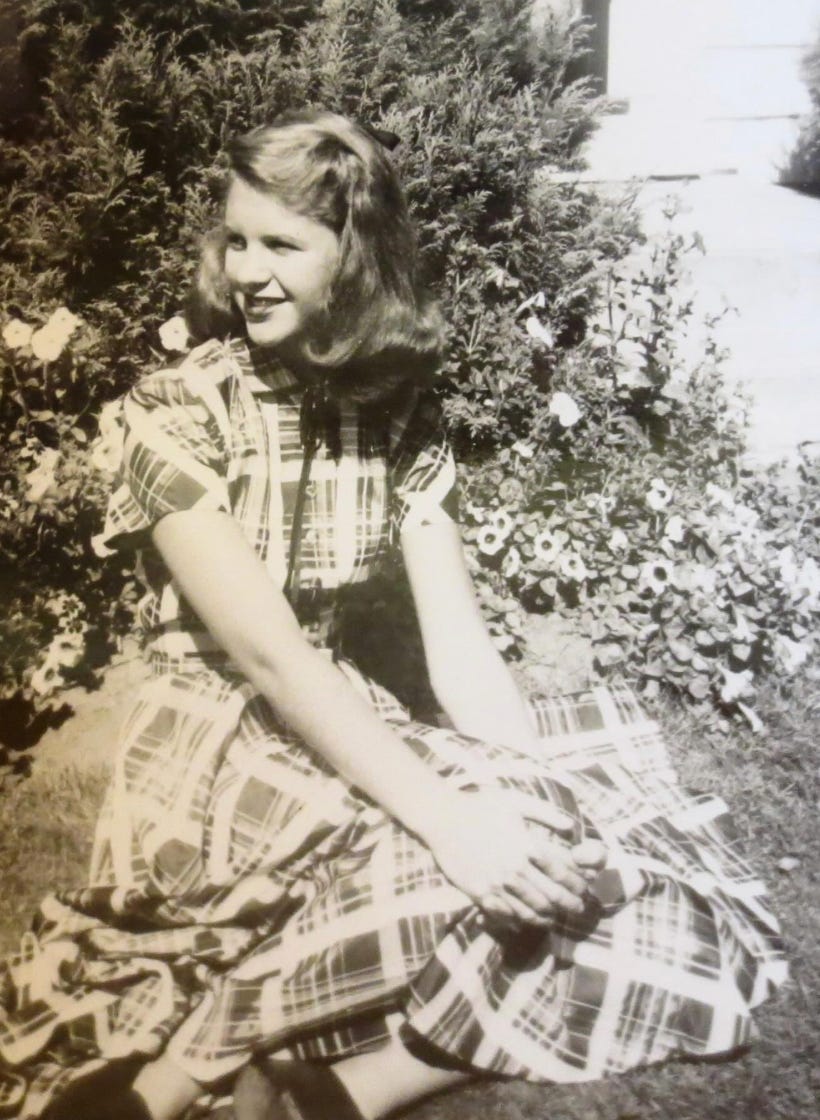
Text within this block will maintain its original spacing when published
Fulbright Scholars

Where was it, in the Strand? A display
Of news items, in photographs.
For some reason I noticed it
A picture of that year’s intake
Of Fulbright Scholars. Just arriving -
Or arrived. Or some of them.
Were you among them? I studied it,
Not too minutely, wondering
Which of them I might meet.
I remember that thought. Not
Your face. No doubt I scanned particularly
The girls. Maybe I noticed you.
Maybe I weighed you up, feeling unlikely.
Noted your long hair, loose waves—
Your Veronica Lake bang. Not what it hid.
It would appear blond. And your grin.
Your exaggerated American
Grin for the cameras, the judges, the strangers, the frighteners.
Then I forgot. Yet I remember
The picture: the Fulbright Scholars.
With their luggage? It seems unlikely.
Could they have come as a team? I was walking
Sore-footed, under hot sun, hot pavements.
Was it then I bought a peach? That’s as I remember.
From a stall near Charing Cross Station.
It was the first fresh peach I had ever tasted.
I could hardly believe how delicious.
At twenty-five I was dumbfounded afresh
by my ignorance of the simplest things.
Damn. But I digress.
Yale Richmond, a retired Foreign Service Officer (FSO), remembered being stationed in Munich in 1952. He and his young colleagues were told to “get out to towns and villages, buy the burgermeister a beer, and talk to them about the United States and what we are trying to do here.” “We were practicing public diplomacy,” says Richmond, “long before the term had been invented.” Replace the burgermeisters with sindaci, and the beer with espresso, and, sixty years later, my mandate in Milan remains the same.
Things were going well on the information front. Post-war foreign audiences were lavished with (re)education programs about the United States. Yet, some Americans worried about overt domestic propaganda in the face of the Soviets and recent memories of Nazi Germany. Enter Republicans Karl Mundt (SD) and H. Alexander Smith (NJ) and their big brains.
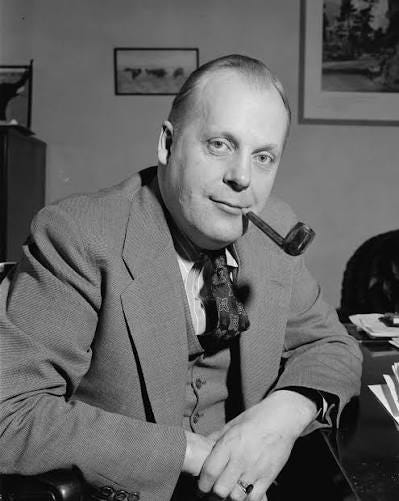
End of Part One. Coming next: The Smith-Mundt Act, the creation of USIA, the Cold War, the Jazz Ambassadors, a drunken William Faulkner, a drunken Ernest Hemingway, and a man named Edward R. Murrow strides onto the stage…
If you haven’t yet read it, here’s our Substack essay about VoA…
Soft, Powerful Beginnings (Voice of America)
·
Jul 22
The term “soft power” was coined by the political scientist and Harvard professor Joseph Nye in his 1990 book “Bound to Lead: The Changing Nature of American Power.” This phrase was not created as an entirely new concept, but instead put into words a practice that has long been a diplomatic t…
Thanks for reading! This post is public so feel free to share it.
No posts
Comments
Nothing yet. Say the first thing.
Sign in to join the conversation.