
For more than half a century, political campaigns have organized the electorate into increasingly refined categories:
The average suburban woman.
The average independent.
The average evangelical.
The average Hispanic voter.
The average union household.
Every election seemed to produce another label that consultants quickly converted into a targeting universe. Entire media plans, messaging strategies, and turnout operations were built around these broad demographic buckets. And for a long time, that made reasonable sense. Demographics were among the best predictors available.
The problem is that demographics describe people, but they do not reliably explain behavior.
That distinction is becoming one of the most important developments in modern politics.
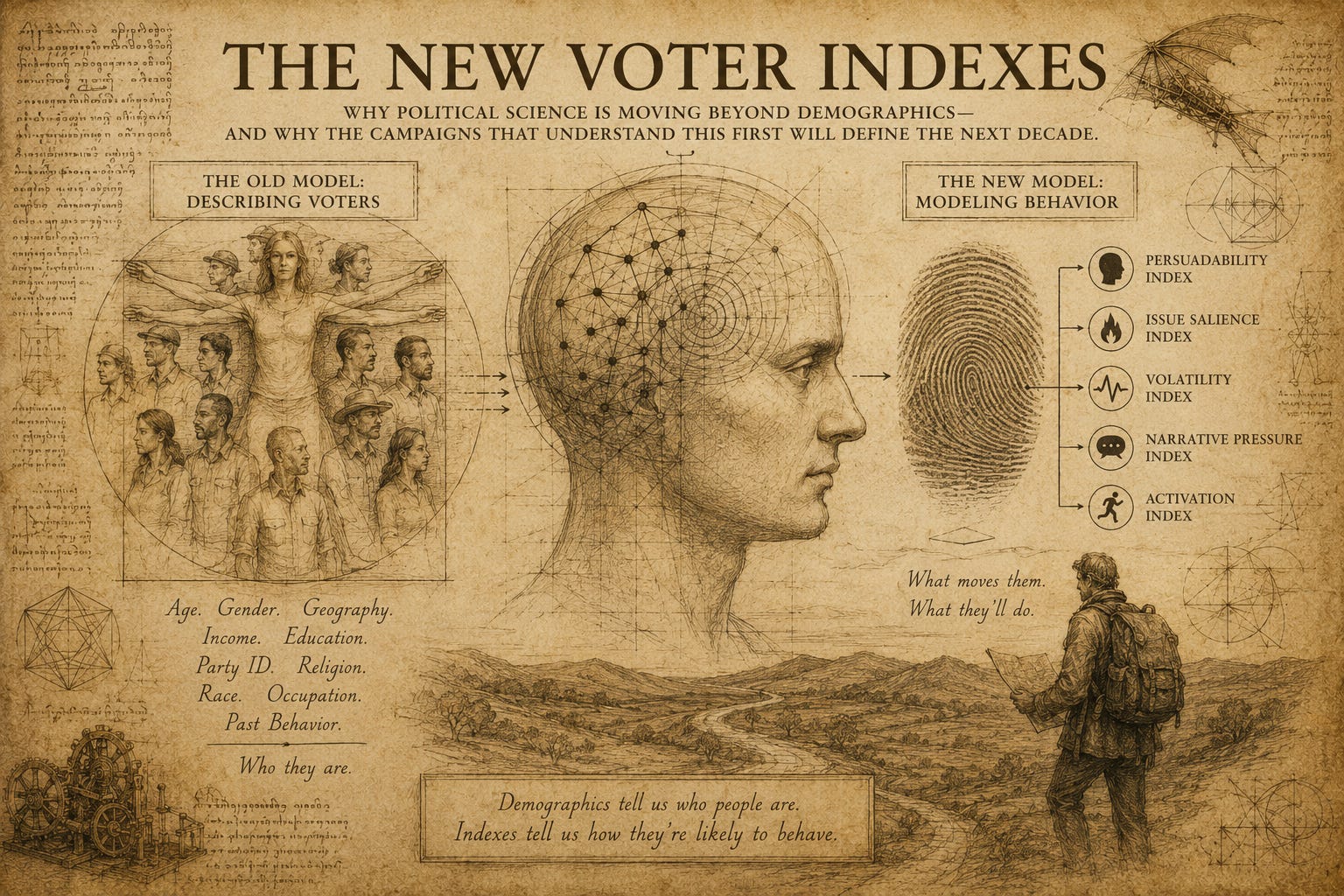
Political science has always tried to answer a deceptively simple question: Why do people vote the way they do?
The first generation of answers focused on demographics. Age, income, education, religion, geography, and race explained a remarkable amount of variation in voting behavior. Later came party identification, ideology, and consumer data. Each iteration added another layer of understanding, and campaigns became more sophisticated as a result.
But over the last decade, something changed: the electorate became less predictable because people who look similar on paper increasingly behave differently in practice.
Two suburban women of the same age, income, education, and party registration can now respond completely very differently to the same political message. Meanwhile, two voters who appear to have almost nothing in common demographically may react to exactly the same issue for exactly the same reasons.
The average voter is becoming less useful as a planning concept.
I was reminded of this several years ago during a statewide research project.
At the outset, the campaign’s assumptions were perfectly reasonable. Like most campaigns, it believed suburban women would primarily be responding to the issues dominating national political coverage. We tested those issues, of course. But we also went looking for something else. We wanted to identify issues that were uniquely salient; not to broad demographic groups, but to smaller behavioral segments that traditional political analysis often overlooks.
One issue kept coming up in focus groups: Red-light traffic cameras.
On its face, it sounded absurd. No serious political consultant would have walked into a strategy meeting and declared that automated traffic enforcement was one of the defining persuasion issues for a critical slice of suburban voters.
But the findings kept telling the same story.
The issue wasn’t really about traffic cameras. It was about fairness, local control, government overreach, and the feeling that ordinary citizens were being treated as revenue sources rather than constituents. The cameras had become a proxy for something much larger.
The lesson had very little to do with transportation policy and had everything to do with behavior.
The most interesting political questions increasingly aren’t “Who is this voter?”
They’re “What motivates this voter?” and “Under what conditions does this voter move?”
This is where data science begins to change the discipline. Traditional political analysis groups voters into categories. Data science identifies patterns.
That sounds like a subtle distinction, but it changes the entire operating model of a campaign.
Modern clustering algorithms don’t begin by asking whether someone is male or female, suburban or rural, Republican or Democrat. They begin by looking for relationships that humans are unlikely to discover on their own. They identify people who behave similarly, consume information similarly, respond to similar narratives, or exhibit similar patterns of movement; even if they share very little demographically.
The result is that campaigns think less in terms of demographics and more in terms of behavioral fingerprints.
That shift is already happening outside politics. Recommendation engines don’t organize people by age. Fraud detection systems don’t organize customers by geography. Modern medicine increasingly groups patients by biomarkers rather than symptoms alone.
Politics has moved in the same direction.
Recent academic work points in this direction as well.
Research on AI-driven political persuasion has increasingly shown that persuasion effects are highly heterogeneous. The same message produces dramatically different outcomes depending on the individual receiving it, and behavioral outcomes often diverge from attitudinal ones.
In other words, changing someone’s opinion and changing someone’s behavior are not the same thing.
The implication is profound: broad averages increasingly conceal the very dynamics campaigns most need to understand.
Behavioral economics has been pointing toward this conclusion for years. Context matters. Identity matters. Timing matters. Salience matters. Human beings do not process information as interchangeable members of demographic groups. They respond through a complex interaction of values, incentives, emotions, habits, and social identity.
The models have caught up. Some campaigns have also caught up, but far too many have not.
Over the past year, one of the most interesting parts of my work has been helping develop a new generation of voter indexes designed to measure characteristics campaigns have historically treated as intuition. Not demographics, but:
Behavior.
Persuadability.
Issue salience.
Coalition volatility.
Narrative pressure.
Behavioral activation.
These aren’t labels. They’re probabilities. They describe how people are likely to behave under changing political conditions, not simply who they are.
I suspect this is where the next decade of campaign strategy is headed.
The implications extend well beyond politics.
Businesses increasingly segment customers by predicted behavior rather than demographics. Financial institutions assess risk through behavioral models. Healthcare systems identify patients based on likelihood of intervention rather than broad population averages.
Politics has been slower to make that transition, but the direction is becoming difficult to ignore.
Campaigns built around averages are slowly giving way to campaigns built around movement. But too slowly, as this “giving way” also gives way to profit margins.
The next generation of well run campaigns won’t simply ask whether a voter is a suburban woman or an independent voter.
They’ll ask whether she is persuadable.
Whether her support is stable or volatile.
Which issues are most salient to her today; not six months, six weeks or six days ago.
Whether she’s becoming more or less likely to act.
Those are fundamentally different questions.
And they require fundamentally different tools.
For most of modern political history, campaigns asked:
Who is this voter?
Increasingly, the more important question is:
What kind of movement is this voter capable of?
The campaigns that answer that question first won’t just have better data.
They’ll have a better map of the electorate itself.
Comments
Nothing yet. Say the first thing.
Sign in to join the conversation.