
When the Word Became a Weapon
Something happened over time—slowly at first, then with astonishing speed.
As Yeshua’s message spread into Greek-speaking communities, then Roman ones, the Aramaic richness of the word ḥaṭa was gradually compressed into the Greek term hamartia, and later into the Latin word peccatum.
A problem was emerging.
Aramaic words behave like living things:
three-dimensional
relational
layered
fluid
holding multiple truths at once
Greek and Latin words—especially in philosophical or legal contexts—tend to behave like coins:
one face
one value
fixed
rigid
When “sin” shifted from the Aramaic world to the Greco-Roman world, it hardened.
What had been fluid became fixed.
What had been a condition became a crime.
What had been a momentary misalignment became a permanent identity.
In the centuries that followed, sin was reinterpreted not as veering off the path but as violating divine law, offending God’s honor, damaging the church’s purity, or earning punishment.
The word became a weapon.
And the weapon was fear.
But this was far from Yeshua’s intent.
Yeshua’s Encounters: How He Reframed Sin in Real Time
The clearest way to understand what “sin” meant to Yeshua is to watch him interact with the people religious society labeled as sinners.
The Woman Caught in Adultery
She is dragged into the public square, surrounded by men ready to stone her—men certain that they are acting on God’s behalf. She trembles, already half-buried in shame.
But Yeshua bends down.
He writes in the dust.
He slows down time.
And when he stands to face her accusers, he does not argue theology.
He simply holds up a mirror.
“Let the one without sin cast the first stone.”
Silence.
One by one, stones drop.
Then he turns to her—not with condemnation, but with restoration.
“Neither do I condemn you.
Go your way—and be aligned again.”
He is not saying, “Try harder to be good.”
He is saying, “You forgot who you are. Now remember.”
The Paralyzed Man
Lowered through a roof, his friends desperate for him to be healed.
Before Yeshua speaks a word about his body, he touches the deeper wound.
“Your sins are released.”
Not forgiven.
Released.
Set free.
Untied.
It is the language of healing, not guilt.
Only then does he address the body—because to Yeshua, inner healing and outer healing are intertwined.
The Prodigal Son
A young man who loses himself in every possible way:
distraction, hunger, shame, self-loathing.
But when he returns home, rehearsing his apology, begging to be allowed back as a servant, his father interrupts him with a larger truth.
“My son was lost… and now is found.”
Sin, again, is not about moral failure.
It is about becoming lost.
And salvation is being found.
The father does not require penance or punishment.
He requires only presence.
He wraps the boy in a robe before the boy can even finish confessing.
In Aramaic thought:
the return itself is repentance.
The Good Shepherd
He leaves the ninety-nine to search for the one—not because the one is guilty, but because the one is disconnected from the flock, from safety, from alignment.
And when he finds the sheep, he does not scold it.
He lifts it.
Carries it home.
This is how Yeshua sees the human condition.
Not as rebellion,
but as estrangement.
Not as wickedness,
but as woundedness.
Not as defiance,
but as disorientation.
Sin is the forgetting.
Salvation is the remembering.
How the Empire Changed the Story
When the movement moved from Aramaic villages to Roman basilicas, the concept of sin became useful.
The Empire needed sin to be:
measurable
punishable
controllable
administrable
And so sin became juridical.
It became:
violation of divine law
guilt before a cosmic courtroom
a stain requiring payment
a condition resolved only by institutional mediation
This empowered those who claimed the authority to determine:
who had sinned
what counted as sin
who could declare forgiveness
how forgiveness was obtained
A far cry from the Yeshua who simply said,
“Your sins are untied.”
The Deepest Truth
At its core, the teaching of Yeshua about sin was not about moral imperfection.
It was about misalignment with Love.
Because if Love truly is the Source of all that is,
then sin is what happens when we forget:
where we come from
who we are
what we carry
how beloved we are
how connected all things are
Sin is the loss of spiritual orientation.
Love is the compass that points us home.
And this is why Yeshua never used fear as a weapon to change anyone.
Fear does not align.
Fear constricts.
Fear paralyzes.
Fear diminishes the soul.
But Love…
Love loosens the knots.
Love dissolves the shame.
Love restores the image.
Love reawakens the truth.
Love realigns.
This is why Yeshua could look into the eyes of a tax collector, or a woman bent with shame,
or a man paralyzed inside and out…
and call them home.
Because he saw what they had forgotten.
He saw the divine center beneath the layers of misalignment.
He saw the radiant image beneath the dust.
He saw the gold beneath the tarnish.
And every time he said,
“Your sins are released,”
he was really saying:
“Come back into alignment with Love.
I am here with you.
Let’s walk this Way together.”
In the next post: We will enter Chapter Three.
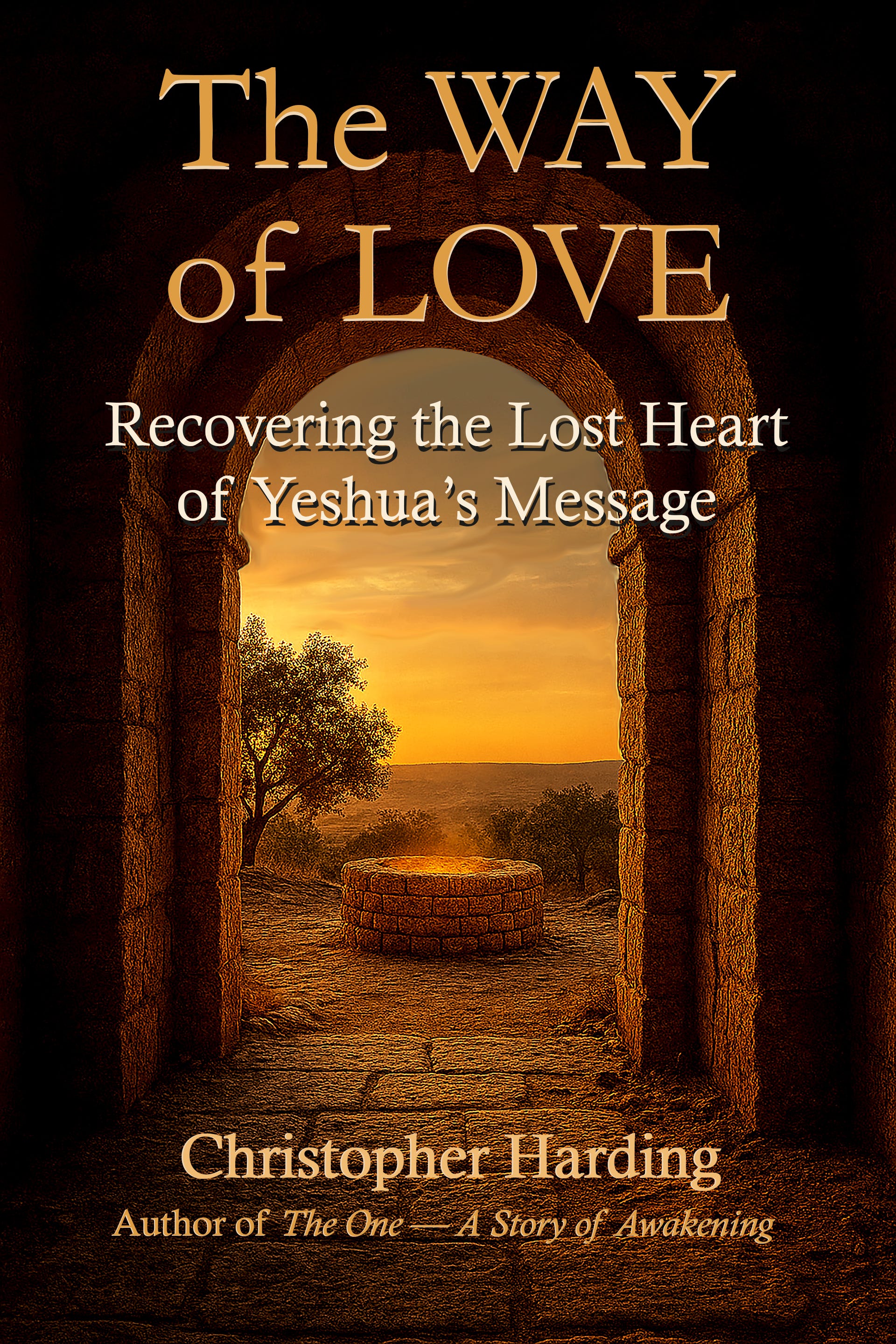
In the days and weeks that follow, I’ll continue to post sections from the new book as I craft them, or as they craft me. Your thoughts and comments, as always, will be greatly appreciated.
~ Christopher Harding
No posts
Comments
Nothing yet. Say the first thing.
Sign in to join the conversation.