
The Claim That Cannot Be Answered
On culture as one system among many, and what happens when a claim can no longer be corrected
Culture does not sit beside the economy, the law, and the state, in a separate room down the hall. It runs through all of them, the way water runs through soil it never announces itself in. A nation decides what it can bear to know, and that decision moves money, moves votes, moves the hand of every regulator who works inside a system built to look impartial. None of that begins with a balance sheet or a statute. It begins with a story someone told well enough that other people stopped arguing with it and started believing it.
Karl Popper spent the Second World War working out the difference between a belief you can still test and a belief you cannot, and he was honest about which one comes naturally. Most of what holds a society together is not reason. It is feeling, habit, and the comfort of believing alongside everyone else, and Popper thought this was simply the human condition, not a flaw waiting to be corrected once and for all. An open society does not rise out of that condition by accident. It has to be built against it, and held against it, year after year, by people willing to pay the cost of staying answerable. A policy can be challenged. A leader can be voted out. A conviction can be revised when the world answers back. None of that is the default setting. It is the harder thing, chosen on purpose, over and over, by people who could have had the easier comfort of a closed room instead. A closed society does not have to be built at all. It is what happens when enough people stop paying that cost, or when someone offers to let them stop.
Four moments make this easier to see than any argument could.
Rachel Carson opened Silent Spring on a town in America where the birds did not come back one spring. The readers who finished that opening carried the missing birds into rooms Carson never entered, until an agency existed whose whole job was to ask what else might go silent. It took years. The agency she helped create will tell you itself that the chemical she warned against is still used today, somewhere, where a different harm outweighs the one she named. A story can open a door. It does not get to decide how long the door stays open, or what walks back through it later.
A few years earlier, a Baptist preacher stood in front of a reflecting pool and described a dream rather than a grievance. He did not read out a bill. He did not cite a single number about segregated schools or unequal pay. He said what a free country was supposed to feel like from the inside, for a child who had never been allowed to feel it, and let two hundred thousand people, and a television audience far larger, finish the thought themselves. The following summer, a civil rights act became law. The summer after that, a voting rights act. Nobody in that crowd could have drafted the statutory language. They only had to want it badly enough that the people who could write it no longer had room to refuse.
Not every story that crosses this line is telling the truth, and some of them never have to answer for what they cost. In 1875 a woman in New England published a book that said the body is not real, illness is a mistake of thought, and prayer alone heals what doctors only pretend to. She built a church on that sentence. A century later, two of the most powerful men inside the White House happened to belong to it, and a federal rule quietly required states to write a religious exemption into their child neglect laws if they wanted to keep their funding. Most states did, and most still have it on the books. Somewhere in the decades since, in ordinary houses, children with fevers a clinic could have broken in an afternoon were prayed over instead, and some of them did not wake up, and no one was found guilty of anything, because the law had already decided, in advance, that the praying was not a crime. The belief was never corrected. It was protected from correction, and the protection is still standing.
A claim does not need an author at all to do this. It can simply be a crowd, agreeing with itself faster than anyone outside the crowd can check the agreement. In a few days of January 2021, a leaderless message board pushed a failing company’s stock to a price no textbook would recognize, because enough strangers decided, together and almost instantly, that making the number absurd was itself the point, a joke that also happened to be a weapon. It worked well enough to put the heads of a brokerage and a social platform in front of Congress within weeks. Nobody had to be Rachel Carson. Nobody had to be a Baptist preacher. The belief only had to be shared by enough people at once, with no single person responsible for having started it, and that turned out to be its own kind of unanswerable claim.
The same thing is being tried right now, on purpose, at the size of a country. China has spent more than a decade building what its own leadership calls, without embarrassment, the project of telling China’s story well. Walk through what that looks like on a phone and you find a hundred small dramas, each one built so the only thing you feel at the end is the need to start the next. It is the precise opposite of a puddle, built by people who understand exactly what a puddle is for and have decided it is bad for the business of ruling. A region that keeps swinging between two great powers, leaning one way and then the other, year after year, is not failing to make up its mind. It is being told two different stories at once, by two systems that both understand the contest is not over facts. It is over which story a tired person, at the end of a long day, will accept all the way in without an argument.
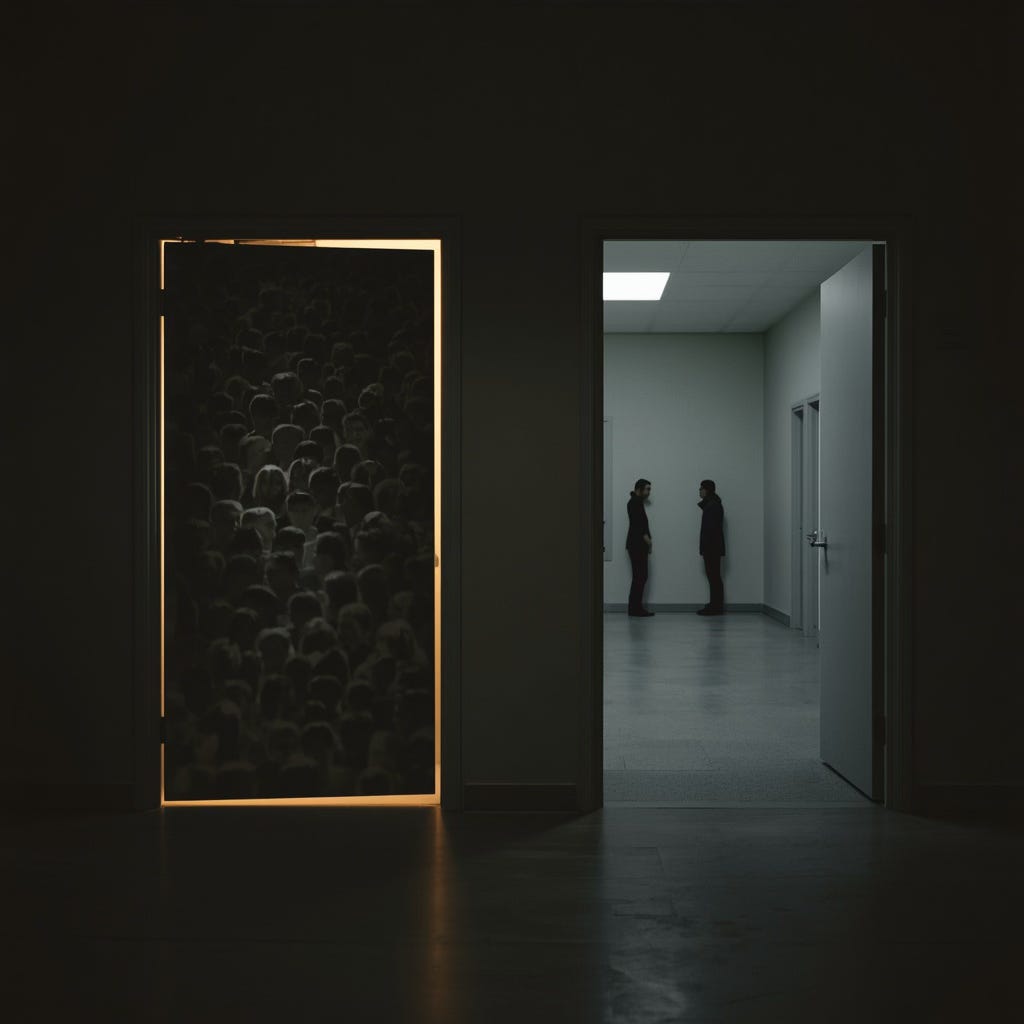
This is the part a dictator understands better than most defenders of an open society ever bother to learn. He does not need to win an argument with reason. He only needs to build a room comfortable enough that staying in it stops feeling like a cost, then guard the door so nothing answerable gets back in. The room he builds will always hold more people than the room next to it, the one with the door standing open, the one that keeps demanding the harder thing of anyone who stays. That is not a failure of the people inside either room. It is arithmetic, not character, and Popper was honest enough to say so out loud. Comfort scales. Vigilance does not.
It would be too easy to read the last few pages and conclude that one system manufactures its stories and the other simply lets them grow wild. Every open society has its own concentration of gatekeepers, a handful of studios, platforms, and publishers deciding what gets made and who gets to see it, and a citizen of a democracy has about as much say over that as a citizen of anywhere else, most days. The difference Popper would want us to hold onto is not who sits in the room deciding. It is whether the room’s stories can still be challenged from outside, by a competitor with a cheaper platform, a regulator with a subpoena, or a crowd on a message board who decided, for one strange week, that the room did not get to set the price after all. China’s apparatus is built so that kind of argument cannot reach the room at all. A democracy’s gatekeepers can still be reached. Badly. Slowly. Often too late. But reached. That is a thinner difference than most defenders of democracy like to claim. It is not, however, no difference at all.
That last claim is being tested in Britain as I write this. In July 2025 the government proscribed Palestine Action, a protest group known for vandalizing arms factories, as a terrorist organization, making membership or even displaying a sign in its support an offense carrying up to fourteen years in prison. Within months several thousand people had been arrested, most of them not for sabotage but for holding placards, and one newspaper columnist published a piece explaining that he had to write about the ban itself carefully enough to avoid risking the same sentence. That is a narrower door than most people living in a democracy assume they are standing in front of. It is also, and this is the part that matters, a room whose openness is still being fought over in public. A court found the proscription unlawful within the year. A government appealed and won. Lawyers and UN officials said so loudly, in the same newspapers the government answers to, without being arrested for saying it. A closed room does not let you watch the argument happen. This one does, at a price that is not nothing. That is the whole, uncomfortable distinction this essay has left to stand on.
Here is what I keep returning to. Every one of these stories did exactly the same thing to the person who received it. None of them asked to be argued with. They asked to be felt, and once felt, believed, and once believed, acted on. Two of them left the world better, slowly, imperfectly, at a cost we are still paying down. One is still collecting its price in small houses, in fevers that did not have to end the way they ended. One was a crowd amusing itself, for no reason nobler than to see if it could. One is a government working on an entire region right now, on purpose, at scale, and winning more often than it is losing.
None of these claims announced what they were while they were happening. That is the whole point of the device, and it is also the whole danger of it. The fable and the lie use the same method. The only way to tell them apart afterward is to ask what kind of door the feeling opened. Whether it let evidence back in, eventually, the way Carson’s door did. Or whether it sealed the door from the inside, the way one mother’s faith sealed it, so that nothing that happened next, no fever, no silence in a small room, could ever be let back in as a reason to ask whether the belief was wrong.
I think about a particular kind of silence sometimes. The one in a house where a fever finally breaks, one way or the other, and no one in the room is allowed to call a doctor, because seventy years before anyone in that room was born, a woman in New England wrote a sentence and meant every word of it, believing she had found the only real medicine there has ever been. I do not think she meant to build a door that could never be reopened. I think she believed, the way the preacher believed, the way Carson believed, that what she felt was simply true, truer than any objection anyone could raise against it. That is what should frighten us about this story, more than any single case on its own. It carries no warning label telling you, from the inside, which kind of door you are standing in front of. You only find out afterward. And by then, in some of those houses, it is already morning, and someone is still waiting for a sound that is not going to come.
That is the part of the message I cannot fix by writing about it, and would not want to. The feeling is the only honest payment a story like that ever makes on its reader. What is still left to us is refusing to let the feeling end the conversation there. A story earns the right to move us. It does not earn the right to settle the argument by itself. The open society Popper described was never a guarantee. It was a habit, practiced by people willing to feel a thing all the way through and still ask, the next morning, whether it was true. Assuming a question is finally settled is how a door starts to close. The instant you stop expecting an answer to talk back, you have already begun building the room that does not need one.
No closed claim has ever managed to nail that habit shut from the outside. It only goes unused, by people who decided feeling was enough and stopped there. It is the harder room to stay in. It has never once been the more crowded one. That has never yet been a good enough reason to leave it. Pretending the room at home never narrows is its own kind of closing. The only thing that has ever kept the distance between the two rooms real is people willing to say, out loud, when their own door is swinging shut too.
No posts
Comments
Nothing yet. Say the first thing.
Sign in to join the conversation.