
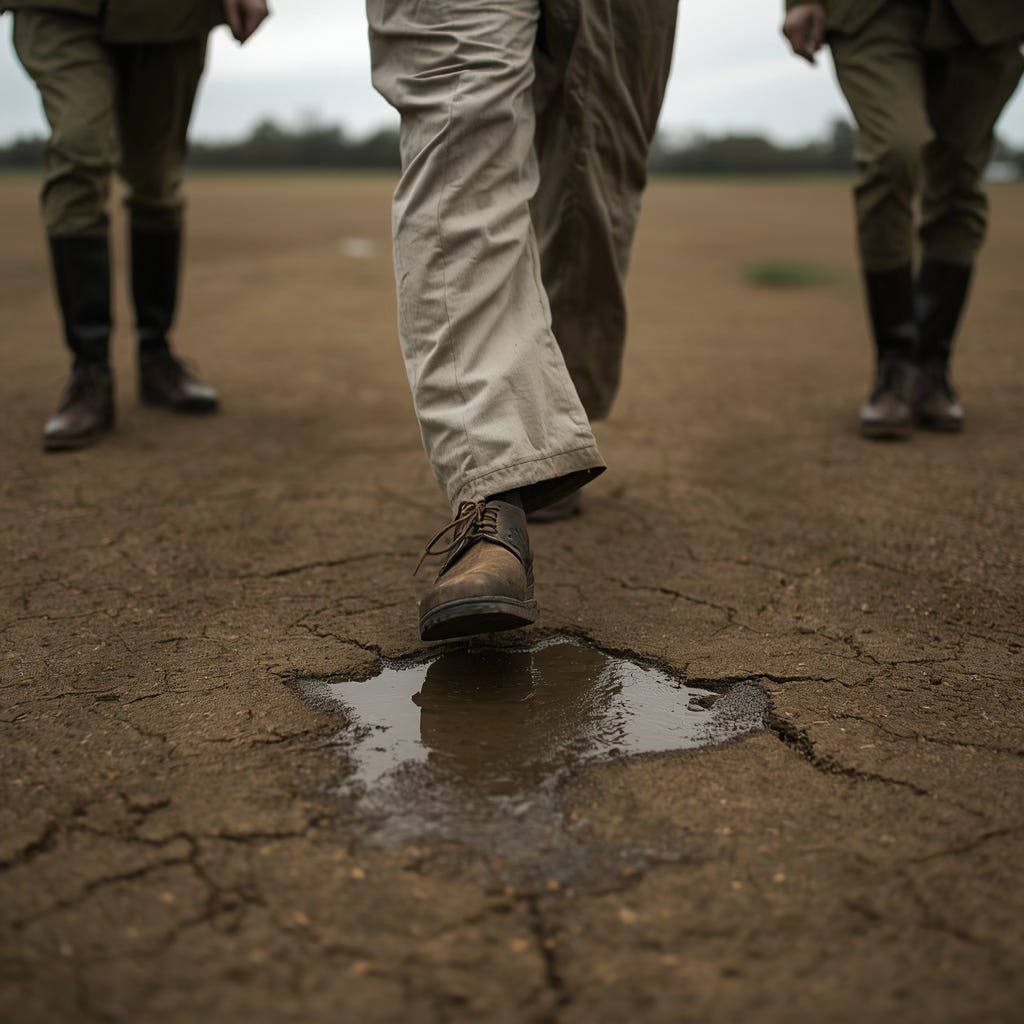
A man on his way to be hanged steps around a puddle.
Burma, a wet morning in the 1920s. The writer who would become George Orwell, then a young colonial policeman, walks behind a condemned prisoner toward the gallows. Two warders hold the man by the arms. The yard is forty yards wide. Somewhere in those forty yards the prisoner, bound and minutes from death, moves a little to one side to keep his feet out of the water.
Orwell saw it. He wrote later that until that moment he had never grasped what it means to destroy a healthy, conscious man. Not the cell. Not the rope. The puddle. A living body, still careful, still keeping itself dry for a life it was about to lose.
He never argues against the death penalty in that essay. He never says the word colonialism. He does not need to. The wrongness comes through the body, in one small useless act, and the reader feels it before the reader can reason about it. An argument can be answered and forgotten. The sidestep cannot be answered. It can only be felt.
I came to fiction after years in law, and I have come to think the two trades are circling the same fact from opposite sides. A lawyer learns early that the case which wins is rarely the one with the better argument. It is the one with the better exhibit, the single piece of evidence the other side cannot explain away. I have come to think of this, in both trades equally, as the Orwellian puddle. A single ordinary detail, usually physical, usually silent, that carries the whole moral weight of a story without ever stating it. The detail points one way. The meaning arrives from another. The reader, or the juror, takes the last step alone, and because they take it alone, they believe it. Nobody argued them into it. They got there themselves, which is the only place conviction is ever made, in a courtroom or on a page.
A second example, from another country and another wound.
Mississippi, 1967. The film is In the Heat of the Night. Virgil Tibbs is a Black homicide detective from Philadelphia, played by Sidney Poitier. Bill Gillespie is the white police chief of a small Southern town, played by Rod Steiger. By the end of the film Tibbs has solved a murder no one else in town could, or would, and he is leaving on the train.
On the platform, Gillespie picks up Tibbs’ suitcase before Tibbs can lift it himself, and carries it. Tibbs does not ask him to. He lets him. Gillespie shakes his hand, then calls after him as the train pulls in: “Virgil. You take care, you hear?” Tibbs answers, “Yeah,” and boards.
In 1967 Mississippi, that image sits close to unbearable. The whole order of that place decided which man carried which man’s bag. The director reverses it and says nothing else about it. No speech about brotherhood. No music swelling under a confession. A white Mississippi lawman carries a Black man’s suitcase down a platform, and the entire change in him lives in his hands, not his mouth. A speech would have been a thing you could argue with. The suitcase is a thing you cannot. The law has a word for proof of that kind. An act done under no compulsion, with no one demanding it and no one watching to grade it, carries more weight than a hundred sworn statements about intentions. Gillespie was never on the stand. Nobody made him carry the bag. That is exactly why it convicts.
Stirling Silliphant wrote that screenplay and won the Oscar for it. He was a personal friend and a mentor to me in Bangkok, where we had lunch or dinner together twice a week for seven years, until he died there in April 1996. He told me once, over one of those meals, how the scene came about. Norman Jewison went through the script sticking a yellow tag on every page he wanted to argue about, dozens of them at the first sitting. Over weeks of lunches between writer and producer, the tags came off the pages one at a time. When only one tag was left, it was the platform scene. It needed a different ending. Stirling suggested the gesture of the white sheriff carrying the black lawyer’s bag. One scene. After many lunches. Not Stirling nor Jewison anticpated this was what would be remembered. What earned an Oscar.
I cannot prove that conversation happened the way I remember it. There is no surviving draft with a yellow tag still attached, no producer’s memo, no other witness left alive to ask. I have only what Stirling told me, more than thirty years ago, over a meal, and what I have kept of it since.
The lesson I draw from that story is not about Stirling’s talent, or Jewison’s. It is about when the puddle gets found. Nobody sat down planning to write the platform scene as the moment the picture would be remembered for. It survived dozens of rounds of argument because it was the one thing, after everyone had picked over everything else, that no longer needed defending. That is usually how it goes, in fiction as much as film, and it is rarely a solitary act. The puddle seldom arrives with the first draft. It turns up after the third, or the seventh, once a writer, and often an editor or a producer beside the writer, has cut away everything the story does not need and can finally see what was holding the weight all along. Looking for it before that point is a way of writing toward a symbol instead of toward a story, and a symbol assembled on purpose tends to announce itself, the way a planted clue does in a bad mystery. Write the story through, and revise it until the unnecessary is gone, and it will show you its own puddle, if it has one. If it does not, after enough honest rewriting, that is the answer too. The story may hold a reader for an evening. It will not hold one for thirty years.
Two countries. Two kinds of cruelty. Thirty-six years between them. The same move.
The device is older than either man. Chekhov is supposed to have told a younger writer not to describe the moonlight, but to show the glint of light on a piece of broken glass, and let the reader build the night from the shard. That instruction is the whole principle in a sentence. Trust the shard. Withhold the moon.
You can watch it work straight across the century. The Grapes of Wrath does not end on a speech about the poor. It ends in a barn in the rain. A girl who has just lost her own baby gives her breast to a starving stranger, a grown man, while her mother watches. The two women trade a single look. Nothing is explained. Everything is understood. It is the most political image in the book, and it contains no politics at all.
Rachel Carson found a different shape for the same thing. Silent Spring is a book of evidence, tables and footnotes and chemistry. It opens, though, on a fable. A town in the heart of America where one year the birds do not come back. No birdsong. Only the silence where the sound used to be. The puddle can be an absence. A missing sound. A plate of food left untouched. The reader leans into the gap and fills it, and the filling is the feeling.
A puddle only works if the reader stops. The whole device rests on a held breath, a second of stillness in which a small thing swells to fill the mind. Orwell’s sidestep does nothing if you are scrolling past it. The suitcase is only luggage if you are half watching on a phone while three other windows blink for your attention. This is not a claim about what is happening to attention in general. It is narrower than that, and stranger. It is a craft problem. The device was built for a reader who could be trusted to sit still one sentence longer than the sentence asked. I do not know how many readers, or how many jurors for that matter, that still describes.
My experience as a lawyer taught me this before the page confirmed it. Show a jury the photograph of the bent fender, and the expert’s testimony about velocity becomes ornamental. The wrecked car convicts on its own. That is the puddle, doing in a courtroom exactly what it does on a page. The detail asks nothing of the viewer except to keep looking one second longer than habit allows. Two trades, one instrument. Neither one invented it. Both of them, on their best days, just get out of its way.
No posts
Comments
Nothing yet. Say the first thing.
Sign in to join the conversation.