
I hope your Holy Week has already been an occasion for prayer and contemplation as we approach the liturgical height of the Christian year. Obviously this Friday ‘flection is running quite late, but I hope to be back on schedule for the foreseeable future.
Last commentary, I made a passing allusion to the blood and water that flowed from the side of Christ when his body was pierced by the spear of a Roman soldier. This week I’m going to reflect on it directly.
As I have remarked elsewhere, the most I ever heard about this detail of the Passion growing up in Evangelical circles was a passage in The Case for Christ about the apologetic value of its medical accuracy. A worthwhile point, to be sure, but nowhere near exhausting the richness of the moment. Let me quote in full the paragraph of the Catechism that I relegated to a footnote in my last post:
766: The Church is born primarily of Christ's total self-giving for our salvation, anticipated in the institution of the Eucharist and fulfilled on the cross. "The origin and growth of the Church are symbolized by the blood and water which flowed from the open side of the crucified Jesus." "For it was from the side of Christ as he slept the sleep of death upon the cross that there came forth the 'wondrous sacrament of the whole Church.'" As Eve was formed from the sleeping Adam's side, so the Church was born from the pierced heart of Christ hanging dead on the cross.
This blew my mind when I first read it. I find it no less beautiful after a dozen reads—just the opposite, it’s proved fertile grounds for reflection.
Popular piety has it that Christ is present in the Eucharist for about 15 minutes after reception. Not because (according to another kind of popular piety) that’s when we’re legally allowed to leave if a teacher doesn’t show up for class, but because that’s roughly the amount of time it takes the appearance of bread and wine to come to an end in our stomachs.
This means that when the congregation streams out in front of the church after Mass, Christ is still present in them. Some choose to spend those 15 minutes in silent prayer before leaving; a practice that is both reverent and beautiful. But there is something beautiful in its own right about the people carrying Christ with them into the world. And the key to seeing it is meditating on the wound to Christ’s side.
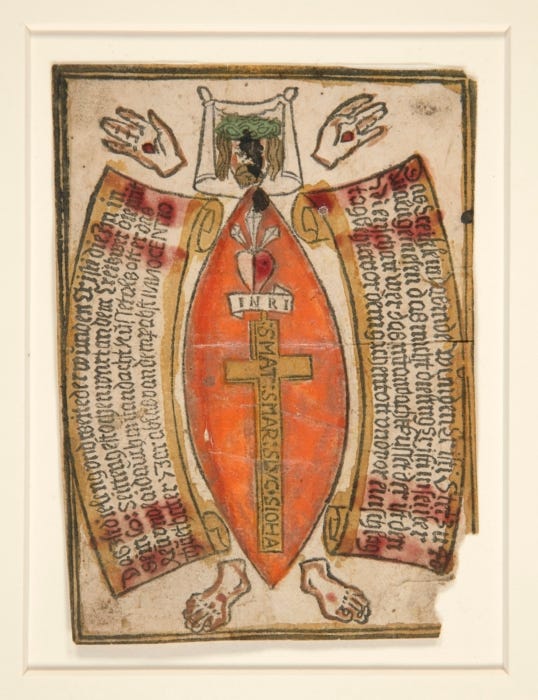
If the Church is the Body of Christ, then maybe it’s not too much of a stretch to see the congregation spilling out the doors as a reenactment, at once literal and metaphorical, of that moment. They have been made one by baptism and bound together again in Christ by their communion; forged in water, divinized in Blood.1
They go out weeping the tears of repentance, and rejoicing over the choicest wine, which gladdens the heart. They leave mourning the scarlet stain of sin, but celebrating because it has been washed away by streams of living water. They fall from Christ’s side to the soil of the world, making it rich and moist, eager and ready to receive the word of God.2
Those born first according to the will of man by blood become children of God by water. And the children born in the lavar of regeneration consummate their marriage when the Son uses the very jars that held the water for washing as the casks for the wine of the heavenly banquet. When the people of God leave the Mass, they go in imitation of the Lord of the Harvest, who liberally sows his seed on the road, the rocks, and the weeds.3
Like a little leaven worked through the dough, they make the whole world to rise, so that when Christ’s heart melted like wax in his death, it was not wasted but watered and fed a sprout that soared upward, spreading its branches for the birds of the air to come and make their nests. The Passion did not close Christ inwardly on Himself; it opened his Sacred Heart to the world, so that those who leave the Church’s consecrated grounds to continue their earthly pilgrimage would be empowered to bring the world back with them when next they come to feast in their Father’s house.4
Those who sow with tears
will reap with songs of joy.
Those who go out weeping,
carrying seed to sow,
will return with songs of joy,
carrying sheaves with them.
-Psalm 126:5-6
< Last commentary | All commentaries | Reformation Catholicism >
1 Corinthians 12:13 - “For we were all baptized by one Spirit so as to form one body—whether Jews or Gentiles, slave or free—and we were all given the one Spirit to drink.”
1 Corinthians 10:16 - “The cup of blessing which we bless, is it not the communion of the blood of Christ? The bread which we break, is it not the communion of the body of Christ?”
Psalm 126:5a - “Those who go out weeping, / carrying seed to sow,”
James 4:8b-10 - “Cleanse your hands, you sinners, and purify your hearts, you double-minded. Be wretched and mourn and weep. Let your laughter be turned to mourning and your joy to gloom. Humble yourselves before the Lord, and he will exalt you.”
John 2:10 - “Everyone brings out the choice wine first and then the cheaper wine after the guests have had too much to drink; but you have saved the best till now.”
Sirach 40:20 - “Wine and music gladden the heart;” also Psalm 104:15 - “wine that gladdens human hearts, / oil to make their faces shine, / and bread that sustains their hearts.”
Isaiah 1:18 - ““Come now, let us settle the matter,” says the LORD. “Though your sins are like scarlet, they shall be as white as snow; though they are red as crimson, they shall be like wool.”
John 4:10 - “Jesus answered her, “If you knew the gift of God and who it is that asks you for a drink, you would have asked him and he would have given you living water.” And John 7:38 - “Whoever believes in me, as Scripture has said, rivers of living water will flow from within them.”
Matthew 13:23 - “But the seed falling on good soil refers to someone who hears the word and understands it. This is the one who produces a crop, yielding a hundred, sixty or thirty times what was sown.”
John 1:12-13 - “Yet to all who did receive him, to those who believed in his name, he gave the right to become children of God—children born not of natural descent, nor of human decision or a husband’s will, but born of God.”
John 3:5 - “Jesus answered, “Very truly I tell you, no one can enter the kingdom of God unless they are born of water and the Spirit.”
Titus 3:5b - “He saved us through the washing of rebirth and renewal by the Holy Spirit.”
Matthew 26:29 - “I tell you, I will not drink from this fruit of the vine from now on until that day when I drink it new with you in my Father’s kingdom.”
Revelation 19:19 - “Then the angel said to me, “Write this: Blessed are those who are invited to the wedding supper of the Lamb!” And he added, “These are the true words of God.””
Matthew 9:38 - “Ask the Lord of the harvest, therefore, to send out workers into his harvest field.”
Matthew 13:3-9 “Then he told them many things in parables, saying: “A farmer went out to sow his seed. As he was scattering the seed, some fell along the path, and the birds came and ate it up. Some fell on rocky places, where it did not have much soil. It sprang up quickly, because the soil was shallow. But when the sun came up, the plants were scorched, and they withered because they had no root. Other seed fell among thorns, which grew up and choked the plants. Still other seed fell on good soil, where it produced a crop—a hundred, sixty or thirty times what was sown. Whoever has ears, let them hear.”
Galatians 5:9 - “A little yeast works through the whole batch of dough.”
Psalm 22:14 - “I am poured out like water, and all my bones are out of joint. My heart has turned to wax; it has melted within me.”
Genesis 38:9 - “But Onan knew that the child would not be his; so whenever he slept with his brother’s wife, he spilled his seed on the ground to keep from providing offspring for his brother.”
Matthew 5:45 - “He causes his sun to rise on the evil and the good, and sends rain on the righteous and the unrighteous.”
Matthew 13:31-32 - “The kingdom of heaven is like a mustard seed, which a man took and planted in his field. Though it is the smallest of all seeds, yet when it grows, it is the largest of garden plants and becomes a tree, so that the birds come and perch in its branches."
Cf. the concept of being incurvatus in se, “turned in on oneself.” The concept is deeply Augustinian but the phrase was coined by Luther.
The “Sacred Heart” is a devotion that emphasizes the gentle, personal love of Christ for sinners. It has its origin in a vision given to a nun.
1 Peter 2:11 - “Beloved, I urge you as sojourners and exiles to abstain from the passions of the flesh, which wage war against your soul.”
1 Corinthians 5:18 - “All this is from God, who reconciled us to himself through Christ and gave us the ministry of reconciliation; that God was reconciling the world to himself in Christ, not counting people’s sins against them. And he has committed to us the message of reconciliation. We are therefore Christ’s ambassadors, as though God were making his appeal through us. We implore you on Christ’s behalf: Be reconciled to God.”
No posts
Comments
Nothing yet. Say the first thing.
Sign in to join the conversation.