
After three days they found him in the temple courts, sitting among the teachers, listening to them and asking them questions. Everyone who heard him was amazed at his understanding and his answers.
For most of Church history, theologians have generally believed that Our Lord was omniscient in his human nature, taking references to his surprise or ignorance as a merely human manner of speaking. They reason that being hypostatically united to the divine nature gives the humanity of Christ all the fullness of possible perfection. Because knowledge is a perfection of the intellect, Christ must have all knowledge.
The problem with this view is that it would seem to follow that Christ diminishes in perfection during the Crucifixion as his bodily integrity is compromised. On the contrary; the Crucifixion reveals the true glory of the Incarnate God. His perfection evidently does not mean He won’t be buffeted about by the same forces the rest of are subject to. Granted that being a divine Person, he is only subject to these forces because He consents to be—but He really does give that consent.1 So with the full humanity of Christ in view, I want to examine an episode that I often see mistreated.
Mary and Joseph track Jesus down on the third day. Christ, lost for three days then revealed in his Father’s house. This is to be read according to the pattern of Jesus’ death and resurrection. This mysterious framing unfolds itself before contemplation like a rose bud to the sun.
In the depictions I’ve seen, one aspect of the story is amplified to the point of drowning everything else out, and another is cheapened to the point of near mockery. The first is Christ as teacher. Yes, He is the True Teacher, the summit of wisdom and even Wisdom itself. “Everyone who heard him was amazed at his understanding and his answers.” Rightly so! But don’t be too fast. Read the preceding sentence again: “…they found him in the temple courts, sitting among the teachers, listening to them and asking them questions.” Because the idea of the Son (in his humanity) learning things through the normal human process has scandalized some theologians, this line has been forcibly glossed as something like, “He sat there, letting them speak, and asking them guiding questions He already knew the answers to.”
On this reading, the rabbis don’t really know much. This leads to the cheapening of their questions. One film adaptation of the scene has a rabbi ask Jesus something like, “How old was Abraham when he led the people out of Egypt?” To which Jesus responds, “Rabbi, Abraham did not lead the people out of Egypt, Moses did.” The rabbi gives a smile of acknowledgement, a kind of fencer’s nod to an opponent who’d seen through a clever feint.
Hogwash.
Let’s return to the story fresh, with the humanity of Christ in mind.
The young Jesus, on the threshold of manhood (contemporary Orthodox Judaism celebrates Bar Mitzvahs at age twelve) enters into the fray of scholarly disputation. He listens with gusto to the exchange of opinions and interpretations, intervening with penetrating questions and objections, and eventually defending his own theses in turn. The questions are not trivial gotcha’s one limping step above puns, but deep, difficult ones. What does he make of the dueteron theon hypothesis? Is the nephesh of Hebrew thought the same as the psyche of the Greeks and anima of the Romans? Were the Zealots right to seek the overthrow of Caesar, or should the Jews rather wait for God to intervene from heaven? These are the kinds of questions that demand intelligence and deep prayer
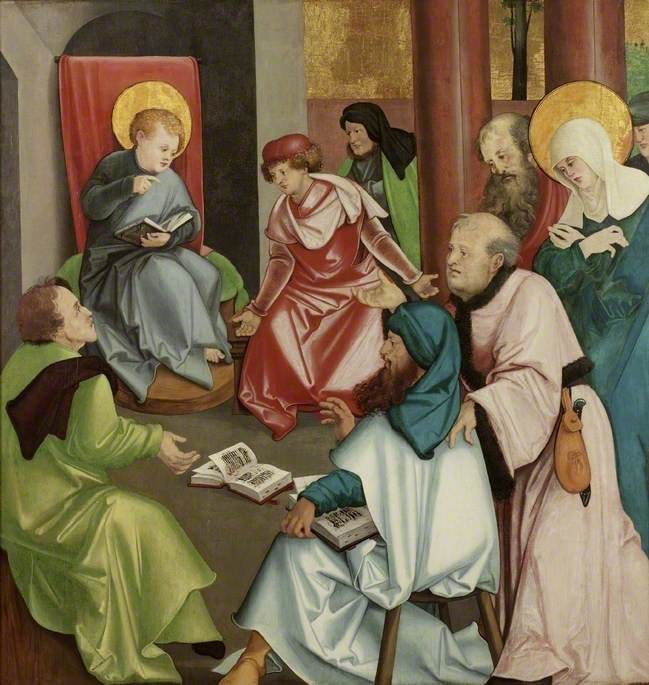
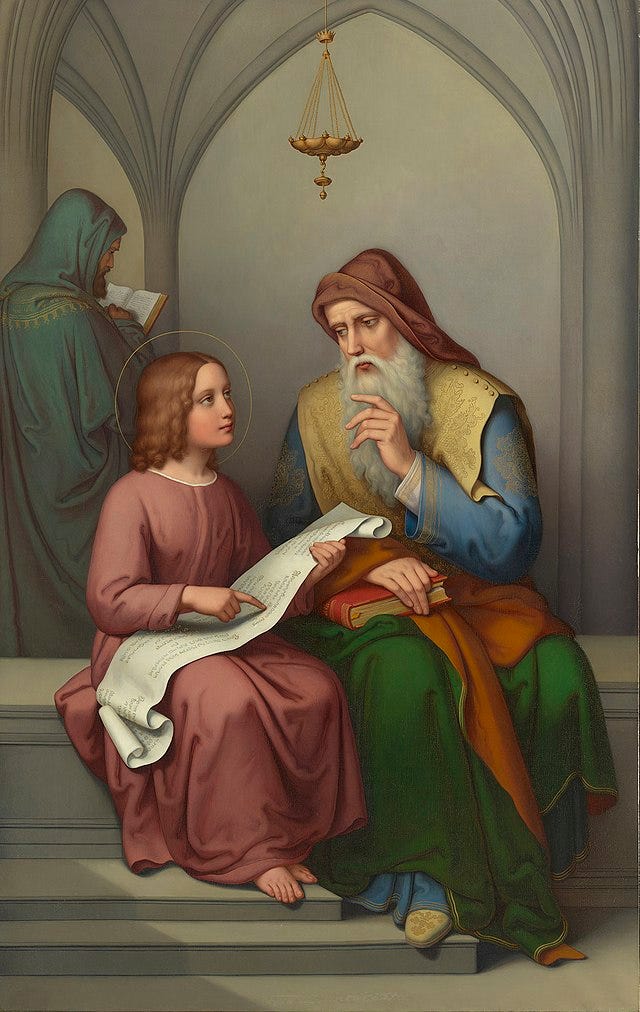
If Jesus generally had to learn things in his human nature in normal human ways, this was not simply a time for Him to show off his divine advantage. He came with real questions, and was really interested in the answers and arguments of those who “sit on the cathedra of Moses.” He is not only the model teacher; the unthinkable humility of God is that He should also become the model student.
Note the natural progression of the passage. First, He is silent; he listens to the masters. Having received, He ventures his own questions, expanding and clarifying the thought of the established wisdom. Finally, He reaches and expresses his own understanding, taking his place among the teachers. He begins as a student asking questions of his teachers, and ends as a teacher answering questions from his students.2
This is not the first time Luke has introduced this sequence. Jesus here takes after his mother. Mary first listens to the words of Gabriel, and, after considering, asks a penetrating question intended to deepen her understanding of the revelation just imparted to her: “How can this be, seeing that I am a virgin?” After Gabriel answers, she expresses her understanding by giving her consent to God’s summons: “Be it done unto me according to thy word.” Finally, she is questioned by Elizabeth, “Who am I that the mother of my Lord should come to me?” and answers with the Magnificat. Given the tradition that Mary was herself raised in the Temple, Marian motifs here are unsurprising.
Through his Church, Jesus continues the theological enterprise of approving some positions, condemning others, and calling for continued debate on still more. The Church teaches her theologians; she also learns from them.
It must be so; Christ must continue his part in the age-spanning disputes, because He still casts the shadow of his death and resurrection over everything. All the contemplation of theologians, the prayers of the mystics, the insights of every Mass-goer, lead to a point of decision: Will you die a death like his, and be raised to a life like his? Wisdom that doesn’t lead to the Cross will certainly not lead beyond it. On the third day, they found Him in his Father’s house. Where will you be found when the third day dawns on the world, the hills melt, and the earth dissolves like snow?
< Last Commentary { All Commentary | Reformation Catholicism >
Where the first view goes wrong is that it equates something being unrealized with something suffering privation. At one point Christ had not yet realized his capacity to have adult hands; it wasn’t because his nature was somehow imperfect, it just meant that He was four months old. Extending the point, remember that the lower is oriented to the good of the higher. The body’s good is the soul’s good, and not necessarily vice versa. Because the destruction of his human nature was in perfect alignment with the completion of his personal mission, Christ was never less than perfect, even if his body suffered privation with respect to its own natural good. It’s the same reason that fasting can be a real privation for the body yet real medicine for the soul.
This corresponds beautifully with the Thomistic/Augustinian reading of the Beatitudes. For Thomas, the Beatitudes are ordered to lead a person deeper into the divine Trinitarian life. One might expect the contemplation of God to be the highest stage of development, but it’s actually the peacemakers who represent the full perfection of Christian life. The pure of heart see God; those who have been purified of sin and made strong in virtue come at last to the Beatific Vision. What could be better than that? What remains? Nothing, strictly speaking. But the love of God is a powerful thing, naturally overflowing to outward action, to its own diffusion and propagation. That’s why the peacemakers are the pinnacle of Christian love; having beheld God, they turn to share that divine love with others. For the same reason, Thomas counts the work of a teacher more blessed than the one who only contemplates.
No posts
Comments
Nothing yet. Say the first thing.
Sign in to join the conversation.