
Good morning,
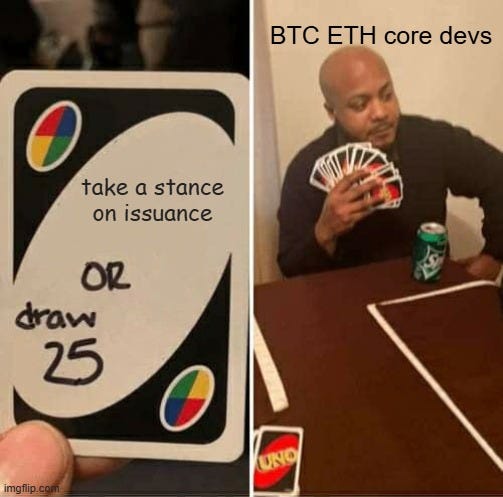
It’s turning out to be the summer for protocol issuance debates. Just as the Ethereum community is getting over the throes of another heated debate on reducing issuance, the Bitcoin community is belatedly responding to the remarks shared by a prominent Bitcoin developer, Peter Todd, who earlier this summer raised the idea of extending Bitcoin’s issuance schedule.
Let’s get into it.
Yours truly,
Christine D. Kim
☁️ To get early access to this week’s BTC Before Light newsletter, make sure you are signed up for a premium subscription:
⛅ Interested in being a featured sponsor of this newsletter? Learn more about sponsorship opportunities available for BTC Before Light:
☀️ I also run a research and advisory firm called Protocol Watch for businesses building on Bitcoin and Ethereum. Learn more about how I can help your business understand and stay ahead of protocol changes:
In July, bitcoin++, a Bitcoin developers-focused conference series, organized an event in Toronto, Canada, themed on “consensus.” It was a three-day conference where speakers and attendees were invited to delve into topics related to how consensus is, or is not, formed on Bitcoin.
There were talks on soft-fork mechanisms, upgrade activation paths, covenant proposals, and more. One of the talks was given by Peter Todd, a prominent Bitcoin developer and an early contributor to Bitcoin Core in 2012.
Leaning into the theme of the conference, Todd gave his talk on the thorny subject of changing consensus on Bitcoin’s issuance policies. A ballsy move, as I’m sure my Ethereum readers can understand right now.
His talk didn’t immediately stir the community's ire, mainly because the only people who had heard it were the hundred or so in the audience.
But this past Friday, August 14, conference organizers published Todd’s talk online, and now, several weeks after the conference, the community is getting a chance to respond, and no surprise to anyone, but especially my readers who are also watching the issuance debates unfold in Ethereum, the responses have been mostly hysterical and sensationalist.
Before getting into the online response, I want to provide some context on what was actually discussed at the Bitcoin++ conference in Toronto regarding changes to Bitcoin’s issuance policy.
In his 30-minute presentation, which includes a constructive question-and-answer period, Todd explains that, for miners to be incentivized in the long term to produce blocks, the financial incentive cannot depend solely on volatile transaction fees. They must be compensated with either tail emissions, that is, a constant block reward after the block subsidy ends, or demurrage, an additional fee for spending idle or dormant coins, which could act as a type of inflation tax on all BTC holders.
Todd presented the latter, demurrage, as the more plausible option on Bitcoin because it can be implemented as a backward-compatible change, unlike the former, which would necessitate a backward-incompatible change to Bitcoin’s monetary policy and thus require a hard fork to activate.
Todd admitted he’s not entirely sure what demurrage fee would be appropriate and sufficient to incentivize mining in the long-run. But he said he is convinced that any additional source of income for miners is better for the protocol’s security than relying exclusively on transaction fees once the block subsidy runs out.
Based on the line of questioning he received from the audience immediately following the talk, people were skeptical of his views and challenged whether there weren’t other ways to compensate miners without touching issuance.
Since the presentation was posted online on Friday, many have characterized Todd’s remarks as an “attack” on Bitcoin and a serious affront to the values of scarcity and hard money the protocol stands for.
Here’s what Giacomo Zucco, the President of Plan B Network, Bitcoin’s “educational layer,” had to say on Todd’s talk:

Giacomo Zucco (Bear Market Edition)@giacomozucco
@btcplusplus @peterktodd If this unthinkably obscene madness was ever to be enforced by any relevant economy, it would mean the market is so irrecoverably retarded I would have no choice to sell all and join Bdash (to be more precise: I would actually pivot to physical gold and survivalism, but I'll
4:22 PM · Aug 14, 2026 · 5.93K Views
23 Replies · 6 Reposts · 179 Likes
Zucco’s comment above has about three times as many likes as the original post sharing Todd’s video by Bitcoin++ organizers.
The top comments on YouTube are even more charged and riddled with profanities and obscene language against Todd.
Bitcoin reporters like the former editor-in-chief of CoinDesk, Pete Rizzo, posted sensationalist headlines about Todd’s talk, exaggerating the urgency and weight of the remarks that were shared.

The Bitcoin Historian@pete_rizzo_
JUST IN: CORE DEVELOPER PETER TODD JUST SAID #BITCOIN SHOULD ELIMINATE THE 21,000,000 SUPPLY LIMIT "IF BTC HAD TAIL EMISSIONS TO BEGIN WITH, NO ONE WOULD CARE" "ECONOMICALLY, IT'S SIMILAR TO GOLD" "WE HAVE THIS TYPE OF SYSTEM THAT SEEMS TO WORK, BUT WE KEEP MARCHING TO A KIND
6:24 PM · Aug 16, 2026 · 232K Views
549 Replies · 74 Reposts · 336 Likes
To be clear, Todd did not “just” say Bitcoin developers should eliminate the protocol’s hard supply cap. He said it several weeks ago as part of a broader conversation on all of the controversial aspects of changing the broad consensus in Bitcoin.
Further, Todd is no longer an active contributor to Bitcoin Core, and his ideas do not reflect what Core developers think about Bitcoin's long-term issuance policies. As highlighted by the questions Todd received during his talk by developers at the Bitcoin++ conference, as well as from some who asked questions afterward online, the sentiment among the broader developer community remains divided on changes to issuance.
It’s clear from both the in-person and online responses to Todd’s presentation that tail emissions are not the answer to Bitcoin’s long-term security budget problem, nor is a demurrage tax on dormant coins.
Both proposals give up properties about Bitcoin that many protocol stakeholders treat as non-negotiable, and, more importantly, neither has anything close to the consensus it would need to successfully activate on Bitcoin.
However, the responses that treat Todd as out of line for even broaching the subject of changing issuance are an ostrich, head-in-the-sand move. Bitcoin’s long-term security budget is a real concern. As Todd put it in his presentation:
The Bitcoin subsidy going down is a scary phase change. We have this system that seems to work, and we keep marching towards a type of system that we don’t know works. We don’t have examples of that type of system working.
The reality is Bitcoin’s block subsidy is going to zero. Transaction fees have not grown to replace it, and no proof-of-work chain has ever run on fees alone, so nobody knows exactly what happens next.
No amount of yelling online changes these facts. The sooner the community can face them without retreating into fear and engage in constructive dialogue about what potential solutions stakeholders could broadly support, the better.
The feature freeze deadline for Bitcoin Core v32 is this Thursday, August 20 (GitHub). Starting next week, developers will work on bug fixes only for inclusion in the v32 release.
Transcript of last Thursday’s August 13 Bitcoin Core Developers meeting (Chaincode).
AI summary of Bitcoin Core development activity from August 10 to 16 (This Week in Bitcoin).
Eugene Siegel, a Bitcoin Core contributor sponsored by Brink, discusses the utility of “incremental snapshots” when testing the Core codebase for bugs (Eugene’s Blog).
Hazync is a new research project that aims to verify Bitcoin blocks within a zero-knowledge virtual machine (bitcoinghost.org). Created by “defenwycke,” details about the project have been shared on Delving Bitcoin.
A new release for kartograf, v0.5.0, is available. It includes breaking changes that will prevent users from reproducing maps created with prior versions of the software. Users are encouraged to upgrade to the latest version (GitHub). As background, kartograf is the tool that generates asmap data, a map of which parts of the internet belong to which network operators. Bitcoin nodes rely on this map to diversify their peer connections.
eCash, a new fork of Bitcoin, launches next week (X). More on what users can expect from the eCash hard fork in this prior post.
🙏 Thank you for reading. If you liked today’s issue, consider sharing it with a friend who might also enjoy the content.
💥If today’s post sparked any thoughts, opinions, or questions, I’d love to hear them. Please share your feedback on today’s newsletter by leaving a comment.
🌟 Finally, if you’re a premium subscriber, don’t forget to join the subscriber channel on Telegram. It’s an exclusive space to discuss the evolution of Bitcoin Core and Ethereum with fellow readers. The invite link to join is posted here:
Comments
Nothing yet. Say the first thing.
Sign in to join the conversation.