
Good evening,
Tonight, I’m sharing updates on Glamsterdam and Hegota, the two next immediate Ethereum upgrades coming up later this year and sometime in 2027, respectively.
On Glamsterdam, developers have converged on a final block gas limit increase target of 200 million gas. They have also launched a short-lived public testnet for the upgrade called Plataberget. Below, I discuss the significance of these updates and recent developments in the planning for the Hegota upgrade.
A note to subscribers: As most of you already know, I’m back from my two-week vacation. I had a lovely time up in Alaska, journeying through many beautiful parks and sites. I was also lucky to see one of the state’s most famous humpback whales, Flame!

Now, enough whale watching, let’s get into what I’m watching in Ethereum.
Yours truly,
Christine D. Kim
🌕 To get early access to this week’s ACD After Hours newsletter, make sure you are signed up for a premium subscription:
🌓 Interested in being a featured sponsor of this newsletter? Learn more about sponsorship opportunities available for ACD After Hours:
🌑 I also run a research and advisory firm called Protocol Watch for businesses building on Bitcoin and Ethereum. Learn more about how I can help your business stay ahead of protocol changes:
First, a couple of important updates on Glamsterdam.
Developers are still on track to start upgrading public test networks in September.
In my prior ACD After Hours post, I shared that developers were planning to launch one final developer-focused test network (also called devnet), followed by a short-lived public testnet and a non-finality testnet before upgrading public testnets.
They officially launched their final devnet, Glamsterdam Devnet-8, today, August 13. And rather than launch another dedicated public testnet shortly after this devnet, developers have designed Devnet-8 so that anyone can join the network.
Given the major changes to the block-building process featured in Glamsterdam, third-party block builders, in particular, are encouraged to start testing their infrastructure now against the new protocol specifications.
Instructions on how to join Devnet-8 are featured on Forkcast.
Developers confirmed a block gas limit increase of 200 million gas shortly following Glamsterdam activation on mainnet.
Back in May, developers aimed to more than triple Ethereum’s block size through Glamsterdam.
This week, they confirmed the final numbers for Glamsterdam’s gas repricing proposals, which seek to better optimize network resource usage. Based on these numbers, developers could also confirm that they can indeed safely increase network throughput after the Glamsterdam upgrade from 60 million to 200 million gas without posing a risk to the setups of existing node operators.
In anticipation of this increase, Ethereum Foundation’s Barnabas Busa recommended the inclusion of an optional EIP, EIP 8261, in Glamsterdam that would enable clients to set an automated gas limit schedule and incrementally raise the block gas limit following Glamsterdam activation on Ethereum mainnet.
Developers confirmed tighter history expiry limits will become the default in client software.
Alongside plans to increase the block gas limit, developers agreed to implement stricter default history expiry settings in client software.
The default in most clients today is to store historical block data up to the Merge upgrade, which happened back in September 2022.
However, now that the rate of history growth is expected to more than triple due to the upcoming block gas limit increase, node operators will need to prune larger volumes of history to continue operating on their existing hardware without issues.
On the latest developer call, ACDE #243, developers discussed setting the rolling history expiry default to five or six months.
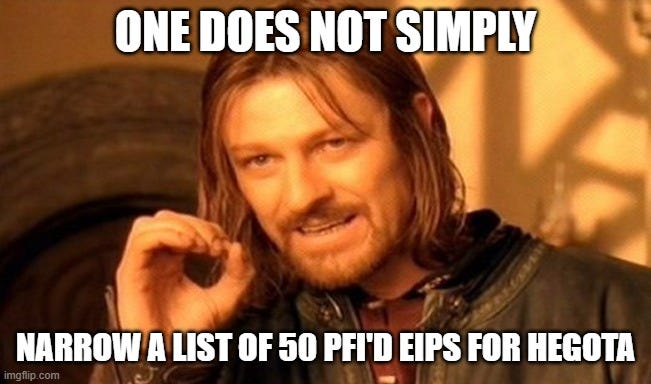
Regarding Hegota, the deadline for EIP submissions has passed, and developers can now begin the arduous task of determining which of these submissions to prioritize for implementation after Glamsterdam.
As a reminder, there is one EIP that developers have already agreed to include in Hegota and have started work on: EIP-7805, fork-choice-enforced inclusion lists. For a refresher on this EIP, refer to this post.
There are currently 37 EIPs proposed for inclusion in the Hegota meta EIP. 17 additional ones were newly proposed on the latest ACD call. So, in total, developers are working through a list of roughly 50 proposals and trying to create a shortlist to prioritize in Hegota.
Nixo Rokish, who chaired ACDE #243, said that execution layer (EL) client teams should come prepared to present and debate their ideal shortlist for Hegota by the ACDE call on September 10. It is likely that consensus layer (CL) client teams will work towards a similar deadline.
While client teams' preferences are the most influential in the upgrade scope decision-making process and therefore the most important to watch in the coming weeks, they are not the only factor.
Two EIPs proposed for Hegota have sparked intense controversy in the Ethereum community.
First is EIP-8363, tapered issuance burn, which would introduce a dynamic burn of Ethereum’s issuance rewards. For a refresher on the arguments for and against lowering issuance, refer to this prior post.
Then there is EIP-8141, frame transactions, which introduces a new transaction type that allows user-controlled Ethereum accounts to verify transactions and pay fees using arbitrary logic defined in smart contract code. It’s designed to make Ethereum more user-friendly today and more adaptable to post-quantum (PQ) cryptography in the future.
In general, both are more supported amongst protocol-focused researchers, developers, and client teams than amongst application developers and users.
On ACDE #243, nearly all client teams expressed their support for EIP-8141. However, vocal opposition from representatives of Base and Offchain Labs, two prominent Layer-2 protocol teams, made it difficult for developers to affirm it in its current form in Hegota.
Instead, they agreed to a breakout call to work out their differences in opinion and possibly adjust the EIP to make it more palatable to Layer-2 teams.
In both conversations about EIP-8363 and EIP-8141, there is a conflict between what many protocol researchers and client teams believe is best for the Ethereum protocol and what application developers believe is best for it.
Speaking in favor of EIP-8141, Geth client developer “Lightclient” said on ACDE #243:
At the end of the day, like, we need to do what is best on L1, and I want it to be something that is supported across L2s, and I want to do what we need in frame so that people are happy, but at the end of the day, everyone’s gonna be a bit unhappy. You know, that’s just the way that controversial EIPs end up, and so we need to be ready for that.
However, from the perspective of Layer-2 developers like “Chris” from the Base team, who proposed EIP-8130 as an alternative to EIP-8141, their views on frame transactions genuinely reflect what they believe is in Ethereum's best interest.
Chris responded to Lightclient saying:
I genuinely believe [EIP] 8130 can satisfy the same long-term goals [of Ethereum] in a way that is ultimately more performant and doesn’t make compromises that are hard to come back from.
Ethereum is not purely a technical project. If it were, the developers closest to the protocol would have the final, most informed say on what is best for it, and today’s client tally would have settled the question of EIP-8141’s inclusion in Hegota outright.
But Ethereum is a community at its core. Protocol rules are determined first and foremost by social consensus. The views of one stakeholder group do not unilaterally define what is good or best for the protocol. Only the collective can.
Thus, setting technical arguments aside for a moment, the existence of intense disagreement over a proposal may itself be strong grounds to reject it for inclusion in an upgrade.
All Core Developers Execution #243 call summary and transcription (Forkcast).
All Core Developers Consensus #184 call summary and transcript (Forkcast).
Overview of the Platåberget testnet, also known as Glamsterdam Devnet-8, a public testnet anyone can join to test their applications and node configurations for the Glamsterdam upgrade (Forkcast).
List of all EIPs proposed for inclusion in Hegota (Ethereum.org). For the finalized Glamsterdam EIP list, refer to this Google spreadsheet.
Ethereum Foundation Researcher Justin Drake claims that hash-based cryptography is the superior choice for post-quantum blockchain signatures (X). Refer to this prior post for background on the different post-quantum signature types.
Galaxy Research’s Lucas Tcheyan writes about the parallels between Ethereum’s and Solana’s issuance-change debates (Galaxy).
Ethlabs’ stance on the Hegota fork scope (X).
🙂 Thank you for reading! What did you think of today’s issue? Please share your feedback by leaving a comment.
😁 If you like what you read today, consider sharing it with a friend who might also enjoy the content.
🥳 Finally, if you’re a premium subscriber, don’t forget to join the subscriber chat. It’s an exclusive space to discuss and debate the future of Ethereum and Bitcoin with fellow readers and yours truly.
Comments
Nothing yet. Say the first thing.
Sign in to join the conversation.