

This edition is sponsored by Zondervan Reflective
Over the past decade, the rise of movements like MAGA and the Democratic Socialists of America have profoundly changed the landscape of American politics. It’s perhaps natural to wonder, as America celebrates its 250th birthday, what’s next for the United States. In this week’s newsletter, CT political correspondent Harvest Prude takes a look at three books on American politics. Two are fascinating mirrors of each other—a conservative and a progressive looking at what’s gone wrong within their own parties and trying to map out a new future—while the third is a time capsule of the political past.
Happy Reading,
Taylor Berglund
Senior Features Editor, Christianity Today
A portion of this newsletter appeared as a column at Christianity Today. Join CT for full access to all our journalism.
This email may contain affiliate links that help support CT at no additional cost to you.
Our busy lives demand a lot. Sometimes, it seems like sleep, rest, and Sabbath are just necessary downtimes or missed opportunities to be productive. But in reality, there’s a deeper theological meaning to be found in our rest. Brett McCracken’s new book, The Wisdom of Sleep, uncovers the profound spiritual lessons we can learn from our God-given need for sleep.
In this book, you’ll learn that rest, sleep, and Sabbath are sacred practices and surprising gifts from God that deepen our relationship with Him, nurture our love for others, and bear witness to His grace. As you learn the astonishing science behind the ways sleep revives and restores us, you’ll see how this God-designed physical reality daily reminds us of spiritual truths, growing in your love for Him along the way. Order your copy of The Wisdom of Sleep today and check out this free Spotify playlist, “Songs for Sleep,” curated by Brett McCracken!
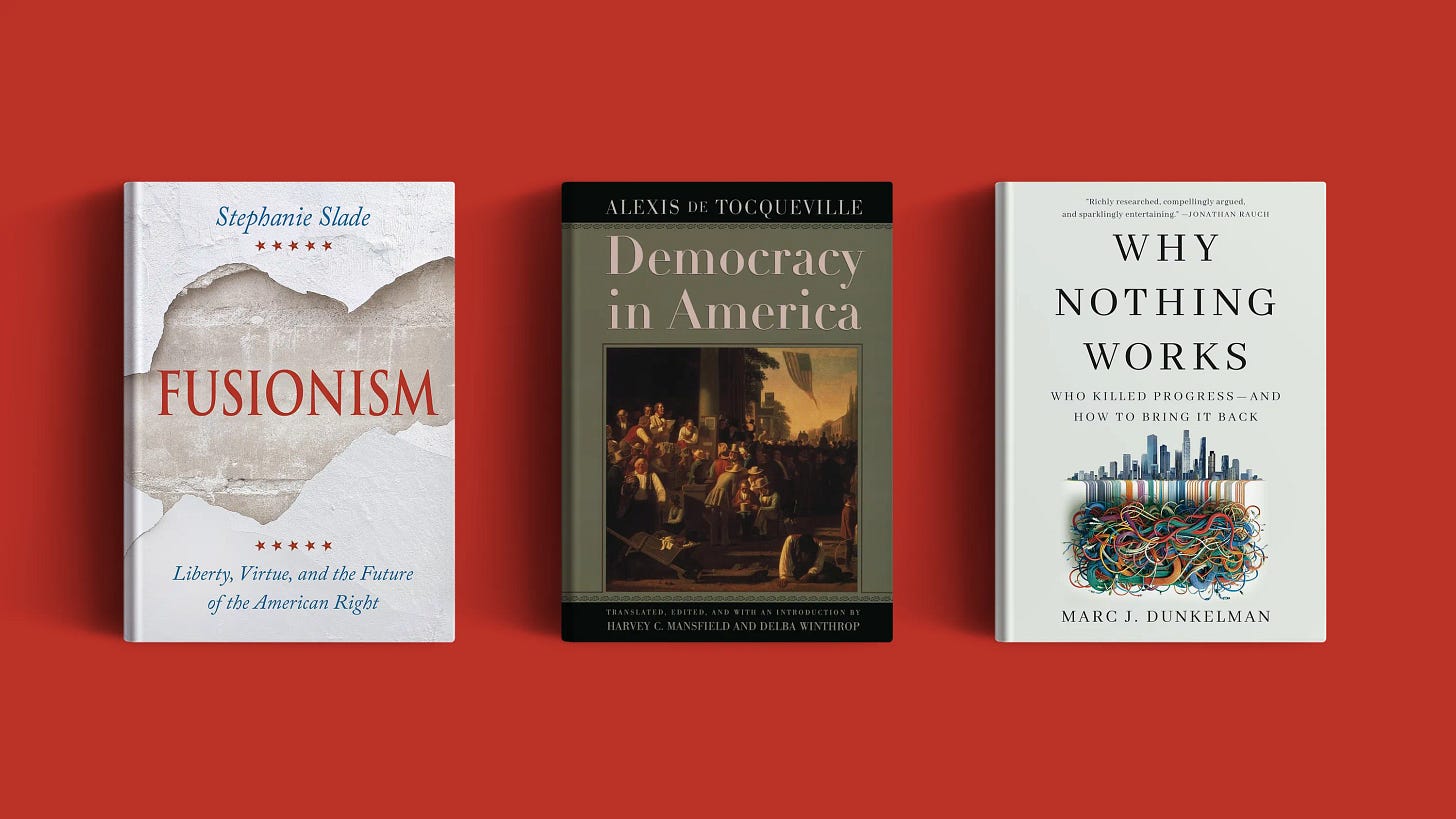
In her new book, Stephanie Slade dusts off the idea of “fusionism,” which defined American conservatism for decades but has been near forgotten and long neglected in today’s bruising era of politics. Slade, herself a devout Catholic and libertarian, defines fusionism as the marriage of the Judeo-Christian moral tradition and classical liberalism. For years, conservatives held that virtue fused with liberty is essential for a well-ordered society and human flourishing. No longer, Slade holds. In a time when both sides of the aisle have become enamored with big, bold government, fusionism has fallen out of favor.
Slade charts the rise, influence, and aims of what she terms the newly ascendent Dissident Right with concern. This cohort is eager to crack up what they view as the faulty foundations of yore, and in their place erect a new politics built on grievance through whatever means necessary—aided by a more forceful government. This Dissident Right is eager, Slade details with depressing but manifest detail, to leave liberty, virtue, and at times even the Constitution behind in furtherance of its project.
At only 270 pages, Fusionism is a well-oiled machine of a book. Both the writing and the content hum smoothly along. With colorful storytelling and a depth of research that testifies to her journalistic background, Slade reintroduces readers to the central casting of American conservatism’s theorists, philosophers, and prime movers—and their contributions, internal spats, and influences on the conservative project at large. (She does the same, more briefly, for the Dissident Right.) She occasionally references the progressive left but avoids sensationalism and maintains a clinical tone. Her prevailing concern is with her own camp of conservatives, and her clear-sighted analysis makes it hard to disagree with her conclusions. Those concerned about the health of the American political right will find plenty to ponder in Fusionism.
Why does the same America that once sent a man to the moon struggle to do things like build high-speed rails or housing adequate to its population’s needs? Why, in one instance in San Francisco, did it take years—and over a million dollars—to construct a single public bathroom?
Marc J. Dunkelman, a political historian at Brown University’s Watson School for International and Public Affairs, has a finger to point—and it’s at those of his own political persuasion. Dunkelman is a Democrat, and Why Nothing Works is his decidedly wonky, unapologetically progressive take on how his party has contributed to the gridlock and dysfunction in American politics.
Dunkelman contends that conservatives deserve a measure of blame for the current state of affairs, but he nearly always steers back to reminding his (presumably progressive) readers of the left’s culpability—and therefore responsibility. He also traces a direct line from incompetent liberal governance to the embrace of Donald Trump, whom he said would be curtailed if people had confidence that their government truly worked, and worked for them. Progressives must strive for a government that, well, works. Otherwise, Dunkelman warns darkly, conservative populism will only continue to grow.
Within the heart of progressivism, Dunkelman describes, lie dueling impulses that date back to America’s founding. The movement’s Hamiltonian impulse seeks to build up a powerful government to do great things for the greater good. But the movement’s Jeffersonian impulse wants to do the opposite: decentralize, distribute power, and equip people with the tools that will allow them to protect themselves from a corrupt elite.
Often, the Jeffersonian impulse came on the heels of the casualties of a Hamiltonian era, as Dunkelman notes in the case of Robert Moses’ engineering of New York City. And the predictable result of these flip-flops? A stalemate, plus a lot of wasted money and effort besides. Many people can say no, from neighbors who don’t want development to environmentalists concerned about the impact on wildlife. Meanwhile, nobody can actually say yes.
But Why Nothing Works is weakest when it comes to solutions. Even readers desirous of change may be skeptical of Dunkelman’s vision: Presidential administrations past and present have done little to inspire confidence that concentrated power will be wielded discretely or in a way untainted by fallen human nature.
Still, readers at odds with Dunkelman’s progressive bona fides (or his conclusions writ large on a host of topics, from abortion to the role of the judiciary) may still find his take on where progressivism has gone wrong interesting. However, the book’s dry, dense style makes it less approachable than some other recent offerings in the same genre.
It seems ironic in the year of America’s semiquincentennial to recommend a book not initially meant for an American audience at all. Yet Democracy in America, written by a young French aristocrat for his fellow countrymen, has long merited a place in America’s foundational canon of influential political works.
Alexis de Tocqueville’s tour de force on America is something of an anthropology of the still-young democracy. The political scientist drew upon nine months of crisscrossing the United States for his book. In it, Tocqueville seems to wed the observational skills of a beat reporter with the sweeping political analysis of an Edmund Burke. Tocqueville describes America’s strengths and foibles, drawing on vivid vignettes of people he encounters.
Tocqueville’s portrait of American society is at times so unfamiliar as to give force to the line “the past is a foreign country,” but he very often describes a silhouette that—however blurred the feature—still boasts a recognizable outline. Americans’ ambitious natures, individualism, disdain for class, and even original sin are all seen through fresh eyes by Tocqueville. Despite the occasional section that has aged poorly, Democracy in America allows Americans to experience being tourists to their own history—quite as fine a 250th birthday gift as any country is likely to receive.
Harvest Prude is national political correspondent at Christianity Today.
August is Make-a-Will Month. Have you reviewed your estate plan recently?
Through Christianity Today’s partnership with PhilanthroCorp, you can receive free, biblically grounded estate planning guidance to help you steward what God has entrusted to you and support the ministries you love.
Whether you need to create a will, update your existing plan, or simply have questions, take this wise step with confidence. Learn more.
EXCERPT: “What Israel’s Only Female Judge Teaches Us About Leadership,” by John C. Maxwell
REVIEW: “The Christians You Need Might Be the Christians Next Door,” by Jeffrey Bilbro
REVIEW: “How Jesus Sounded to a First-Century Galilean,” by Andrew Wilson
EXCERPT: “Why Some Christians Choose ‘God Lite’ Over God,” by Douglas Groothuis
REVIEW: “How to Live and Die in Biological War,” by Myles Werntz
Comments
Nothing yet. Say the first thing.
Sign in to join the conversation.