
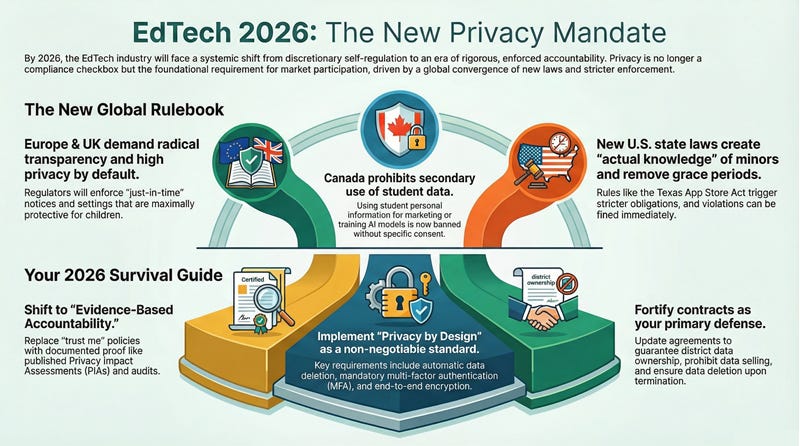
For the past decade, the education technology (EdTech) sector has experienced a period of rapid, often unregulated growth. It was a digital “Wild West,” where innovation frequently outpaced oversight. That era is officially coming to a close. The year 2026 marks a fundamental shift from self-regulation to strict, enforced accountability for student privacy.
This isn’t just about updating a privacy policy; it’s a structural change in how technology can operate in the education market.
The central theme for 2026 is the realization that privacy is no longer a peripheral compliance check but the foundational architectural requirement for market participation.
This isn’t just about new rules; it’s a market-wide pivot from the era of rapid experimentation to an era of long-term durability, where trust is a non-negotiable feature. As new laws and enforcement actions come online globally, EdTech companies, schools, and even parents will face a new reality. Here are the five most surprising and impactful changes you need to know about.
App Stores Will Now Tell Developers Your Kid’s Age.
A major change is coming directly from the marketplaces where apps are downloaded. The Texas App Store Accountability Act, which becomes effective on January 1, 2026, forces app stores to verify user ages and transmit that information directly to app developers.
This is a game-changer because it creates “actual knowledge” that a user is a minor. For years, many platforms operated under a veil of plausible deniability regarding their users’ ages. This law pierces that veil, creating an unavoidable legal trigger for the stringent protections of laws like the federal Children’s Online Privacy Protection Act (COPPA). Once a developer has this knowledge, a cascade of much stricter privacy requirements is automatically triggered, forcing companies to treat child users with the highest level of care by default.
Sharing Precise Geolocation Is No Longer an Option.
Regulators on both sides of the Atlantic are taking a hard line against the collection of location data, viewing it as a direct threat to children’s physical safety. This reflects a global consensus that such data is too sensitive to be an opt-out feature. In the UK, the Information Commissioner’s Office (ICO) now expects that any feature sharing a child’s precise geolocation must be switched off by default.
The rules are even stricter in the United States. Amendments to Oregon’s Consumer Privacy Act (OCPA), effective January 1, 2026, completely ban the sale of precise geolocation data, which the law defines as any location within a 1,750-foot radius. This move signals the end of apps quietly collecting background location data for secondary purposes. The legal risks are now immediate and unforgiving, as Oregon has also eliminated the “cure period,” meaning a company can be fined for a violation without first receiving a warning—a signal of regulators’ decreasing tolerance for lapses in compliance.
Canada Is Walling Off Student Data From AI Models.
In a landmark move, a joint resolution from Canada’s federal, provincial, and territorial privacy commissioners has put a wall around student data, specifically targeting EdTech vendors.
The resolution explicitly prohibits vendors from using students’ personal information for secondary purposes. This includes common industry practices like using data for product improvement or, most critically, for training artificial intelligence models without specific, informed consent from users. This move is part of a broader crackdown that also targets “manipulative design” in user interfaces, reinforcing the global trend toward making the highest privacy settings the default, not the exception. In an industry rushing to integrate AI, Canada’s stance creates a major operational and ethical hurdle, forcing companies to find new, privacy-preserving methods like federated learning (where AI models are trained on user data locally, without the data ever leaving the user’s device) to improve their products.
Your Brain Data Now Has Special Legal Protection.
The legal definition of “sensitive data” is expanding beyond familiar categories like health or financial records into the realm of science fiction. Effective July 1, 2026, amendments to the Connecticut Data Privacy Act (CTDPA) will officially classify “neural data” as sensitive personal information.
The implication is both surprising and futuristic: any EdTech tool that uses brain-sensing technology for personalized learning—such as neuro-feedback headbands—must now treat that data with the highest level of security. Companies will be required to get explicit consent just to process it, legally acknowledging that this data is intrinsically linked to a person’s cognitive autonomy. While the immediate impact is on niche neuro-feedback tools, this legal precedent sets the stage for future battles over biometric data generated by emotion-detecting AI or attention-tracking software, establishing a person’s inner cognitive state as a protected class of information.
Schools Are Done with Empty Promises; They Demand Proof.
Perhaps the biggest shift isn’t in any single law, but in the new culture of “evidence-based accountability” that will define market access. By 2026, a vendor’s promises will be worthless without documented proof, turning procurement into a pass/fail compliance gateway.
This will fundamentally change how schools buy software. Procurement teams will require vendors to provide evidence of their security and privacy practices, such as formal Privacy Impact Assessments (PIAs), third-party security audits like ECNO VASP Assessments, and official certifications such as 1EdTech’s “TrustEd Apps” seal. This demand for proof extends beyond privacy. With an April 2026 deadline for new ADA Title II regulations, which mandate digital accessibility for public entities like schools, becoming a non-negotiable, “pass/fail” criterion for any vendor hoping to sell to a public school.
These changes, while challenging for vendors, represent a coordinated global effort to build a more durable and trustworthy digital learning ecosystem. The era of experimentation is being replaced by an era of durability, where privacy and safety are no longer features to be bolted on, but are the core architecture of any commercially viable product. For companies, educators, and families, this new landscape is built on a single, non-negotiable foundation.
In 2026, digital trust is the most valuable currency in the education market, and proving that your security and privacy protections meet the bar, is the only way to earn it.
As these new rules create a safer digital classroom, what responsibility do we as parents, educators, and students have to understand and exercise our new digital rights?
Comments
Nothing yet. Say the first thing.
Sign in to join the conversation.