
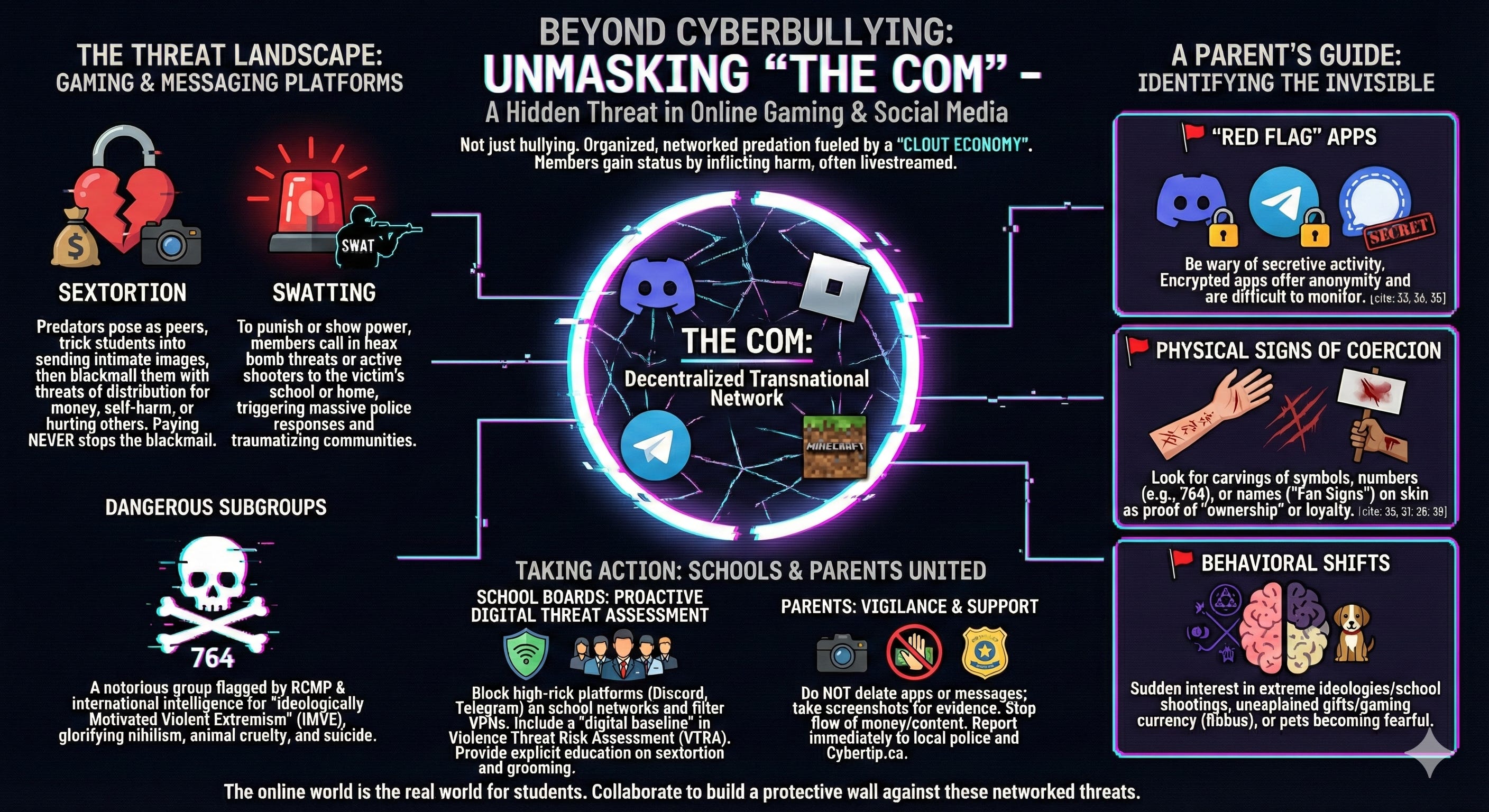
For years, the conversation around online safety in Canadian schools has focused on “cyberbullying”—peer-to-peer harassment, exclusion, and mean comments. However, as highlighted by a recent CP24 report (Durham police warn threats targeting Pickering school may be associated with online network that preys on kids) regarding police warnings about threats to a Pickering school, a far more dangerous threat has emerged—one that operates not in the schoolyard, but in the encrypted corners of the internet.
It is called “The Com.”
This is not a single club or a website. It is a decentralized, transnational network of online groups that target children and youth—often between the ages of 8 and 13—to coerce them into acts of severe violence, self-harm, and sexual exploitation.
As educators and parents, we must urgently update our understanding of digital safety. The strategies that worked for cyberbullying are insufficient for organized, networked predation.
“The Com” (short for community) is an umbrella term for a loose coalition of online subcultures found primarily on gaming and messaging platforms like Discord, Roblox, Telegram, and Minecraft.
Unlike traditional gangs, these groups are fueled by a “clout” economy. Members, many of whom are minors themselves, gain status by inflicting harm. They compete to see who can force a victim to commit the most extreme acts, which are often livestreamed or recorded for the group’s entertainment.
One of the most notorious subgroups, 764, has been flagged by the RCMP and international intelligence agencies for its connection to “Ideologically Motivated Violent Extremism” (IMVE). These groups do not just bully; they groom children into a worldview that glorifies nihilism, animal cruelty, and suicide.
The impact of “The Com” is already being felt in Canadian schools through two primary vectors:
Sextortion: Predators, often posing as peers, trick students into sending intimate images. Within minutes, the dynamic shifts to blackmail. The student is told that if they do not perform specific tasks (sending money, hurting themselves, or hurting others), the images will be sent to their family and classmates.
Swatting: To demonstrate power or punish a victim, members of “The Com” may call in hoax bomb threats or active shooter reports to the victim’s school or home. This triggers a massive police response, traumatizing the student body and disrupting education.
School Boards must pivot from reactive discipline to proactive Digital Threat Assessment (DTA).
Infrastructure Hardening: High-risk platforms like Discord and Telegram, which serve as the operational hubs for these groups, should be blocked on school networks. Advanced filtering must be in place to detect Virtual Private Networks (VPNs) used to bypass these blocks.
Modernized Threat Assessment: Traditional Violence Threat Risk Assessment (VTRA) teams must now include a digital component. A student who appears quiet in class may be a high-status leader in a violent online group. Ignoring the “digital baseline” leaves a dangerous blind spot in safety planning.
Explicit Curriculum: We need to move beyond “password hygiene.” Students need frank education on sextortion (what it is, and that paying never stops the blackmail) and the psychological tactics of grooming.
For parents, the most terrifying aspect of “The Com” is that it happens in the same apps their children use for gaming and homework. Parents should be vigilant for these specific indicators:
Be wary if your child is secretive about their activity on Discord, Telegram, or Signal. These encrypted apps are the preferred communication tools for these networks because they offer anonymity and are difficult for parents to monitor.
“The Com” often requires victims to carve symbols or names into their skin to prove “ownership” or loyalty. Look for:
Carvings: Cuts that form numbers (like 764) or names.
“Fan Signs”: Photos of a name written on a piece of paper (or skin) placed next to a wound or a deceased animal.
Sudden, intense interest in extreme ideologies, occult symbols (like the O9A), or school shootings.
Unexplained gifts, gaming currency (Robux), or money appearing in their accounts.
A pet becoming suddenly fearful of the child, or unexplained injuries to family animals.
If you suspect your child is being targeted:
Do NOT delete the app or messages. This is crucial evidence. Take screenshots of everything, including user IDs.
Stop the flow of money/content. If it is sextortion, do not pay. The demands will never stop.
Report immediately. Contact your local police and file a report with Cybertip.ca.
We can no longer afford to view the online world as separate from the “real” world. For our students, they are one and the same. By working together—schools providing the infrastructure and education, parents providing the vigilance and support—we can build a protective wall against these networked threats.

Comments
Nothing yet. Say the first thing.
Sign in to join the conversation.