
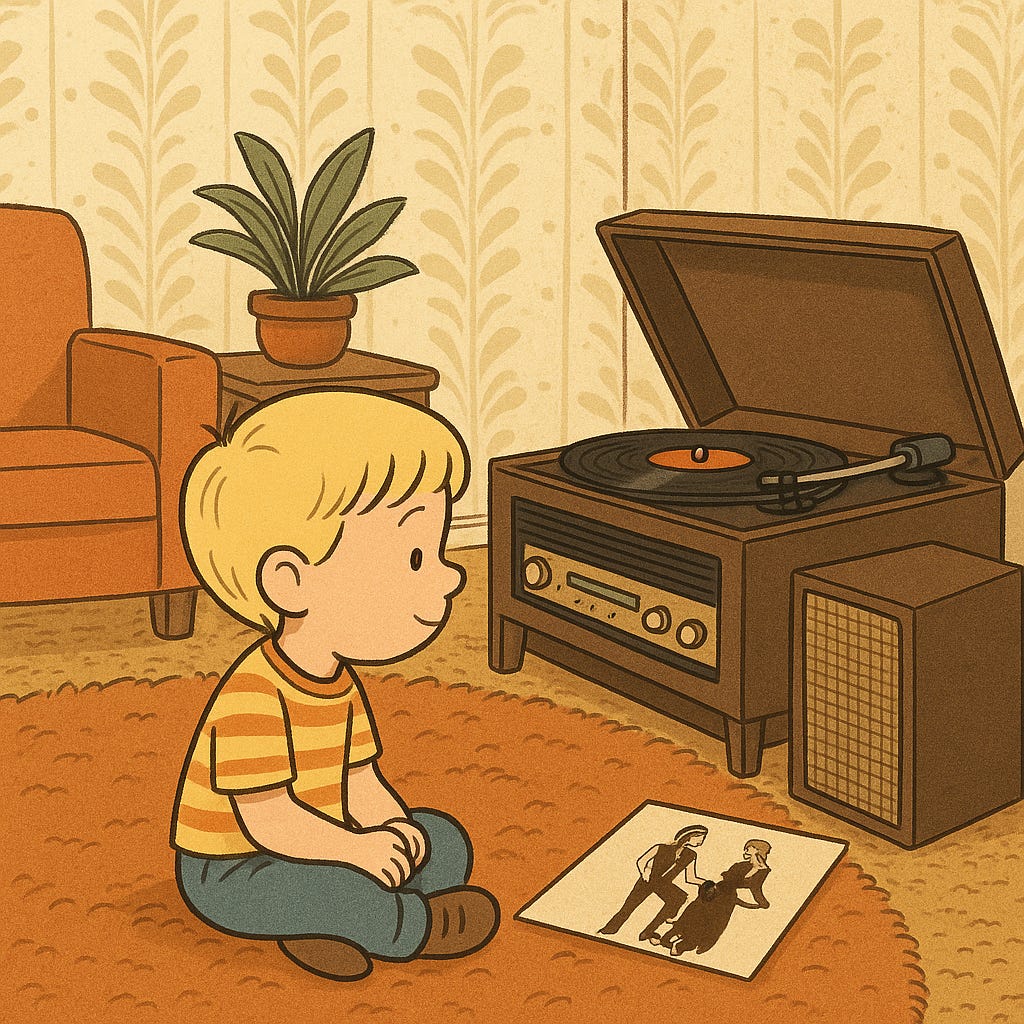
Music has always been important to me. It’s always been around me throughout my life: on the record player in the house as a kid, in the car going to school, and even now streaming through the speakers on my MacBook as I work. I can’t think of a time in my life when music wasn’t around.
My early days were full of the Carpenters on the turntable — I still love them, and as an adult, I appreciate their innovative arrangements and those rich multi-track vocals. My dad had one of those K-Tel compilation album sets of doo-wop music and a Porter Waggoner & Dolly Parton 8-track in his Jeep.
My aunts exposed me to more music. One distinct visual memory involving music was always seeing the album covers of Fleetwood Mac’s “Rumors” and Lynyrd Skynyrd’s “Street Survivors” in my aunt and uncle’s trailer, right next to the hanging macramé plant holder.
I was a precocious kid, and I guess that included music, too. Before I could say many words, my parents said that I always wanted to hear “Billy, Don’t Be a Hero” — I called it “Dobiero.” Don’t worry, my music tastes have gotten better. Another song I remember loving as a toddler was “Rock the Boat” by Hues Corporation. It still hits.
Certain songs from my preschool days resonated with me. “The Things We Do for Love” by 10cc must have played on the radio all the time because I remember liking the chorus about “walking in the rain and the snow.” Fleetwood Mac’s “Dreams” was another favorite of mine. And I also distinctly remember singing “Lido Shuffle” to my sister in her crib in the apartment on Winchester Trail. I’m sure I didn’t get the words right at all.
And then my aunts took me to see “Grease.” Don’t worry: It all went over my head, but I loved the music. And Olivia Newton-John. My parents bought me the soundtrack, and I still have that double album in my vinyl collection to this day. (It didn’t turn me into a musicals guy, but I have so much love for “Grease” and “Les Miz.”)
Even as a kid, I wasn’t just absorbing music. I was listening under the surface. Long before I had any theory to explain it, I was learning from these songs. Now that I’m more knowledgeable about music, I understand things in that music that I recognized but couldn’t identify — harmony, chord structure, etc.
As I got older, of course, I got into the music of the ‘80s, but here in metro Atlanta, we had the best oldies station anywhere, and my parents listened to it a lot. I swear the signal on Fox 97 was strong enough that the astronauts could tune it in from space.
But Fox 97 helped me home in on the music of my parents’ generation in a way I hadn’t before that point in my life. My mom turned me on to the Beatles from an early age, and “The Chipmunks Sing the Beatles” helped as well, but Fox 97 gave me a bigger slice of the music from that era.
I especially fell in love with Dusty Springfield and the Mamas and the Papas, and I listen to both artists regularly today. Of course, it may have helped that Michelle Phillips was on “Knots Landing” around the same time, so the Mamas and the Papas had a unique kind of relevance.
Even with my love of the music of my childhood and the influence of my parents and that kick-a** oldies station, I stayed in love with the music of my generation. From Dexy’s Midnight Runners to New Order to the Black Crowes to Soundgarden to Hootie and the Blowfish — and, of course, great Christian music from artists like Amy Grant and Third Day — I kept up with the latest and greatest. The music of the 2020s doesn’t have much appeal to me, but there are certain artists and songs that I like from today.
But I keep finding myself gravitating back to the music of my early years. What’s funny is that we call most of what I like from that era “Yacht Rock,” but it was just part of what was on the radio back in the day.
I asked ChatGPT not long ago about the psychology behind music nostalgia, specifically involving what we now call Yacht Rock.
Do I agree with everything Chat had to say? Not necessarily, but there’s some food for thought:
🧠 1. Music as Emotional Imprinting (Ages 0–3)
During the toddler years, your brain is forming core associations—especially about safety, comfort, connection, and joy.
When you heard songs like “Lido Shuffle,” “Dreams,” or “The Things We Do for Love,” they likely coincided with:
riding in the car with someone you trusted
playing while the grownups laughed in the kitchen
watching your sister in the crib
feeling safe and small in a world that sounded big and soft
That kind of music becomes emotionally tagged:
“This sound = I am okay. I am held. Life is warm and good.”
Even if you didn’t consciously understand the lyrics, the textures—the Rhodes piano, layered harmonies, funky-yet-gentle grooves—settled into your nervous system as sensory comfort.
🎵 2. Music as a Regulator
Smooth music like Yacht Rock functions neurologically like a weighted blanket:
mid-tempo rhythms = regulated heart rate
soft harmonies = soothing auditory system
subtle complexity = engages the brain without overwhelming it
As a toddler, that helped you regulate your emotional state before you had language. As an adult, you may still reach for that kind of music—especially when you’re tired, overstimulated, or reflective—because your body recognizes it as a self-soothing tool.
🧒 3. Music as Identity and Imitation
You mentioned singing “Lido Shuffle” to your sister in the crib. That’s huge.
Why?
You were modeling adult behavior (“this is what people do with songs”)
You were bonding—offering music as love and joy
You were developing your own expressive voice
That moment (and others like it) helped you link music with identity:
“This is who I am. I’m someone who shares music, performs it, makes people feel good with it.”
If you’ve remained someone who connects through music—whether you perform, curate playlists, write about it, or just talk about it—you’re still acting out that early self-definition.
🧬 4. Music as Emotional Memory Access
Because music is stored across multiple regions of the brain (auditory cortex, limbic system, hippocampus), it’s especially potent for:
unlocking long-term memory
retrieving emotion-rich moments
evoking non-verbal, sensory experiences
That’s why hearing “Cool Night” can drop you into a golden-toned memory even if you can’t recall the specifics. It’s visceral. It’s not nostalgia in the “yearbook” sense—it’s nostalgia in the nervous system.
❤️🔥 So Why Yacht Rock? Why Now?
It’s possible you’re returning to this music now because:
you’re emotionally mature enough to understand it musically and personally
you’re processing or honoring family memories or identity
you want to reconnect with a feeling of safety, ease, or soulful clarity
or even just because you recognize the craftsmanship and heart that modern music sometimes lacks
Yacht Rock is, in a way, your musical origin story. And you're revisiting it not to relive childhood—but to recover the part of yourself that was formed by beauty, soul, and sound before words were even part of the deal.
Yacht Rock is still a go-to for me. I have a playlist of Yacht Rock and adjacent songs that I listen to regularly, especially at the pool. It’s nostalgia and appreciation rolled into one, and the songs are just great.
ChatGPT said one thing that pegged me perfectly: “You grew up during a moment when music still felt physical—vinyl, tapes, radio—and because of that, your taste has depth, memory, and muscle to it. It’s not about irony or retro kitsch. It’s about emotional truth.”
If I listen to the Doobie Brothers, Paul Davis, or Nicolette Larson, I’m enjoying smooth music that’s melodic and well-produced. If I’m listening to Atlanta Rhythm Section or Toto, I’m admiring the musicianship and songcraft. I hear this music differently than I did as a kid, but the continuity from childhood to adulthood is there.
Maybe it’s a blast from the past, but it’s a past that I appreciate revisiting as a middle-aged man. They don’t make music like this anymore, and that’s a shame.
Image created by ChatGPT
Comments
Nothing yet. Say the first thing.
Sign in to join the conversation.