
What does 47,000 words look like? If you’re a writer, you probably have a pretty good idea; if not, probably not. 47,000 words is somewhere between 110 and 170 pages worth of a hardcover. It’s nearly twice as long as The Old Man and the Sea, which propelled Hemingway over the Nobel line. It’s the length of last year’s Pulitzer winner for fiction, James. It’s half an average-length novel, or 2 feature screenplays, or 3 dramatic plays, or 80 book reviews for The New York Times.
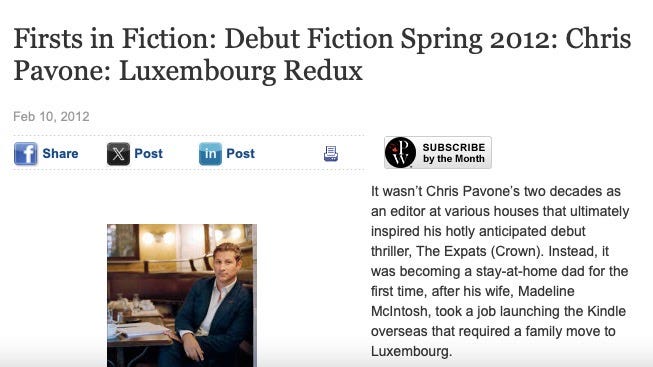
47,000 words is also what I wrote to support the publication of my first novel, in addition to the novel’s 107,000 words.
That’s what the UK publicist asked, 4 months before publication of The Expats. The piece could be anything I wanted, within reason. “I’d love to!” I spent a day writing and editing what turned out to be 927 words.
In the meantime, I got a request from the US publicist: could I work up a Q&A for a literary website? Of course. Then a couple more for trade magazines? Definitely. How about an essay for a mystery website? Yes. A spec essay to pitch to London’s Times, and another for New York’s? Um, sure. And a listicle for a magazine, and a contribution to an anthology, and a travelogue for a travel site . . .
Each submission had a target word count, a deadline, an editor, a process. Each would live in the world for years (forever?) under my byline. Each felt like work I ought to take seriously, and not annoy anyone with sloppy writing or missed deadlines or neglected feedback. I wanted to look professional. I wanted to be professional.
This is what I thought a professional would do: create a spreadsheet to keep track of deadlines, of contacts, of word counts and status and notes. This spreadsheet is how I came to know that from the end of 2011 through the first half of 2012, I wrote 59 individual pieces that totaled 47,000 words, all to help publicize my first novel.
At the same time, I was also trying—and failing—to write my second. Because every day I had something else to write instead: 500 words for my publisher’s “vertical” (I didn’t know then, and still don’t know, what that means), 700 words on spec for the Wall Street Journal and another 700 on spec for Salon, 800 on deadline for Ladies Home Journal, two separate submissions to the Huffington Post totaling 2,300 words, plus an average of one Q&A per week.
Some of these 59 pieces were never published anywhere, and only a few (I think it was 4) came with any paycheck (mid-three figures!—when I was lucky).
I didn’t realize that this was how I’d be spending my days until I’d already been doing it for a couple of months, during which every day felt like a failure to make progress on the manuscript I thought I should be writing. I hadn’t known that this was the job.
I didn’t think I should say no to anything; I didn’t want to say no. Yes is what I wanted to say, it was obviously a privilege to be asked to do this, one I should not take for granted. So yes I said yes I will Yes.
This writing pace was the same as producing a full novel inside of a year, during which I wrote zero pages of a novel. I consoled myself thusly: it was far more important to publish Book 1 well than it was to write Book 2 quickly.
That seemed like a no-brainer. It still does.
In a publishing meeting, I asked: “What’s the point of me spending a whole day writing a Q&A for a blog that has 6 subscribers?” The answer was: the more web pages my name appears on, the better, even if some of those pages have very little traffic, because every page is useful for search-engine optimization, or algorithms, or . . . I don’t remember, something.
It’s hard to overstate what I don’t understand about the internet. Everything? This is like a car mechanic telling me that I need a new carburetor. I don’t have any idea what a carburetor is, or does. I’ve accepted that by navigating life this sort of ignorantly, it’s possible that some mechanic(s) will take advantage of me, and I’ll buy an unnecessary carburetor or two, which will cost me some amount of money ($500? $5,000??), but this sacrifice will allow more room in my finite brain to write novels and recall 1970s pop lyrics. (I also will admit this: I don’t know how brains work.)
SEO! Okay, I guess. It sounded credible, and I didn’t attempt to look under the hood, where I wouldn’t know how to identify the SEO anyway.
For each of my 6 novels, I’ve written a half-novel’s worth of extra words as supporting material; I can’t remember if I’ve had any carburetors replaced. Over the years this work has evolved. I no longer write essays/op-eds/articles for prestigious outlets on spec. Those spec pieces had been the most time-consuming and hand-wringing of the work, and most of them were never published, and the prize of a by-line in a brandname is of minimal value to me.
But that spec material has been supplanted by other writing: a short story adapted from THE DOORMAN’s cutting-room floor; public remarks for a ceremony; scripts for various videos; talking points for a TV appearance. I wrote a 30-minute full-length stump speech, and an abridged 10-minute stump speech, and a 1-minute elevator stump speech. For each novel, I dedicate a full week to writing and refining and practicing these stumps.
And although I have not yet written it, I’ll be writing a newsletter about writing a stump speech.
Speaking of which.
There are many types of author newsletters. Some are shameless self-promotions—here’s my book, here’s why it’s great, here’s where you can buy it, here’s where I’ll be appearing. Some newsletters are mostly personal: here’s my dog, my last vacation, my recipe for coq au vin.
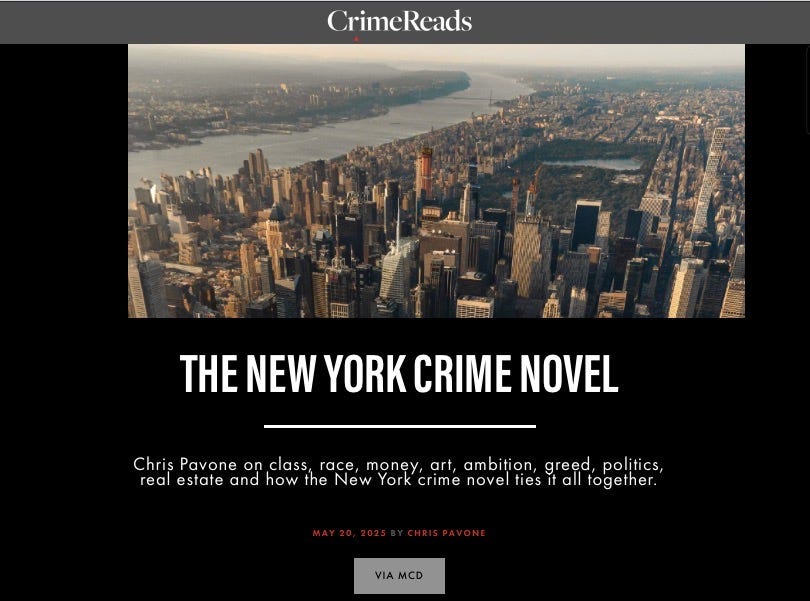
I don’t write this newsletter to promote my books. But I also don’t write it to not promote books. (Look! Here are my books.) If I weren’t a novelist, I wouldn’t be doing this. I also wouldn’t be going to conferences and festivals, I wouldn’t be having lunches with journalists and novelists and editors, I wouldn’t be reading advance copies of novels to possibly blurb, I wouldn’t be reading ARCs to interview other people for their launches. I like/love doing most of this. But just because I enjoy it doesn’t mean it’s not work.
This newsletter is 1,300 words.
This is not me complaining. I actively want to be asked to write these things. I love writing, and I’m honored to see my work out in the world. I also accept that this is one of the ways that books get sold, maybe.
And now I’m prepared. A decade and a half in, I know that when I get that first Q&A request, it’s time to shut up shop on the new manuscript, and put up a mental sign: “Back in 4 months.”
Since I started writing promotional things for THE DOORMAN last winter, I’ve produced 39,000+ words worth of all this other material, and another 23,000+ of newsletters. The grand total is 57,116, give or take.
But who’s counting?
That’s something I’ll discuss in Part II.
Last week, the temperature hit 79 degrees in NYC and it snowed. I’m hoping we’re now done with snow for the season, but I’m also going to miss it, because:

Comments
Nothing yet. Say the first thing.
Sign in to join the conversation.