
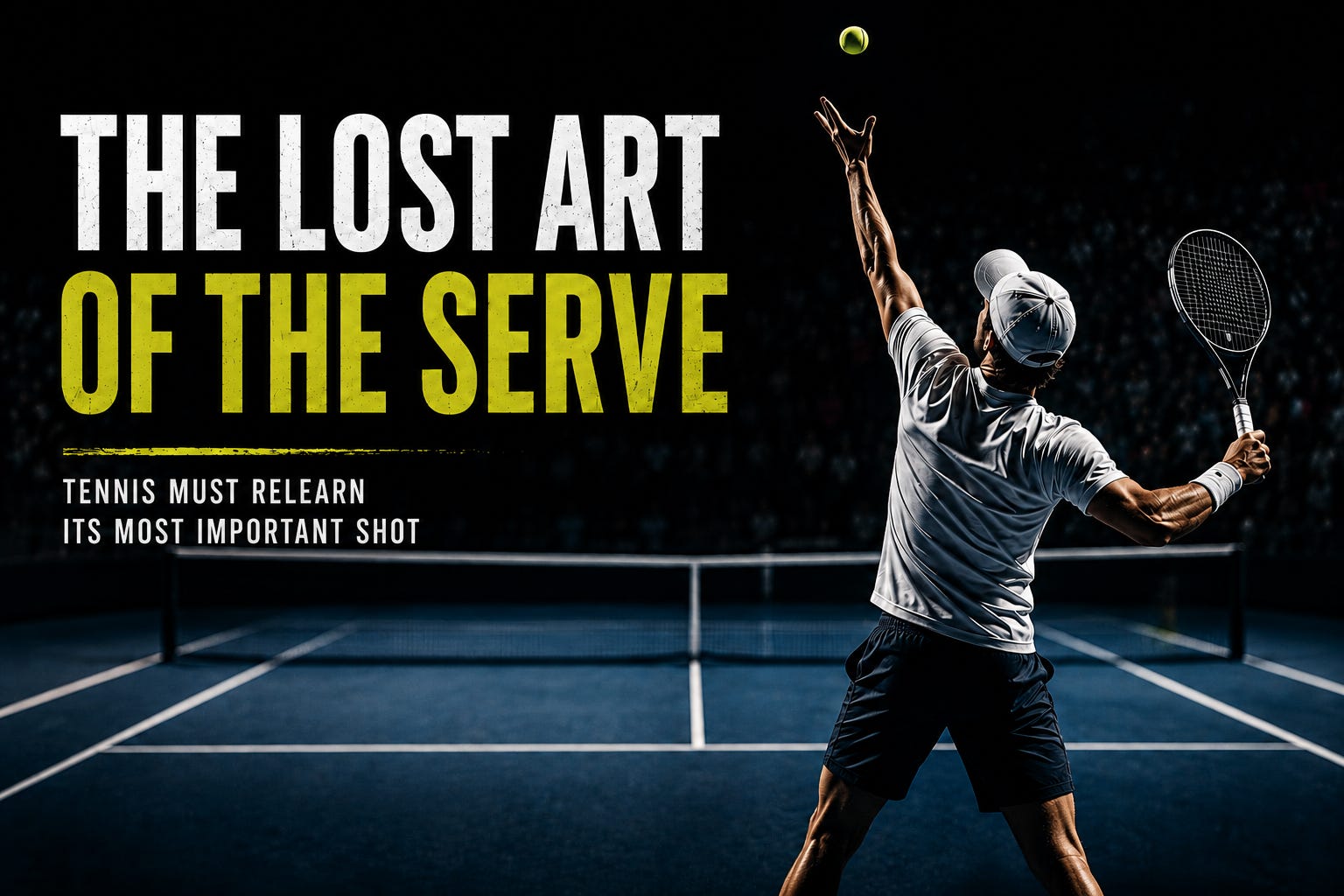
“Do you have a slice serve?”
“Of course. My coach says it’s great.”
The player serves. The ball travels nearly straight, with little rotation, no meaningful curve, and no angle pulling the returner off the court.
“How about your kick?”
“It’s pretty good.”
Another serve follows—essentially a slower flat ball that does not jump at all.
I have had versions of these conversations hundreds of times, even with nationally ranked juniors. Players arrive believing they possess a full arsenal of serves, yet the ball often tells a different story.
Summer high-performance camp is my tennis technique laboratory. I work with players from Dubai, Hong Kong, China, Canada, Pakistan, Europe, and across the United States. Seeing athletes from so many different training environments gives me a rare opportunity to compare how serving technique is taught around the world and to continually refine the efficiency and effectiveness of my own methods.
Despite the diversity of their backgrounds, I see many of the same weaknesses across ages, levels, and nationalities. Most striking is the widespread neglect of the serve, arguably the most important shot in tennis. Five salient areas consistently require greater attention if juniors—and adults—want to develop serves capable of carrying them to a higher level.
Purposeful Practice
The first is sheer practice volume—and general practice habits. Players simply do not serve enough these days. A standard two-hour group practice contains one hour and 50 minutes of groundstrokes and drills, followed by 10 minutes of serving while the coach’s attention drifts elsewhere. Private lessons usually follow a similar schedule, with serving saved for the last few minutes of the session. That is not a development model; it is an afterthought.
This imbalance is especially damaging because the serve stands apart from every other shot in tennis. It is the only stroke that begins entirely under the player’s control. There is no incoming ball to read and no opponent determining the initial speed, height, spin, or location. The server controls the stance, routine, toss, rhythm, target, and type of serve. The forehand and backhand are inherently reactive: players must perceive an approaching ball, move into position, and adapt the stroke to constantly changing conditions. The serve, by contrast, is self-initiated and can be practiced alone. That makes it uniquely trainable through concentrated blocks of repetition to a degree that rally strokes generally are not.
In traditional motor-learning language, the serve sits closer to the self-paced or closed end of the skill continuum, while rally strokes are more open and externally paced. This does not mean that serving should become mindless or overly mechanical. Ecological dynamics emphasizes that skills emerge through interactions among the athlete, the task, and the environment, and that practice should retain information that matters in competition (Davids et al., 2008; Pinder et al., 2011). All serve training should eventually include variations in constraints, targets, spins, scoring situations, returner positions, and tactical intentions. However, because the player creates the initial conditions, coaches and players themselves can temporarily stabilize selected constraints and work intensively on the toss, kinetic chain, rhythm, contact, or placement before returning the skill to a more representative competitive setting.
This distinction helps clarify the role of repetition. Serve development permits more “repetition after repetition” than forehand or backhand development: A player can repeat the same general task, from the same position, while concentrating on a particular technical or tactical objective—while maintaining a close connection to match execution. The goal should be to produce a biomechanically informed yet adaptable motion. Nikolai Bernstein described skilled practice as “repetition without repetition,” meaning that the athlete repeatedly solves the same movement problem, with each solution incorporating small adaptations. Applied to serving, the target and intention may remain stable while the body continually organizes itself in response to subtle changes in balance, fatigue, timing, and ball toss. The purpose of repetition is therefore not to manufacture a robotic motion, but to develop a stable outcome through an adaptable movement system (Bernstein, 1996). The serve is unique in tennis because it allows players and coaches to combine both principles: a high volume of controlled repetitions and enough purposeful variation to create a motion that survives pressure and changing match conditions.
In my experience, building a world-class serve requires dedicated practice blocks of 30 to 60 minutes, preferably with a trained professional who provides specific augmented feedback. Repetitions within this timeframe need to be performed with focus and maximum engagement, and with a purpose: targets, spins, trajectories, routines, and measurable outcomes. Players should know what they are practicing and why, rather than simply trying to empty a basket. Many kids practice their serves too rapidly, often while chit-chatting. Quality repetitions require concentration and recovery time between serves, and players need to receive and process expert feedback to reduce the risk that technical errors become ingrained or contribute to injury.
Research on intermediate players found that structured serve practice improved achievement and technique, while a variable-practice study showed gains in velocity and aspects of accuracy (Van Wieringen et al., 1989; Hernández-Davó et al., 2014). Video analysis or any single gadget is not magic. Focused, repeated, and intelligently varied work matters.
Biomechanics and the Kinetic Chain
The second failure is biomechanical. Every day, I see players without a defined power position, effective loading of the back hip and leg, sufficient coil, stable posture, or coordinated leg drive. Low tosses cramp the body. The trunk opens early. The tossing arm collapses. Hips drift, grips are wrong, and landings finish off balance. From my vantage point, we are living through an epidemic of poor serving technique in children.
Many of these problems begin when players are young and remain unaddressed for years. As players grow stronger and begin serving faster, small inefficiencies can become major limitations, or even injuries. A player may compensate for poor loading by swinging harder with the shoulder and arm, or compensate for a poor toss by torquing the body in a dangerous way. The serve may survive temporarily, but the motion becomes difficult to repeat under pressure and places unnecessary stress on the body.
The serve is a linked, full-body action, not an isolated arm swing. Energy must move from the ground through the legs, hips, trunk, shoulder, arm, and racket in sequence. The legs help generate force, but that force must be transferred through a stable, properly timed trunk. The shoulder and arm should transmit and accelerate the energy rather than being forced to manufacture all of it independently. And all of this can be worked on; it's all trainable. The coach can help provide some healthy checkpoints and safe parameters, even as the skill itself emerges one repetition at a time.
Mark Kovacs and Todd Ellenbecker’s (2011) eight-stage model is valuable because it examines preparation, acceleration, and follow-through from a total-body perspective. Research on lower-limb coordination suggests that leg action and shoulder mechanics are linked (Reid et al., 2008). Coaches must examine the whole chain, not merely random points along that chain.
Developing Real Spin
The third weakness is spin development, as alluded to in the opening vignette. Many accomplished juniors cannot hit a true slice or kick serve. They have been told they possess a slice, but the ball does not curve. They claim a kick serve, but the ball is simply slower and follows almost the same path as the flat serve.
Real spin demands distinct racket paths, contact relationships, and ball rotation. Studies comparing flat, slice, and kick serves show measurable differences in racket-vector direction and body position, while direct measurements of elite serves found clear differences in spin rate and axis among the three types (Sheets et al., 2011; Sakurai et al., 2013). Spin is not merely decorative but fundamentally changes flight, bounce, margin, and geometry.
Spin also gives players greater margin. A topspin or kick serve can travel higher over the net and still drop into the box. Slice can move the returner laterally, create sharper angles, and keep the ball lower after the bounce. These effects become particularly important on second serves, when players must balance reliability with enough movement and quality to avoid giving the returner an easy attack.
I work on serving with spin religiously. My players learn to make the ball curve before obsessing over speed. We develop a genuine slice and a topspin or kick serve from a young age. That work may begin with slower serves, exaggerated shapes, and large targets so players can feel the intended rotation before adding pace. For some female players, a well-developed slice may ultimately produce a more effective result than a kick serve that does not jump enough, but every player should be given the opportunity to develop both forms of spin and make an informed choice from there.
Serve Strategy and Court Geometry
The fourth missing element is strategy. Too many players have narrow tactical philosophies about serving. They hit as hard as possible, usually toward the center of the box, as though every serve must be an ace. Players need to understand that the serve is supposed to start the point—not end it.
The serve is primarily about beginning the point with an advantage. Good serving should build a point pattern by creating a predictable return, opening space, and organizing the next ball. Yet many juniors serve mainly toward the middle of the box, closing the geometry rather than stretching it. They must learn to use the wide serve intentionally: to pull the returner beyond the sideline, expose open court, and create a favorable serve-plus-one pattern. The body serve can restrict the returner’s swing, while the T serve remains an important selective option for reducing angles, targeting a weaker return side, or preventing the opponent from leaning toward the wide serve.
Elite match research has shown that flat serves down the T can be highly effective in particular competitive contexts, but that finding should not be interpreted as a universal prescription to serve centrally (Gillet et al., 2009). Serving patterns depend on court side, spin, surface, opponent, and intended next shot. Biomechanical research is more useful here in demonstrating that professional players can direct serves to T, body, and wide locations while managing subtle changes in setup, toss, and contact (Reid et al., 2011). My real-world experience has shown that most juniors do not develop their wide-angle serves nearly enough. My developmental message is therefore not “serve wide every time,” nor is it “serve down the T because professionals win points there.” The lesson is to learn to stretch the service box, develop every location, and own the entire box.
From an ecological perspective, especially as players advance in level, it’s imperative that they think of the serve and the next shot as a connected pattern. A wide serve might create an open forehand into the opposite side. A body serve might produce a jammed return and a short ball opportunity. A kick serve may push a returner backward or outside the court, allowing the server to move forward and take control. The best serve is not always the fastest, but the one that produces the response and pattern the player wants. That’s why I often like to practice serving with a returner on the other side of the net for a more representative training session.
Placement and control come before uncontrolled force. The complete server changes location, speed, spin, and trajectory while preserving disguise. Players should be able to use similar preparation while sending the ball to different areas of the box. 99 percent of the kids I see on the court don’t disguise or vary their serves effectively, yet this is a critical aspect of high-level serving.
Physical Preparation and Injury Prevention
The fifth area is physical preparation and injury prevention. The serve can be enhanced in the gym and protected through intelligent prehabilitation—preventive training designed to prepare the body before pain or injury develops. Shoulder and scapular control; spinal mobility; leg, hip, and abdominal strength; and total-body power all contribute. Players also need the range and strength to safely move through maximal external rotation of the shoulder, rapid internal rotation, pronation, and long-axis rotation.
The physical demands of serving are repeated hundreds or even thousands of times across practices and tournaments. A player may possess enough strength to hit one fast serve but lack the endurance, mobility, or control to repeat the motion safely over an entire match. Fatigue can alter timing, reduce leg contribution, and force the shoulder and arm to take on more of the workload. Preparation must therefore include not only power, but also stability, muscular endurance, and the ability to decelerate the body and arm after contact. This training is not merely defensive. Improving lower-body force production, trunk control, shoulder function, and total-body coordination can support racket speed, serving endurance, and the ability to maintain technique deep into a match (Kovacs & Ellenbecker, 2011).
Research comparing injured and uninjured servers has shown that inefficient energy flow can increase upper-limb loading while reducing performance (Martin et al., 2014). Shoulder research likewise emphasizes an intact kinetic chain to generate force and stabilize the joint (Kibler, 1995). This is another reason biomechanics cannot be postponed until a player is older or already in pain.
Mark Kovacs has been relentless—and rightly so—about connecting mechanics, physical preparation, and injury prevention. I am certified through the iTPA Tennis Serve Specialist course, which I highly recommend for coaches seeking a systematic framework. We can train mobility, strength, loading, and deceleration while refining technique. Health and performance are not competing goals.
Systematic Serving
A world-class serve emerges from purposeful repetition, sound biomechanics, genuine spin development, intelligent strategy, and a body prepared for the motion. That process can—and should—be guided safely and effectively along the way. Unfortunately, poor serving creates more than lost points: Double faults, weak second serves, and injuries can erode confidence and drain a player’s love of the game.
By developing the serve systematically, we can build better weapons, healthier athletes, and more confident competitors. Players can raise their UTR, improve their rankings, and enjoy tennis more. But serving mastery does not emerge without hard work, intelligent guidance, and years of intentional training. A world-class serve must be built—one purposeful repetition at a time.
Key Takeaways
— Give the serve dedicated practice time. Build daily or near-daily serving blocks with clear targets, purposeful repetitions, and expert feedback.
— Teach the entire kinetic chain. Effective serving depends on coordinated loading and energy transfer through the legs, hips, trunk, shoulder, arm, and racket.
— Develop real spin from a young age. Players should learn true slice and topspin serves that create measurable curve, bounce, and margin.
— Use the serve to create an advantage. Placement, variety, disguise, and court geometry matter more than simply trying to hit the ball as hard as possible.
— Train the body for both performance and durability. Mobility, strength, stability, deceleration, and injury-prevention work should develop alongside serve technique.
References
Bernstein, N. A. (1996). On dexterity and its development (M. L. Latash, Trans.). In M. L. Latash & M. T. Turvey (Eds.), Dexterity and its development (pp. 3–244). Lawrence Erlbaum Associates.
Davids, K., Button, C., & Bennett, S. J. (2008). Dynamics of skill acquisition: A constraints-led approach. Human Kinetics.
Gillet, E., Leroy, D., Thouvarecq, R., & Stein, J.-F. (2009). A notational analysis of elite tennis serve and serve-return strategies on slow surface. Journal of Strength and Conditioning Research, 23(2), 532–539. https://doi.org/10.1519/JSC.0b013e31818efe29
Hernández-Davó, H., Urbán, T., Sarabia, J. M., Juan-Recio, C., & Moreno, F. J. (2014). Variable training: Effects on velocity and accuracy in the tennis serve. Journal of Sports Sciences, 32(14), 1383–1388. https://doi.org/10.1080/02640414.2014.891290
Kibler, W. B. (1995). Biomechanical analysis of the shoulder during tennis activities. Clinics in Sports Medicine, 14(1), 79–85. https://doi.org/10.1016/S0278-5919(20)30259-3
Kovacs, M., & Ellenbecker, T. (2011). An 8-stage model for evaluating the tennis serve: Implications for performance enhancement and injury prevention. Sports Health, 3(6), 504–513. https://doi.org/10.1177/1941738111414175
Martin, C., Bideau, B., Bideau, N., Nicolas, G., Delamarche, P., & Kulpa, R. (2014). Energy flow analysis during the tennis serve: Comparison between injured and noninjured tennis players. The American Journal of Sports Medicine, 42(11), 2751–2760. https://doi.org/10.1177/0363546514547173
Pinder, R. A., Davids, K., Renshaw, I., & Araújo, D. (2011). Representative learning design and functionality of research and practice in sport. Journal of Sport and Exercise Psychology, 33(1), 146–155. https://doi.org/10.1123/jsep.33.1.146
Reid, M., Elliott, B., & Alderson, J. (2008). Lower-limb coordination and shoulder joint mechanics in the tennis serve. Medicine & Science in Sports & Exercise, 40(2), 308–315. https://doi.org/10.1249/MSS.0b013e31815c6d61
Reid, M., Whiteside, D. P., & Elliott, B. (2011). Serving to different locations: Set-up, toss, and racket kinematics of the professional tennis serve. Sports Biomechanics, 10(4), 407–414. https://doi.org/10.1080/14763141.2011.629206
Sakurai, S., Reid, M., & Elliott, B. (2013). Ball spin in the tennis serve: Spin rate and axis of rotation. Sports Biomechanics, 12(1), 23–29. https://doi.org/10.1080/14763141.2012.671355
Sheets, A. L., Abrams, G. D., Corazza, S., Safran, M. R., & Andriacchi, T. P. (2011). Kinematics differences between the flat, kick, and slice serves measured using a markerless motion capture method. Annals of Biomedical Engineering, 39(12), 3011–3020. https://doi.org/10.1007/s10439-011-0418-y
Van Wieringen, P. C. W., Emmen, H. H., Bootsma, R. J., Hoogesteger, M., & Whiting, H. T. A. (1989). The effect of video-feedback on the learning of the tennis service by intermediate players. Journal of Sports Sciences, 7(2), 153–162. https://doi.org/10.1080/02640418908729833
No posts
Comments
Nothing yet. Say the first thing.
Sign in to join the conversation.