
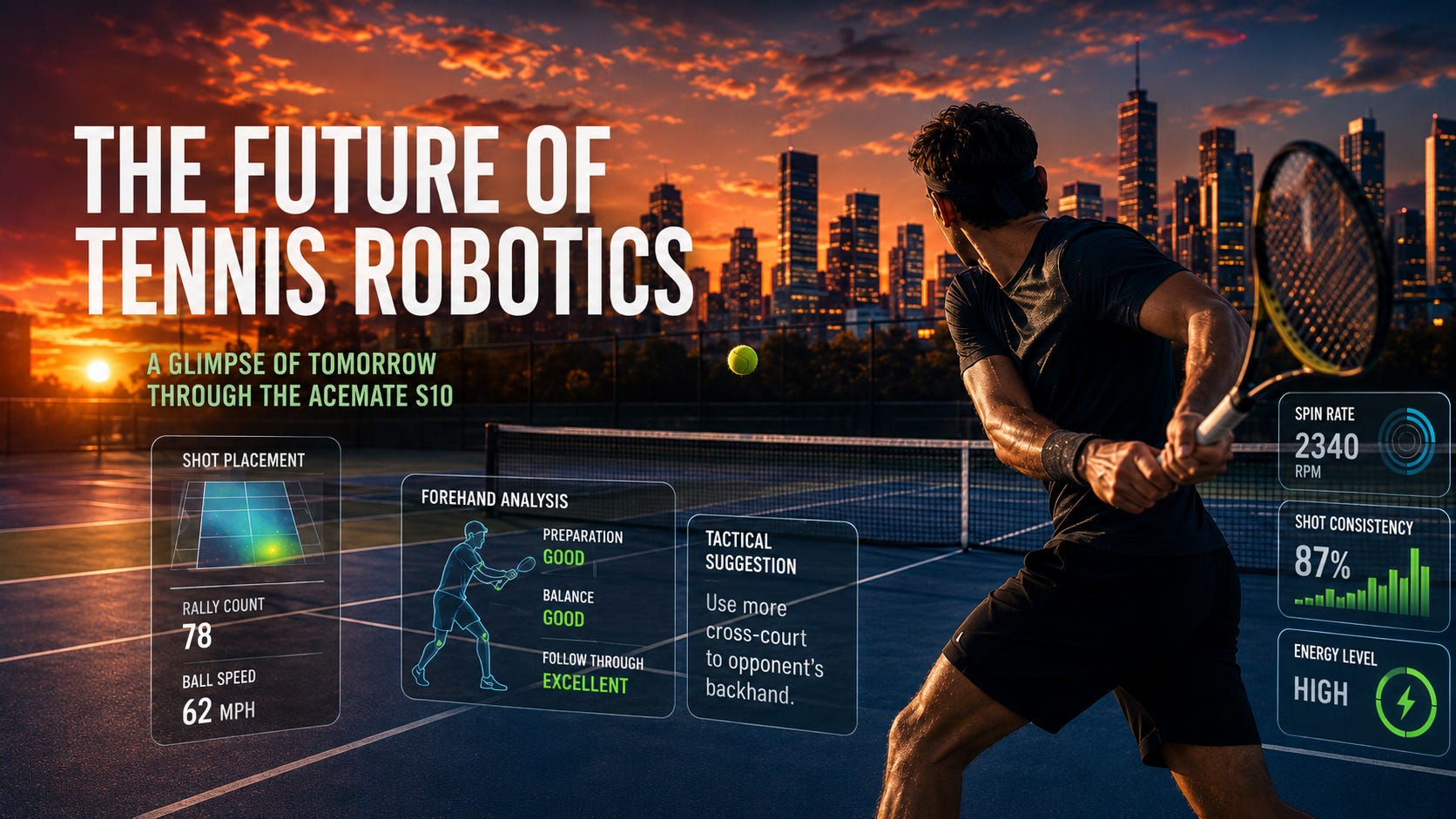
Imagine it is the near future. You arrive at your local tennis court carrying nothing but your racquet. Waiting for you is your robot practice partner. It knows your game intimately. The machine can rally for hours without fatigue, never gets frustrated, never misses a practice session, and can imitate the playing style of Jannik Sinner, a legend like Bjorn Borg or John McEnroe, or even your local arch nemesis. Or perhaps you ask it to give feedback in the style of your favorite professional coach. How cool would that be?
The robot can offer tactical advice, notice when your forehand preparation is late, recognize when your balance deteriorates under pressure, and suggest strategic patterns based on your tendencies and your opponent’s style. After practice, it delivers a detailed report analyzing your movement, biomechanics, shot selection, and tactical decisions. Most remarkably, it possesses infinite patience. This vision may sound like science fiction, but I recently caught a glimpse of this future while reviewing the Acemate S10 tennis robot for my YouTube channel, Tennis Evolution.
The Acemate is not yet the ultimate robotic tennis partner, but it may be the clearest early signal I have seen of where tennis robotics is headed. Its combination of machine vision, movement, ball retrieval, target training, and early automated feedback suggests that the future of practice will be more interactive, more personalized, and far more engaging than the static ball-machine model we have known for decades.
The First Ball Machine That Feels Like a Partner
Traditional ball machines are excellent tools for repetition. They can feed balls with consistency and precision, but they remain fundamentally passive devices. They launch tennis balls according to a programmed pattern and wait for the player to respond. Only certain players truly enjoy that kind of repetitive training. Many find it boring or unrealistic. The Acemate introduces something qualitatively different. Rather than functioning solely as a launcher, the robot actively participates in the rally process. It tracks incoming balls, repositions itself, collects balls via an ingenious catchment system, and returns shots that create the feeling of rallying with a partner.
The result is surprisingly engaging. For the first time, I found myself visually tracking position changes on the opposite side of the net. Instead of staring at a stationary machine, my eyes followed movement, particularly in the lateral visual field. My brain and body responded to that movement. I recovered after each shot in a way that felt more like actual tennis, and the robot’s movement triggered tactical thoughts. This variability within perception-action coupling is an important aspect of tennis training that is sometimes overlooked.
From an ecological dynamics perspective, skilled movement is not simply a stored motor program repeated again and again. Skill emerges from the continuous relationship between the player, the task, and the environment (Davids et al., 2008). In tennis, players do not merely execute strokes. They perceive information, anticipate, move, adapt, and coordinate their actions in response to changing constraints. This type of decision-making and action regulation is deeply shaped by the information available in the performance environment (Araújo et al., 2006; Gibson, 1979; Warren, 1988). This is why the Acemate feels different from a traditional ball machine. A static ball machine is strongly associated with technical repetition and movement automatization. It can be valuable, but it often removes important information from the practice environment. A moving robot restores at least some uncertainty and variability. A mobile machine gives the learner something to watch, track, and respond to.
My external academic advisor, Dr. Keith Davids, one of the world’s leading scholars in perceptual-motor action, ecological dynamics, and motor learning, captured this point beautifully when he wrote to me after seeing clips of the Acemate: “I can see why it seems much more fun compared to a static ball projection machine. The static machine is more associated with technique repetition and movement automatisation which is not as much fun. There is a little more uncertainty and variability in horizontal movement. Fun for beginners and children. A bit more ‘repetition without repetition’ mostly in the horizontal plane of movement by the robot” (K. Davids, personal communication, June 2026).
That phrase, “repetition without repetition,” comes from the work of Nikolai Bernstein and remains one of the most important ideas in skill acquisition (Bernstein, 1996). The best training does not merely repeat identical movements. It asks athletes to solve similar movement problems under slightly changing conditions. This variability helps players become adaptable problem-solvers. The Acemate begins to move practice in that direction.
What the Current Robot Still Lacks
At the same time, it is important to be honest about the current limitations. The Acemate creates more information than a static machine, but it still does not provide the full informational richness of a human opponent. A human hitter gives off countless cues before the ball even crosses the net: body orientation, shoulder rotation, head position, balance, timing of the step, arm path, racquet preparation, racquet-face angle, and swing speed. Skilled tennis players learn to use this information to anticipate, time, and coordinate their own actions.
Dr. Davids emphasized this limitation clearly: “What is missing is other valuable information from the striking actions of the opponent hitter: information from the orientation of the body in space, head positioning, the timing of the stepping action, the swinging of the arm and the racket, and much more. All this information helps a learner time their return actions and coordinate their whole body movements in addressing the performance environment in tennis strokeplay” (K. Davids, personal communication, June 2026).
This is a crucial point. The current Acemate is not replacing a great coach or a high-quality human hitting partner. A human partner still provides richer perceptual information, especially for advanced players. The more skilled the learner becomes, the more valuable these subtle opponent cues become. But this limitation also points directly toward the future. The Acemate still represents a meaningful step because it begins to restore variability, visual tracking, and interaction to a training environment that has traditionally been static.
The Machine Vision Breakthrough
The true innovation of the Acemate lies in its machine vision system. The robot employs dual 4K cameras to observe the court environment and track ball movement in real time. While this may sound straightforward, the engineering challenge is extraordinary. Tracking a tennis ball is one of the hardest problems in sports robotics. The ball is small. It moves fast, spins, and blurs. It can be partially hidden and change direction after the bounce. It can be affected by lighting, shadows, court color, background clutter, player movement, and camera vibration.
The robot must process visual information quickly enough to estimate the ball’s trajectory before the ball completes its flight. This requires several simultaneous tasks: ball detection, ball localization in three-dimensional space, trajectory prediction, bounce and landing-point estimation, robot path planning, and motor control. Each of these tasks presents significant computational challenges.
The dual-camera architecture is especially important because it enables stereoscopic vision. Just as human eyes provide depth perception through binocular disparity, two cameras allow the robot to estimate the ball’s position and velocity in three-dimensional space. Without accurate depth estimation, reliable trajectory prediction becomes extremely difficult. This is where the Acemate’s engineering becomes impressive. The cameras must gather high-quality visual data, identify the ball, distinguish it from background noise, predict its trajectory, and then instruct the robot to move accordingly. This is a perception-action loop inside a machine.
In robotics research, this type of challenge is often described as visuomotor control: transforming visual inputs into motor actions. Modern robotics has made major progress in this area by training systems that connect visual data to motor outputs, but doing this reliably in the real world remains difficult (Levine et al., 2016). More recent vision-language-action (VLA) systems extend this idea by linking visual perception, language-conditioned goals, and action generation in a single robotic policy, pointing toward future machines that can connect what they see, what a player or coach asks, and how the robot should move (Zitkovich et al., 2023). Reinforcement learning and vision-based robotic manipulation research have also shown tremendous promise, while highlighting the difficulty of making robots act intelligently under noisy, dynamic, real-world conditions (Kalashnikov et al., 2018; Kober et al., 2013).
The Acemate’s engineers also faced the challenge of ruggedization. Tennis courts are harsh environments for sensitive optical systems. Cameras must withstand vibration, transportation, heat, humidity, dust, ball impacts, and repeated setup and breakdown. The dual-camera system also needs to remain calibrated. If the cameras shift, shake, or lose alignment, depth estimation and ball tracking can degrade. That means the engineering challenge is not merely software. It is also mechanical design, materials engineering, sensor protection, calibration stability, power management, and real-time control.
Seeing the ball is only the beginning. The machine must convert noisy sensor data into actionable decisions, determine where it needs to move, calculate a path, and execute that movement quickly enough to sustain the rally. When viewed through the lens of robotics engineering, the Acemate’s performance is genuinely impressive.
The Catchment Net: An Underrated Innovation
The catchment net deserves special attention because it solves two problems at once. First, it reduces the transition tax of practice. Every coach and player knows how much time and focus are lost when a session is constantly interrupted by ball pickups. This is one of the Achilles’ heels of traditional ball-machine training. A retrieval system that returns balls back into the machine helps preserve rhythm, saves energy, and allows the player to stay immersed in the task. That matters because good training is not only about the quality of each repetition, but also about the continuity and flow of the practice environment.
Second, the catchment net creates a visible target. That changes the psychology of the drill. Instead of simply hitting balls back toward a machine, the player now has an aiming task that sharpens concentration and gives each shot a clearer purpose. Targets create measurable outcomes. Measurable outcomes create challenges. Challenges create games. Games increase engagement. Imagine future systems that award points for depth, accuracy, spin production, tactical patterns, rally length, or consistency. Imagine adaptive challenges that dynamically adjust difficulty based on the player’s performance. Imagine skill ratings generated from thousands of shots and compared against player databases. In this sense, the catchment net is more than a ball retrieval system. It is an early target-training, data-collection, and gamification platform that transforms practice into an interactive feedback loop.
For children and beginners, this may be especially powerful. Fun matters. Engagement matters. Motivation matters. A practice environment that feels alive can invite more repetitions without the boredom often associated with traditional ball-machine training.
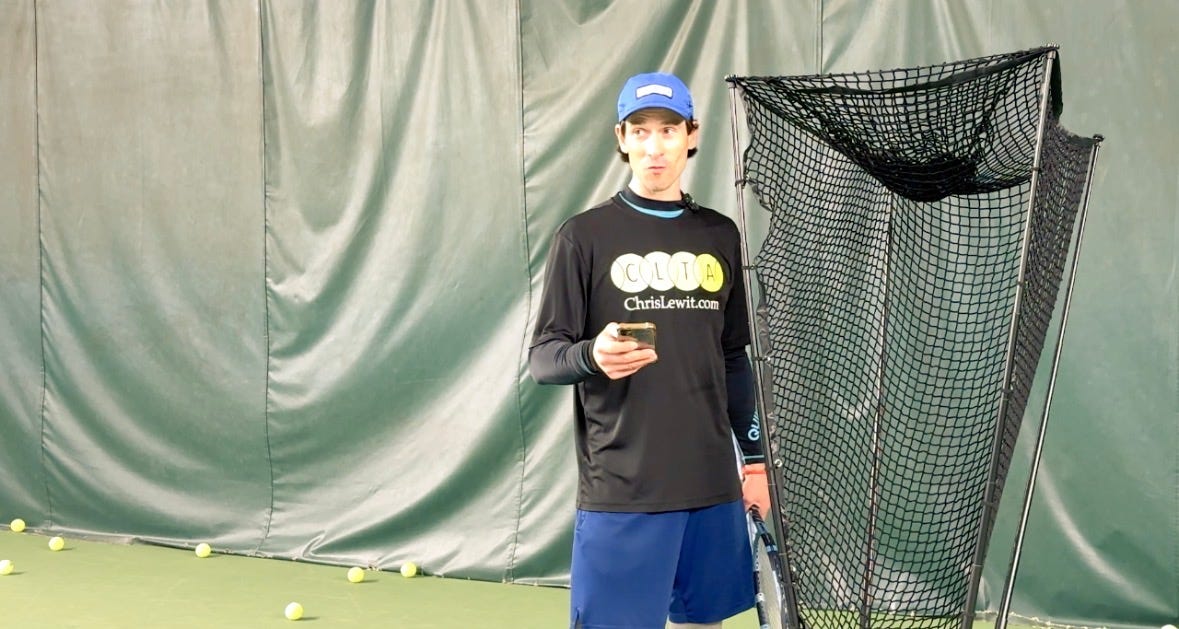
The Acemate’s Innovative Catchment Net
Automated Feedback and Future Coaching Systems
The Acemate also includes an automated feedback layer that can generate basic shot analyses. At present, these evaluations are relatively limited. The feedback is useful, but it remains broad and somewhat generalized. Nevertheless, the significance of this feature should not be underestimated.
Computer vision, automated performance analysis, and multimodal feedback tools are improving rapidly. These technologies can already analyze text, images, video, and performance data in increasingly sophisticated ways. Future systems will almost certainly become far more detailed and personalized. Imagine a robot capable of identifying early versus late contact points, footwork inefficiencies, weight-transfer problems, tactical predictability, spin-production deficits, recovery movement weaknesses, biomechanical injury risks, poor spacing from the ball, inefficient split-step timing, and breakdown patterns under fatigue.
Such a system could provide expert and personalized coaching at a scale never before possible. As a student of biomechanics, I find this possibility particularly intriguing. The current Acemate appears strongest as a ball-reading system: it tracks the shot, evaluates outcomes, and generates basic feedback from what the ball does. The next leap will be player-reading. Future systems will analyze preparation, spacing, balance, contact point, swing shape, recovery patterns, movement efficiency, and tactical decision-making. Many technical flaws are invisible to players, and advanced vision systems may eventually detect subtle movement patterns that even experienced coaches can miss.
Beyond Wheels: Future Form Factors
The Acemate moves on wheels, and for practical reasons this remains an excellent design choice. Wheels are efficient, reliable, and relatively inexpensive. Yet it is difficult not to imagine what comes next. Future robotic tennis partners may adopt entirely different physical forms. Some may remain compact mobile platforms with dramatically improved speed and agility. Others may develop articulated hitting mechanisms capable of producing more realistic shot trajectories. Eventually, bipedal humanoid designs may emerge.
Although such systems remain technically challenging, advances in robotic locomotion suggest they are becoming increasingly plausible. Biorobotics research has shown how difficult it is to emulate animal-like movement, but also how rapidly machines are improving as engineers draw inspiration from biological locomotion (Ijspeert, 2014). A future tennis robot might have legs, hips, shoulders, elbows, wrists, and a racquet. It might step, coil, swing, recover, and disguise shots. It might create the very opponent-movement information that Dr. Davids correctly identifies as missing in current machines.
Dr. Davids made exactly this point: “Judging by the interesting robotics in the previous video clips that you sent me, that may be around the corner and ready for use on court in a few years. The precision with which these future robot tennis feeders can be programmed to use variability in their ball feeding actions—with articulating limbs, joints, and swinging, stepping opponents—will be off the scale” (K. Davids, personal communication, June 2026).
That is the road ahead. The current Acemate gives us lateral movement, visual tracking, catchment, and early automated shot feedback. Future robots may give us stepping actions, body orientation, racquet cues, tactical disguise, stroke production, personalized motivation, and deep coaching intelligence. At that point, robotic tennis training enters an entirely new category. The robot ceases to be a training device and becomes a true synthetic practice partner or coach.
The Ultimate Practice Companion
The most exciting future may not be physical but cognitive. Imagine a tennis robot capable of embodying different playing styles. One day it rallies like Rafael Nadal, generating heavy topspin and relentless depth. The next day it mimics Daniil Medvedev’s unusual court positioning. Perhaps it reproduces Carlos Alcaraz’s explosive transitions from defense to offense. Perhaps it can play like a counterpuncher, a serve-and-volleyer, a moonballer, a lefty grinder, or a flat-hitting baseliner.
The robot could become the ultimate sparring partner, adapting instantly to any tactical scenario. After the session, it could provide detailed reports explaining exactly how and why you succeeded or failed. Such systems would blend robotics, biomechanics, computer vision, sports science, ecological dynamics, motor learning, and automated shot feedback into a unified training ecosystem.
A Glimpse of the Future
The Acemate S10 is not the final destination, but the machine is an early waypoint that hints at the future of sports robotics. After spending time with the Acemate, I came away convinced that tennis robotics has crossed an important threshold. For the first time, I experienced a ball machine that felt less like a feeder and more like a partner. As additional innovations arrive, this points toward a future in which robotic practice partners become increasingly intelligent, interactive, and personalized.
The road ahead will be long. True robotic tennis partners capable of human-level play and coaching remain years, perhaps decades, away. But the pace of technological change is accelerating. Advances in computer vision, machine learning, robotics, battery technology, large language models, and humanoid locomotion are occurring simultaneously. The ingredients are coming together.
What I saw in the Acemate was not merely a new ball machine. It was a glimpse of a future in which every tennis player may one day have access to an endlessly patient practice partner, a personalized coach, and a sophisticated performance analyst, all embodied within a single robotic system. Watch this space. The next decade is likely to bring innovations that today seem almost unimaginable.
References
Araújo, D., Davids, K., & Hristovski, R. (2006). The ecological dynamics of decision making in sport. Psychology of Sport and Exercise, 7(6), 653–676. https://doi.org/10.1016/j.psychsport.2006.07.002
Bernstein, N. A. (1996). On dexterity and its development. In M. L. Latash & M. T. Turvey (Eds.), Dexterity and its development (pp. 3–244). Lawrence Erlbaum Associates.
Davids, K., Button, C., & Bennett, S. (2008). Dynamics of skill acquisition: A constraints-led approach. Human Kinetics.
Gibson, J. J. (1979). The ecological approach to visual perception. Houghton Mifflin.
Ijspeert, A. J. (2014). Biorobotics: Using robots to emulate and investigate agile locomotion. Science, 346(6206), 196–203. https://doi.org/10.1126/science.1254486
Kalashnikov, D., Irpan, A., Pastor, P., Ibarz, J., Herzog, A., Jang, E., Quillen, D., Holly, E., Kalakrishnan, M., Vanhoucke, V., & Levine, S. (2018). Scalable deep reinforcement learning for vision-based robotic manipulation. Proceedings of Machine Learning Research, 87, 651–673.
Kober, J., Bagnell, J. A., & Peters, J. (2013). Reinforcement learning in robotics: A survey. The International Journal of Robotics Research, 32(11), 1238–1274. https://doi.org/10.1177/0278364913495721
Levine, S., Finn, C., Darrell, T., & Abbeel, P. (2016). End-to-end training of deep visuomotor policies. Journal of Machine Learning Research, 17(39), 1–40.
Warren, W. H. (1988). Action modes and laws of control for the visual guidance of action. In O. G. Meijer & K. Roth (Eds.), Complex movement behaviour: The motor-action controversy (pp. 339–379). North-Holland.
Zitkovich, B., Yu, T., Xu, S., Xu, P., Xiao, T., Xia, F., Wu, J., Wohlhart, P., Welker, S., Wahid, A., Vuong, Q., Vanhoucke, V., Tran, H., Soricut, R., Singh, A., Singh, J., Sermanet, P., Sanketi, P. R., Salazar, G., … Han, K. (2023). RT-2: Vision-language-action models transfer web knowledge to robotic control. Proceedings of Machine Learning Research, 229, 2165–2183.
No posts
Comments
Nothing yet. Say the first thing.
Sign in to join the conversation.