
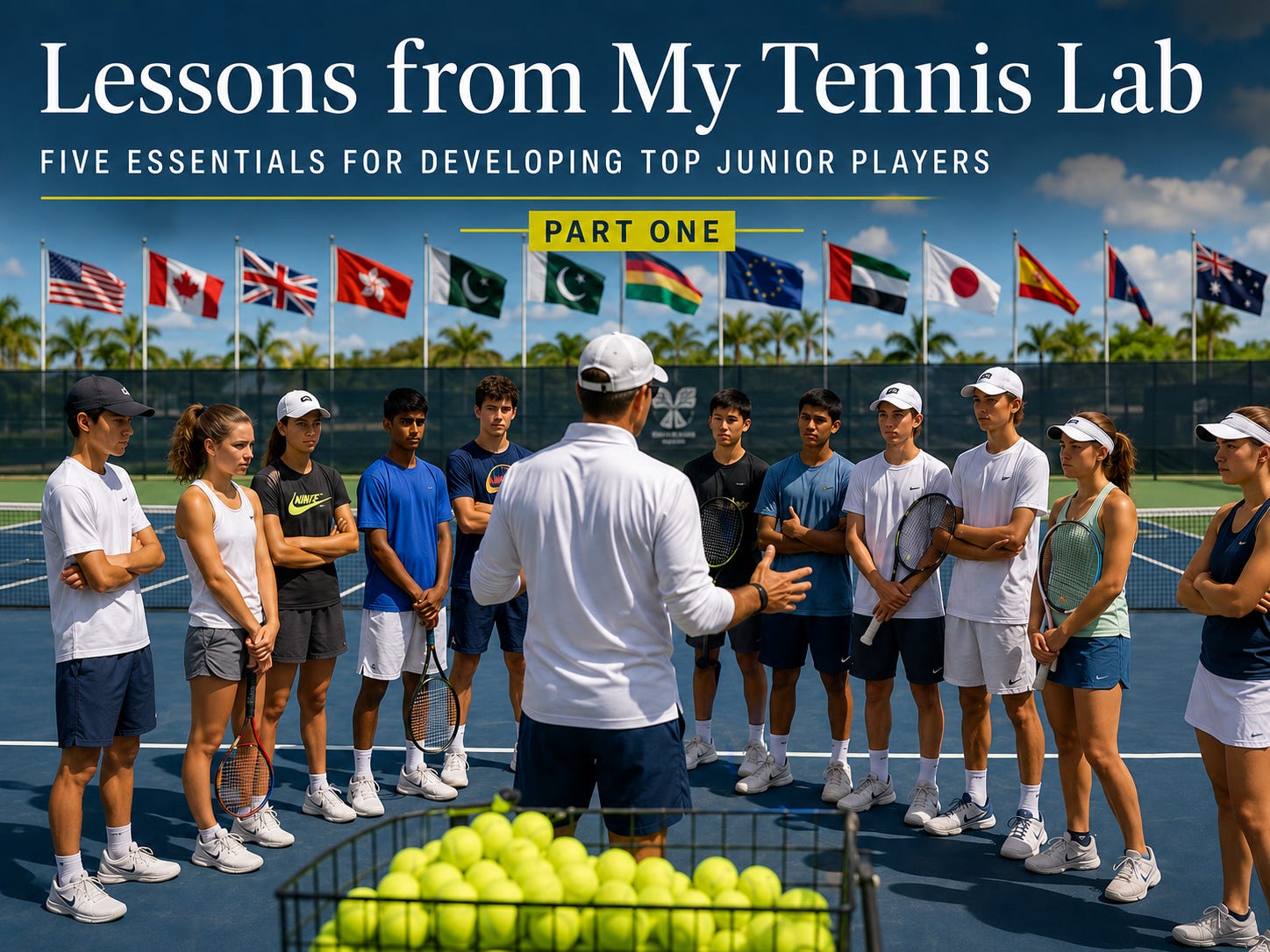
Every summer, the world of junior tennis arrives at my small club in Vermont’s rural Green Mountains.
In the middle of our high-performance camp, the courts become what I think of as my tennis technique laboratory—a place to observe, compare, experiment, and learn. This summer, I have worked with players from Dubai, Hong Kong, Canada, Pakistan, Europe, and across the United States, including Virginia, Florida, California, and Hawaii. They arrive from very different tennis cultures, drawn to Vermont by the opportunity to work with me intensively on their technique.
For me, that variety creates a remarkable collection of movement patterns and stroke styles to study. As both a practicing technician and a biomechanics student, I am fascinated by how players have been taught to organize their bodies, generate energy, and strike the ball. Some have developed with private coaches, in large academies and private clubs, and others through national training programs. They bring different grips, stances, footwork patterns, tactical habits, coaching language, and ideas about how tennis should be played. Yet beneath all those differences, I continue to find many of the same technical gaps.
Junior tennis is now more athletic, international, and competitive than ever. Players are stronger and faster, competing year-round at increasingly younger ages. But in the rush to enter tournaments, improve rankings, and produce immediate results, essential parts of long-term development are often neglected. Players may learn how to win junior matches before they have learned how to use their bodies efficiently or build strokes capable of evolving with the speed and physical demands of the modern game.
My summer lab repeatedly brings me back to five areas that I believe are crucial to developing a top junior player: the serve, the forehand, topspin, movement, and modern stroke construction. These are not isolated technical subjects. They are interconnected parts of a complete game—and they are still not being taught consistently or comprehensively enough.
In Part One, I focus on the two primary weapons of the modern attacking game: the serve and the forehand. In Part Two, I will examine topspin and movement, and in Part Three, modern stroke construction.
Develop the Serve From the Ground Up
The serve remains one of the most critical shots in tennis, yet it is also one of the least effectively developed. I have been building world-class serves for decades, and it has become one of my specialties. No matter where players come from, I tend to see the same problems: inefficient power positions, low tosses, cramped contact points, limited use of the legs, poor posture, and very little upward explosion.
Kids need to learn how to jump on the serve. I mean an intentional, explosive jump—not a mere by-product of the motion—in which the player fully extends the ankles, knees, and hips while driving upward and into the court. The widespread idea that the jump should simply “happen” has hurt player development by discouraging coaches from teaching leg drive, full extension, and purposeful upward explosion.
I still see far too many junior players serving with both feet planted on the court, trying to create speed primarily with the arm while the lower body contributes very little. The result is a serve that lacks height, power, spin, and long-term potential. A high-level serve should be an explosive, full-body action in which the player loads through the legs, pushes against the ground, and transfers force upward and into the court.
A major part of this action is triple extension—the coordinated extension of the ankles, knees, and hips. As the player pushes through the forefoot, straightens the knees, and drives the hips upward, the body reaches greater height and creates more racket-head speed. But leaving the ground is not enough. The player must jump with alignment, balance, and full extension rather than remaining folded at the hips, bent at the knees, or collapsed through the waist.
One of the most widespread problems I see is a low, cramped contact point. The serving arm remains partially bent, the shoulders become compressed, and the player allows the ball to fall into a comfortable striking zone instead of stretching fully upward. This limits mechanical advantage, racket-head speed, spin, and the margin available over the net. The goal is not merely to reach the ball, but to contact it at the highest point the player’s motion can efficiently produce.
The toss is a major part of the problem. Most junior players toss the ball too low and too close to their bodies. A low toss rushes the motion, giving the legs little time to load and explode. A toss that remains too close crowds the player and prevents the body from extending upward and into the court.
Most players instinctively toss within a comfortable range. They place the ball where they can reach it easily without jumping, stretching, or extending fully. A high-level serve requires something different. The toss should be placed high enough and far enough away to encourage the player to drive upward, lengthen the body, and attack the ball at full extension.
This does not mean tossing the ball carelessly or excessively high. The toss must remain controlled, consistent, and repeatable. But it must support an explosive motion rather than restrict it.
When the toss is properly placed, the player has room to load the legs, achieve triple extension, rise off the court, and reach fully toward the ball. The contact point becomes higher and less cramped, the body moves naturally into the court, and the racket can accelerate through a larger and more efficient hitting zone.
Young players must understand that the serve is a coordinated kinetic-chain movement. The legs, hips, trunk, shoulders, arms, and racket must work together in sequence. When the lower body is passive, the racket arm is forced to work too hard. That limits power and consistency and may also place unnecessary stress on the shoulder and elbow.
The foundation begins with the ground. Players must learn to load, explode, extend, stretch, and reach. Without those elements, they may develop a functional junior serve, but they will struggle to build a truly powerful, efficient, and world-class weapon.
Developing spin is another major priority in my tennis lab. Very few junior players possess advanced kick and slice serves. It is almost as if coaches have forgotten that players must master three distinct serves: the flat, kick, and slice serves. Each serve has a different purpose. The flat serve provides direct pace and penetration. The slice serve curves away from or into the opponent, opens the court, and creates difficult return angles. The kick serve uses topspin to produce greater net clearance and a higher, more aggressive bounce.
We work on all three from a young age. The goal is to give players the ability to vary pace, spin, height, placement, trajectory, and movement. A server should not be dependent on one delivery or one predictable ball. A complete player needs a versatile serve that can create different problems and function as a genuine weapon in every part of the match.
The same principles that help build a world-class serve—ground force, sequencing, extension, relaxation, and racket-head speed—also shape the modern forehand.
Build a Kinetic Forehand
Along with the serve, the forehand is one of the major weapons in the modern game. For a deeper look at the subject, see one of my most popular Substack articles, “Your Forehand Isn’t Broken—It’s Outdated.” In the Spanish tennis philosophy, the forehand is often treated as the foundation of a player’s identity—the shot used to control the middle of the court, dictate rallies, attack short balls, create angles, run around the backhand, and finish points. Yet despite the amount of time juniors spend hitting forehands, I see surprisingly few that possess the qualities of a truly world-class stroke.
In fact, I can often predict what I am going to see before a new player takes the first swing. The player will step into a closed or neutral stance, tighten through the shoulders and arms, and produce a locked-joint motion with very little use of the legs, hips, or trunk. The stroke may appear organized, but it also looks stiff, forced, and robotic. The athlete must understand how the body creates, transfers, and releases energy.
Spacing is almost always one of the first problems I address. Many young players allow the ball to crowd them, leaving the hitting elbow trapped against the trunk and eliminating the room needed for the arm and racket to accelerate. When the elbow becomes compressed against the ribs, linear tip speed and angular momentum reduce, and there is less freedom, racket speed, and access to spin. Other players create the opposite problem by standing too far away and reaching with the arm, causing the upper body to lean and the contact point to become unstable. Good spacing allows the player to rotate, extend, and accelerate while remaining balanced.
This is why the forehand cannot be taught as mostly an arm action. The legs establish the hitting position, the hips and trunk initiate and support the rotation, and the shoulder, arm, and racket accelerate through the contact zone. When this sequence is coordinated, the player creates racket speed without appearing to force the stroke. My goal is to develop effortless power, heavy spin, and a ball that travels through the court with real weight.
To achieve that, I focus heavily on fluidity and elasticity. I want players to loosen their bodies and allow the stroke to flow rather than trying to muscle the ball. Too many juniors believe power comes from tightening the arm and swinging as hard as possible. In reality, excessive muscular tension slows the racket, restricts rotation, reduces spin, and makes timing more difficult. A world-class forehand needs structure, but it should never become stiff. The body must load and release like a spring: The legs bend, the trunk coils, and elastic energy is stored. That energy is then released through proximal-to-distal sequencing, with the hips and trunk accelerating first, followed by the shoulder, arm, and finally the racket. The player should feel that the stroke is launched by the body rather than initiated by the arm.
I introduce players to open and semi-open forehand stances early because they are essential to the modern game. These positions allow the player to control pace, load the outside leg, rotate effectively, and recover quickly. The neutral stance still has an important role, particularly when moving forward or attacking a short ball, but players who rely exclusively on neutral and closed stances often struggle when the game speeds up and positioning time disappears.
From a semi-open stance, the player can push against the outside leg, rotate the hips and trunk, strike the ball, and begin recovering almost immediately. I want players to feel their hips and trunk actively contributing to the swing because many juniors have very little awareness of this rotation. Their legs typically remain passive, the pelvis barely moves, and the arm performs nearly all the work.
One exercise I use is the jump forehand. This is not an exaggerated leap or a decorative movement. It is a small, controlled explosion in which the player pushes against the ground, rotates the body, and allows the feet to release naturally from the court. The purpose is to help the player feel how the legs and hips contribute to racket speed. The jump should emerge from the upward and rotational force of the stroke rather than being added artificially.
An important part of this action is hip abduction. Anatomically, abduction means moving a limb away from the midline of the body, while adduction means moving it toward the midline. On the forehand, hip abduction helps the player maintain width in the base, stabilize the pelvis, create room for rotation, and push laterally toward the recovery position. Excessive adduction causes the knees and legs to collapse inward, narrowing the base and weakening both balance and recovery.
I see very few juniors abducting their hips effectively. Many rotate while the knees fall inward and the feet move closer together during loading and exploding phases, rather than being wide. The result is limited rotational force, poor stability, and a slower recovery. Teaching proper hip abduction helps players maintain a stronger platform while moving, rotating, and striking under pressure.
The follow-through is another area where unnecessary stiffness appears. Many players have been taught to catch the racket rigidly with the opposite hand after every forehand. This often causes them to shorten the release and tighten the arm before the stroke is complete. I encourage players to let the follow-through drift naturally. A free finish promotes relaxation before and through contact while allowing the racket to decelerate gradually rather than being stopped abruptly.
The finish is not a pose. Its shape should vary according to the height of the ball, the amount of spin, the tactical intention, and the player’s position on the court. The purpose of the follow-through is to allow energy to release safely and fluidly, not to force every swing into the same picture.
A good windshield-wiper action is also essential. During this movement, the racket travels across the body as the upper arm rotates inward at the shoulder. This is known anatomically as internal shoulder rotation, or ISR. Internal shoulder rotation contributes to racket-head speed and helps create the modern windshield-wiper path that produces topspin.
Many players try to manufacture this action by bending the wrist or pulling the racket sharply across the body. But the windshield wiper should come from the coordinated movement of the shoulder, elbow, and forearm, not from an isolated flick of the wrist. When ISR is combined with good spacing, trunk rotation, and a relaxed arm, the player can generate significant spin without sacrificing penetration.
Players also need more than one forehand. The stroke used from a neutral rally position is not identical to the shot used while defending, moving forward, hitting on the run, or attacking from inside the baseline. A player may use a higher, heavier forehand to create time, a deeper and more penetrating ball to control the rally, a shorter-angle forehand to open the court, or a flatter strike to finish the point. The stance, swing path, contact point, and follow-through must adapt to each situation.
Developing a forehand means building an adaptable movement system rather than memorizing one rigid swing.
The best forehands are powerful without appearing forced. They are explosive yet relaxed, structured yet elastic, and technically sound without becoming robotic. That is what I am trying to create in my tennis lab: a kinetic forehand built through the coordinated use of the legs, hips, trunk, shoulder, arm, and racket, producing effortless power, heavy spin, stability, and a ball capable of controlling the modern game.
Conclusion
My summer tennis lab continues to reinforce a simple truth: The serve and forehand are not just two important shots. They are the foundation of the modern attacking game.
Both depend on the same deeper principles—effective use of the ground, proper spacing, full-body rotation, elastic movement, racket-head speed, and the ability to produce power without unnecessary tension. When those elements are missing, players may still compete, but their strokes remain limited. When those elements are developed correctly, the serve and forehand can become genuine weapons that continue to improve as the player grows stronger, faster, and more experienced.
In Part Two, I will turn to the next three areas that repeatedly stand out in my lab: building the heavy ball through topspin, developing movement that creates time and consistency, and teaching modern stroke technique for the game being played today.
Key Insights
Junior players from very different tennis cultures often arrive with similar technical gaps, particularly in how they generate energy, organize movement, and build strokes for the modern game.
The serve and forehand are the two primary weapons of the modern attacking game, and both depend on effective ground force, sequencing, relaxation, extension, and racket-head speed.
Young players should be taught an intentional, explosive jump on the serve, using full triple extension of the ankles, knees, and hips to drive upward and into the court.
A properly positioned toss creates the time and space needed to load, jump, stretch fully, and reach a higher contact point. Players should also develop flat, slice, and kick serves to vary pace, spin, placement, trajectory, and bounce.
The forehand should be built as a kinetic-chain movement rather than an arm-dominant swing. Proper spacing, open and semi-open stances, hip and trunk rotation, hip abduction, and elastic sequencing help create power, spin, balance, and efficient recovery.
The goal is not one rigid forehand or one fixed finish. Players need an adaptable movement system capable of producing heavy rally balls, angles, defensive shots, attacking balls, and finishing shots under the demands of the modern game.
Please consider joining our worldwide tennis community @TennisEvolution. Subscribe today and become part of the conversation.
Also join me on my personal channel, @ChrisLewit, for junior tennis development videos and a look at my other creative pursuits, including writing and more.
No posts
Comments
Nothing yet. Say the first thing.
Sign in to join the conversation.