
Hello stand-up comedian (and anyone else who wants to write funny).
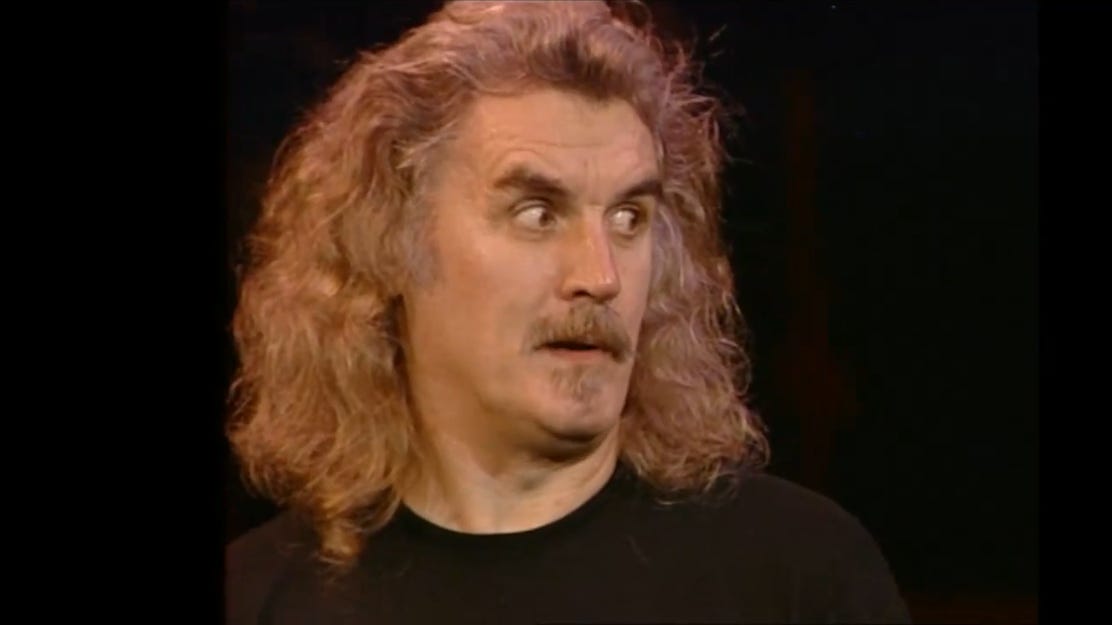
In this week’s post, we’re looking at how you can perform a comedy sketch within your stand-up, analysing a classic example from Billy Connolly.
In a regular stand-up act-out you, often you’re acting out something that really happened to you. We analysed an example in my previous post from Kevin Hart where he acts out the situation of swearing at his teacher. He plays himself, the teacher, the other kids.
A hallmark of the stand-up act-out is the comic themselves appearing in the situation, usually drawn from their life.
In sketch comedy, you’ll have, for example, Tim Robinson, Catherine Kate or Key & Peele playing characters in a scenario. In a stand-up comedy sketch, in the same way, the stand-up is playing characters.
By the end of this post you’ll have tools and inspiration for acting out a sketch as part of your stand-up.
We will be looking at a two part process:
Part 1 is the observational comedy section where you discuss the real situation.
Part 2 is jumping into the sketch inspired by this situation.
Part 1: Observational Comedy
As an example we’re looking at a classic Billy Connolly sketch.
The whole piece is based on a comparison (see my previous post for another comparison example where Aisling Bea compares Irish and American flirting). In this case it’s a comparison between super rich aristocrats and the rest of us.
In the the first part of the routine, Connolly talks about having dinner with an aristocrat. Working class Billy Connolly is out of place in this setting so, in this first observational part of the performance, we have fish-out-of-water comedy. (A topic I will return to.)
The conversation turns to winter sports and the aristocratic man talks about Norway, and how he skied the length of it. Later, Connolly asks this highly privileged man what he does. The man replies that he is a “tobogganist”. Connolly tries to make sense of this:
“It’s Christmas time. I thought, well, maybe he thought I’m saying, what were you doing before I got here? You know, the sledge. I said, ‘no, I meant, what do you do for a living?’ He said, toboggan. I said, ‘Toboggan?’ ‘Yes. Toboggan.’ As if it was the most normal thing on earth.”
Here we’re in a standard act-out with Connolly interacting with this eccentric rich man in a real situation. Connolly then reflects on the difference between the aristocracy and normal folk:
“And that’s the difference. It isn’t money. That’s the difference between them and us, is they think it’s all right to be a tobogganist.”
Next we have a quick first context change. His first thought is, what if you went to your father and said, “I want to be a tobogganist?” What reaction would you get? Connolly imagines the scene:
“You tell your father that’s what you want to be. ‘I’m going to be a tobogganist’.”
And he responds:
“No you’re fu**ing not. Get off your lazy arse.”
That little vignette opens up the sketch space which he now goes into fully.
Part 2: The Comedy Sketch
Next he asks, what if you went to the job centre, the ‘dole office’, and when they asked what you do, and you said, ‘I’m a tobogganist’? (Setting up the game of the sketch).
In this context change sketch, Connolly takes this aristocratic man, who has no need of money let alone welfare, and imagines him in the Job Centre. Specifically, to add to the incongruity, Connolly places the scene in his home city of Glasgow.
My way of describing the classic sketch structure is SHEP:
SET-UP, HOOK, ESCALATION, PAYOFF.
The SET-UP establishes the who, where, when, what of it. The HOOK, well, hooks us in with something surprising and comic. The ESCALATION heightens the absurdity and the PAYOFF gives the sketch a comic finish.
In a TV sketch all of the set-up would be within the action of the scene. In a social media sketch, part of the set-up is the title and description. In this stand-up performance, part of the SET-UP is spoken by Connolly before we go into the action. He says:
“Go to the dole in Govan or Possil or anywhere, Maryhill [in Glasgow]. Go to the dole and say...”
This very economically sets up this lovely sketch, where he acts out the three parts, where this posh aristocrat interacts with the bemused working class Glaswegian civil servants in the job centre.
In the sketch we have the classic character reasonable/ unreasonable dynamic. The reasonable job centre staff have to deal with the man who unreasonably believes you can be a tobogganist for a living. (This dynamic of the voice(s)-of-reason dealing with the character with a strange perspective is a very common sketch dynamic).
Here it is as a sketch script (in performance, of course, Connolly is playing all the parts):
ASSISTANT: Occupation?
ARISTOCRAT: Tobogganist.
ASSISTANT: ….What?
ARISTOCRAT: Tobogganist.
ASSISTANT: Hang on a minute. I’ll have to see Mr McLaverty about that.
This line – needing to see Mr McLaverty is the HOOK, that takes the action in an unexpected new direction.
Next, the assistant steps back from the counter to speak to his supervisor. (To help the audience follow the action Connolly says to “He’s over to the supervisor”.)
The sketch continues with the ESCALATION as Connolly now heightens the absurdity as the two job centre staff appraise the situation, as they stand looking at the aristocrat standing at the counter.
ASSISTANT: He says he’s a tobogganist.
MANAGER: Who?
The manager looks up and identifies the man.
MANAGER: Has he got it with him? Has he got a toboggan?
The assistant looks puzzled.
MANAGER: Has he got a woolly hat on?
ASSISTANT: No. It’s fu**ing June. I suppose that’s why he must be signing on, maybe…
MANAGER: Tobogganist, you say?
ASSISTANT: Aye.
MANAGER: Fuck me. Maybe, maybe he’s got a speech impediment or something? Aye, that’ll be it. Write down “tobacconist”.
And that’s the PAYOFF. (For much more on SHEP in comedy sketches with lots of classic examples from TV shows like Key & Peele and Fry & Laurie, check out my blog).
The sketch itself is a little over one minute. Have a look at how he does it in this video that includes my commentary from when we discussed this in one of my Zoom stand-up comedy material generation courses. September 2026 (and all future) dates here.
Notice how very casually he’s performing the sketch. He also acts it out quite subtly, it’s more like acting for camera than a big theatrical performance.
As Connolly performs the latter interaction between the manager and the assistant, a simple change of eyeline switches between characters. With the simplest means, Connolly shows us the job centre, the three characters, their personalities and where they are physically in relation to each other.
This is one of the great things about stand-up, if you embrace this side of it, you can perform a sketch.
And in this example, it’s all come from changing the context and imagining a scene. Once again we can see how much comic juice is when you go into the hypothetical ‘what if?’ space.
The Change Context Sketch
Part 1: Identify your “Unreasonable” Character
Choose a person you have encountered, who possesses an absurd, eccentric or simply peculiar, attitude. This is your “unreasonable” character.
Part 1 of your routine will be simply talking about this person as they actually are.
Part 2: The “What If?” Context Shift
Now imagine this person in an entirely different context. It could be a mundane environment like the job centre, but you could go the other direction and put them somewhere fantastical, like a Lord of the Rings setting. Either way, their attitude will clash with the new context.
Once you have set up this shift of context, you then go into the sketch.
You have the reasonable character(s) behaving as they normally do for their context.
Then you have your unreasonable character enter their world.
The fun is watching them try and deal with this interloper.
Apply the SHEP structure to the scene.
Set-up: In stand-up this will likely comprise a simple set-up you say directly to the audience, then the opening lines of the sketch itself.
Hook: Introduce a moment that signals the new direction or heightens the absurdity.
Escalation: Now we see the “reasonable” character(s) in the scene to interact with your “unreasonable” character.
The Billy Connolly example is unusual, as the two reasonable characters withdraw to talk about the unreasonable one. In your sketch, you’ll more likely have an ongoing interaction between the reasonable and unreasonable character(s).
Payoff: The line that ends the sketch could give us an unexpected resolution – as the Connolly one does – where the reasonable character(s) solve the problem.
Alternatively, very common pay-off in the classic comedy sketch is what I term the reversal where the reasonable character(s) suddenly reverse their position to buy into the perspective of the other one at the last. In the Connolly sketch, this kind of ending would see the job centre manager, for example, say that he has been inspired by the aristocrat and that he is leaving his job to become a full-time bobsleigher.
As you act-out your sketch, remember to keep it casual. You don’t need a big theatrical performance, or even character voices, You use simple eye-line shifts to show the audience the different characters in the scene, and you can move around the stage to show the geography of the environment. Plus you can drop in the odd line said to the audience to help them follow what’s happening.
Leave a comment below and tell us about any peculiar attitudes you have encountered. What situation might you imagine this person in? And share a favourite example of stand-up where the comic performs a sketch.
Or share a stand-up sketch you’re working on where you’d like some input.
If you’d like a free 15 mins consultation on your stand-up, you can book here.
My next Stand-up Comedy Generation Course on Zoom starts in September.
Here’s my acclaimed book on stand-up.
And here’s my latest book The Complete Comedy Script Toolkit
----------
For context shifts:
For ‘what if’:
Comments
Nothing yet. Say the first thing.
Sign in to join the conversation.