
Hello stand-up comedian (and anyone else who wants to be funny).
Commenting on my post from last week about stand-up sketches, stand-up and writer Greg Bell, commented that he loves it when Richard Pryor does anthropomorphic comedy.
I too love how he anthropomorphises his dogs and other animals (and even things, like his car). In perhaps his most famous bit, he even anthropomorphises his own heart attack. (I’ll definitely do a blog on that in future.)
Anthropomorphism is giving anything non-human a human voice, attitudes and behaviours. It’s not an exact synonym, but instead of “anthropomorphism” I like to use the word “personification” as it’s easier for everyone!
You can personify anything, but for now I’m going to focus on animals.
When coaching animal personification in stand-up and sketch comedy, I noticed two different approaches. There are clearly overlaps (in both the animals have human qualities) but how they relate to the human world is different.
Animals acting like humans to comment on the human world
This is the George Orwell Animal Farm approach. Here the animals fully inhabit and understand the human world. For example, you could imagine chimpanzees in the house of commons in the role of MPs, and as they debate they fling excrement at each other.
Imagining how the human world looks from the animal’s perspective
In this approach, the animals can talk, but they look at the human world from their animalistic perspective. For example, you could take the perspective of the mice in the house of commons as they witness the antics of the humans and try and make sense of it all.
A recent classic example of this, is the movie Over the Hedge where a group of raccoon’s suddenly find a housing development in their midst.
And it turns out this is also a distinction that academics make! They call it:
Allegorical Anthropomorphism and Perspectival Anthropomorphism
Bit of a mouthful. For ease, I’m going to call it
1. ‘As if’ personification – animals acting ‘as if’ they are humans.
2. Observational personification – animals observing the human world.
In this post, I’m going to explore observational personification – animals observing the human world.
By the end of this post you’ll have some great examples of this in action and tools and inspiration to try it yourself. (And next week we’ll look at ‘As if’ personification.)
Kat Williams: Tiger
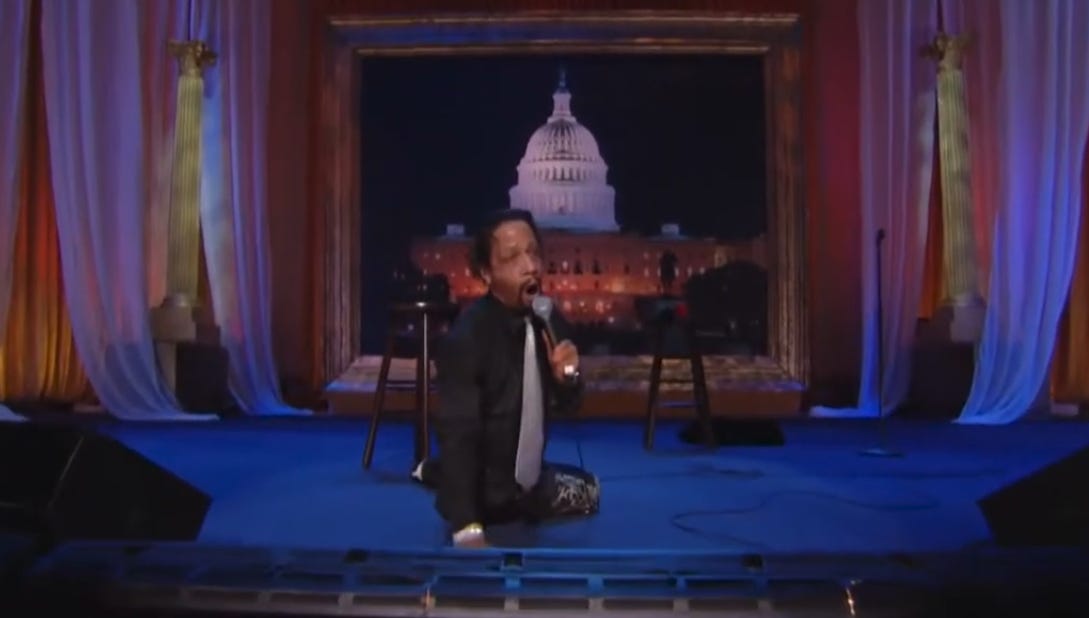
Here’s a superb example of how the human world looks from an animals perspective. It’s Kat Williams taking the perspective of tigers in a zoo.
First of all, he reminds the audience of the news story where kids climbed into the tiger’s enclosure at the zoo and were killed by the tigers.
He then takes a brilliant contrary attitude to the event. Taking a contrary attitude is a real cornerstone of stand-up. This is where you observe whatever the consensus view is on any given topic and go hard in the opposite direction. (See my post on taking contrary attitudes).
“First, like, when them motherfu**ers got attacked by that goddamn tiger in the goddamn zoo in San Francisco and shit. And they had it all on CNN like it was a national tragedy and shit. It’s so sad. Well, I didn’t see nothing sad at all.”
He goes on:
“These wasn’t kids. These was grown motherfu**ers. I feel like if you a grown motherf**ker and you get killed - and you get killed by a tiger - and you get killed by a tiger in a zoo. And you get killed by a tiger in a zoo in San Francisco. I think God’s will has been done for your life. I think that’s exactly what was supposed to happen. And I think he wanted me to laugh about it a whole lot. That’s what I think.”
Williams invokes God and this is a great, preacher-like build:
I feel like if you a grown motherf**ker and you get killed
… and you get killed by a tiger
… and you get killed by a tiger in a zoo.
… and you get killed by a tiger in a zoo in San Francisco.
I think God’s will has been done for your life.
He’s really inflating the balloon (to use Adam Bloom’s metaphor) to then pop it on the final line.
He continues:
“Fuck that. I’m a parent. I got kids. I feel like if you raise a child at any age that’s dumb enough to climb into a tiger’s cage, you should tell them the rest of the goddamn story. ‘Then the tiger eats your asshole out, baby. That’s the end.’”
This gets its comic kick by being framed in the context of a bedtime story. (It’s big-small).
He then impersonates the zookeepers who, on TV, were, as he puts it, ‘talking shit about the tigers.’ They were ‘snitching on the tigers like they was disappointed in the tigers and shit.’ He goes into an act out where the zoo keepers say:
“We can’t believe they would even do something like that. They’ve never done anything like that before. And if they’re a danger to the community, then we’ll have to get rid of them.”
Having set up the straw man of the zoo keeper, he then takes down their argument:
“You gonna get rid of the tiger? You gonna get rid of the only real motherfucker in the whole goddamn story?”
This is a classic technique. In a parody of the people you disagree with, voice their argument you in its most ridiculous form, and then take it down.
He then goes on tell the white people in the audience that if they can’t understand what it’s like to be a tiger in a zoo, they’ll never understand what it’s like to be a black man in America.
Having set up this arresting human/ animal parallel, he introduces the observational personification by saying:
“You got to look at this shit from the tiger’s motherfu**ing viewpoint.”
This is where Williams goes into, as I like to call it, a stand-up sketch. This is where the comic plays characters in a scene like a sketch comedian would, as I explored in my previous post . In this case the characters are the tigers!
Here’s a video of the routine from that point. Check out his wonderful physicality that brings it all to life. As I also discussed in my previous post, often a stand-up act out works because it’s performed casually. But this is an example of really committing to the physical comedy and making a feature of brilliant physicality:
He explains that the animal we’re dealing with…
“ain’t no fake ass ‘got it at the mall’, tiger. This a real goddamn tiger. Like the kind that be on National Geographic every time you turn it on, on the back of a wildebeest ass and shit. Wildebeest don’t even be dead.”
In a terrific bit of physical comedy, he becomes the tiger and the stool on stage becomes the wilderbeest, which he jumps onto and sinks his teeth into. The unimpressed wildebeest complains: “I ain’t even dead!”. To which the tiger replies:
“I don’t give a f**k b*tch, I’m hungry now!”
Underlining that we have a “real fu**ing tiger in a fake ass habitat”, Williams goes on to describe how the tiger is meant to rule the jungle. He says the tiger roars and “shit supposed to happen.”
But every time it roars it in the zoo, it doesn’t work. He arrestingly parallels this with a downtrodden person not being able to progress in life. He then goes on to talk about how they’re fed. He says that tigers are…
“…supposed to be eating elephants and giraffes and shit. And every day they come feeding meat out of a bucket and shit. Just eating that bullshit. What he be looking at? Your good fresh meat ass walking around the zoo with a video camera and shit.”
This is a great flip of perspective from us looking in on the tigers to taking the view of them looking out at us. Kat explains:
“And the tiger be fu**ed up because he don’t know what to feel. And after a while, he get depressed and down and start acting like us. You know how we get depressed and start doubting shit? ….I bet the tigers have got as low as they can possibly get. ‘Are you sure I’m a tiger? I don’t feel very much like a tiger. Maybe I’m just a vicious ass koala bear.’”
He goes onto say that “as a real motherfu**er, you can’t never afford to give up. Because:
“...all real motherfu**ers is only waiting on one opportunity. And that’s the opportunity to show a motherfu**er they ain’t bullshitting.”
He goes on:
“And I bet them tigers have got as low as they could possibly get. And then something wonderful happened in the tiger world.”
In come the kids to the tiger enclosure! The tigers are suddenly on alert:
“N*gga, this is not a drill. Get ready, N*gga. They think we bullshitting…”
Williams acts out the tiger withdrawing to hide, then suddenly pounces on the stool (now representing the kids). He says, “that’s what’s supposed to happen”.
Jerry Seinfeld on racehorses
From that incredible bit of stand-up about a very and dramatic unusual situation, I want to close with a bit on an everyday situation.
Jerry Seinfeld reflecting on a recent visit to the race track betting on the horses, suddenly jumps to the horse’s perspective:
“Do the horses know that it’s a race? Are they aware what is going on here?”
He doubts that after the race, the horses are walking back to the stables going:
“I was third, I was first, I was ninth.”
Having scotched that idea, he suggests more realistically what they’re thinking:
“Oat bag, I get my oat bag now, oat bag time.”
He laments: “I got a bet on this idiot?”
Thinking more about the whole occasion from the horse’s perspective, he goes on:
“I mean, I’m sure the horses have some idea that the jockey is in a big hurry. I mean, he’s on him, he’s hitting him with the thing, he’s going, ‘come on, come on!’… the jockey’s in a hurry. But the horse must get to the end and go…”
And here Seinfeld emphasises his top teeth to suggest a horse and is panting like it’s just been running at full pelt (around a circular track). The horse looks around and says:
‘We were just here. What was the point of that? This is where we were. That was the longest possible route you could take. Why didn’t we just stay here? We would have been first.’
He then reflects on the “one thing the horses definitely do not know”:
“They do not know if you should accidentally trip and break your leg at any point during the race, we blow your brains out. I think they’re missing that little tidbit of information.”
Here he’s going into a what if – what if they did know? (For more on what if see this post)
“I think if they knew that, you’d see some mighty careful stepping coming down that home stretch. Take it easy, take it easy. You win, I’ll place, whatever. The important thing is your health.”
Recall a situation where you were amongst animals – at a horse race, a zoo, a circus, a pet shop… Or perhaps there has been a recent news story featuring animals that caught your eye.
Describe the situation. If it’s a situation that arouses strong opinions can you take a contrary stance?
Then flip the perspective to the animal’s viewpoint.
There is a subtle difference between the Jerry Seinfeld and Kat Williams approaches. The tigers and the horses are both looking at the human world from the animal’s point-of-view, but:
In Seinfeld’s approach, the comedy comes from the horses being entirely ignorant of what’s really going on (as in fact they are in reality).
In Kat Williams’s approach, the tigers are painfully aware of their predicament.
Will your animals be trying to make sense of the baffling human imposed situation they find themselves in?
Or will they be raging against it, in full knowledge of the injustice?
Which aspect of human behaviour is most absurd from the animal’s perspective?
And please feel free share anything you’re working on where you look at the human world from an animal’s POV.
And do share any other examples from stand-ups.
If you’d like a free 15 mins consultation on your stand-up, you can book here.
My next Stand-up Comedy Generation Course on Zoom starts in September.
Here’s my acclaimed book on stand-up.
And here’s my latest book The Complete Comedy Script Toolkit
The reverse! Humans acting like animals:
For act-outs:
Comments
Nothing yet. Say the first thing.
Sign in to join the conversation.