
This is a Saturday morning ramble. No forced center, no single throughline dragging every paragraph back to one tidy thesis by main force. Some of what's below is about tools decaying, some of it is about false permanence, some of it is about hyperfocus, and I'm not going to force-feed any of it into a shape it doesn't want. Force-feeding is illegal when it's done to a hunger striker. It shouldn't be legal to do it to an essay either.
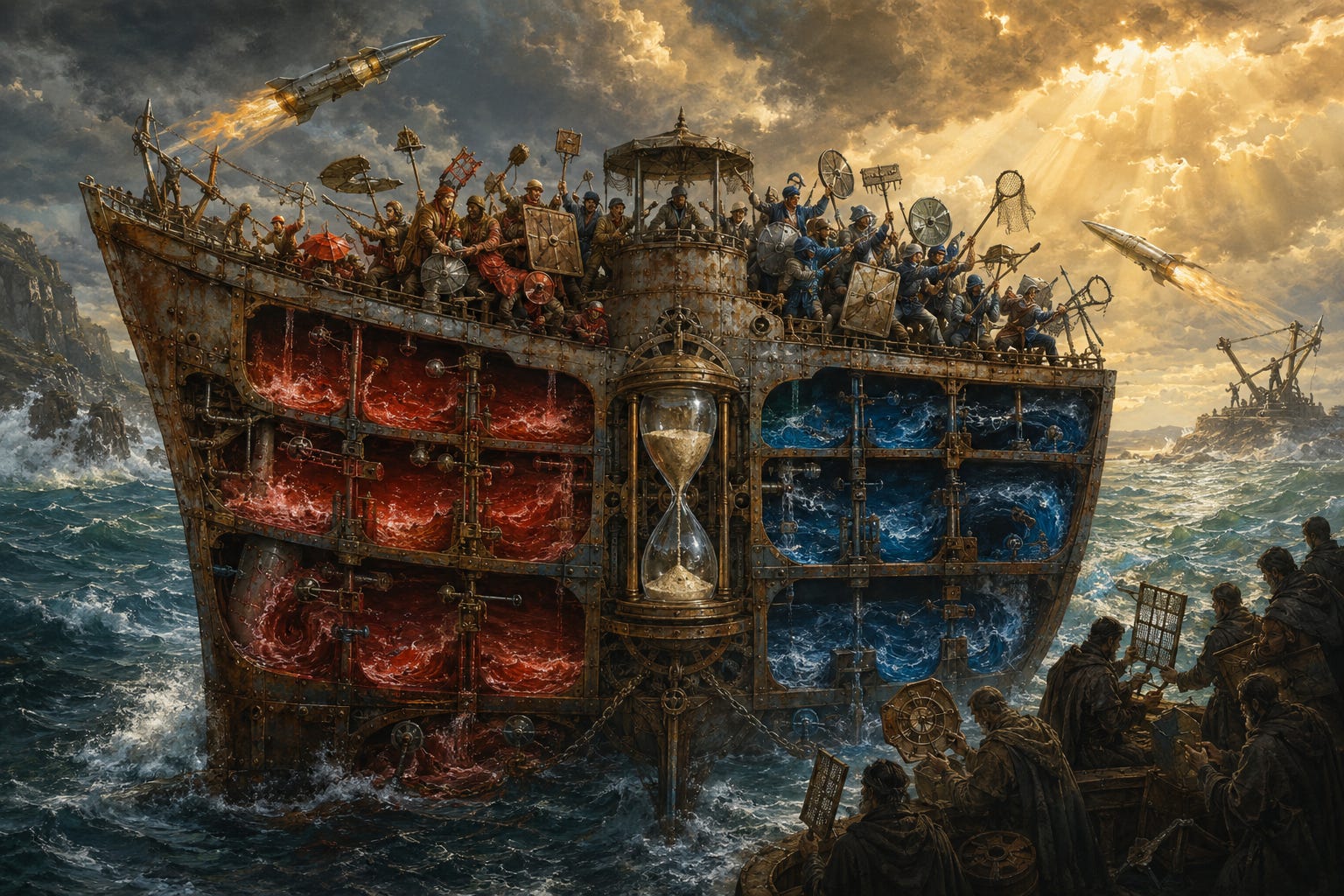
In Lee Child's eleventh Reacher novel, Bad Luck and Trouble, a defense contractor called New Age builds a surface-to-air missile system codenamed Little Wing, engineered to defeat every anti-missile system in existence. Someone asks how long that supremacy lasts. Two years, comes the answer. Not because the engineering is bad. Because two years is roughly how long it takes anyone else to look at what you built and figure out how to turn it back on you.
That's not a rule about missiles. That's a rule about everything.
I was listening to Bill Maher's Overtime, Maher going back and forth with Dana Bash and Jeremy Peters about the Electoral College. Everyone in that conversation is holding some advantage they've mistaken for permanent. It isn't. None of them ever are.
The baffles hold the fifty states apart, and that's the whole point
Fifty states voting means fifty baffles. Drop the baffles and the sloshing begins—one big tank instead of fifty separated compartments, and whichever mass of liquid is heaviest at the moment throws the whole vessel around. That's the Electoral College. It's not a bonus for small states. It's the thing keeping the country from slamming from one side to the other every time turnout shifts by a few points.
The case for the Electoral College is usually framed as protection for the small states: Wyoming and Montana get relevance they wouldn't have in a straight national count, and without that, a handful of dense population centers could steamroll everyone else on every question, every time. That's real, and it's not a new argument. It's Madison's argument.
But the same shield runs in the other direction. The Electoral College is also what stops a "silent majority," a rural or populist coalition large enough to swamp any national popular vote, from doing exactly the same thing to blue states and cities. Take the mechanism away entirely, run the country on raw popular vote, and you haven't guaranteed the coastal, urban vision a permanent majority. You've just unlocked the same weapon for whoever manages to out-mobilize the other side next, with no federalist floor left underneath anyone.
This is the part of the argument that keeps getting skipped: 2024 already answered the question. Donald Trump won the national popular vote, not just the Electoral College. The people arguing that killing the Electoral College guarantees a permanent progressive future are making a bet that already lost once, within the last two years, using the exact voting behavior they're trying to permanently disable a check on.
Treat America honestly and it looks less like one country than a European Union with fifty member states instead of Germany, France, and Italy—Wyoming standing in for Malta, California standing in for Germany, a union that's been slowly accreting new members since the thirteen colonies first signed on. Nobody in the EU assumes Germany's economic weight settles every argument permanently. Nobody should assume California's population does either.
Sovereignty is a tool people pick up when it's useful and put down when it isn't
Watch how selectively the sovereignty argument gets deployed. Sanctuary cities and sanctuary states insist on their right to set their own immigration enforcement posture, independent of federal policy, and that's a states'-rights argument if you've ever heard one. The same coalition making that argument, in the same year, generally wants the opposite everywhere else: one national standard on abortion, one national standard on gun policy, one national floor on labor law. Federalism when it protects you, nationalism when it doesn't.
Republicans have the mirror problem. States' rights has been the load-bearing conservative argument for the better part of a century, and it's the same party currently comfortable with an expanded federal executive, ICE operating with wider latitude, National Guard deployments into cities that didn't ask for them. Neither side actually holds a fixed constitutional philosophy here. Both sides hold a convenience philosophy, and they reach for whichever version of federalism is closest to hand in the moment, the same way Jackie Chan grabs a ladder, a bar stool, a noodle cart, whatever's within arm's reach in the scene. Jackie Chan doesn't win fights because he owns a weapon. He wins because he never gets attached to one.
The coalition itself is rented, not owned
Nobody actually owns the populist bloc that elected Trump twice. That energy is grievance-driven, not doctrinal: it swung from "no more Obama-Clinton" to "no more Biden-Harris-woke," and there's no guarantee it stops there. The same bloc that voted isolationist in the campaign and found itself watching an American aircraft carrier group involved near Iran might just as easily swing toward a populist candidate on the left the next time the establishment feels equally distant, whoever that candidate turns out to be. A coalition built entirely on being against something doesn't have brand loyalty. It has a target, and the target rotates.
Rhetorical weapons decay exactly like physical ones
"Everything is fascism" worked as an alarm the first several dozen times it got said with real conviction. It stopped working roughly the same way any siren stops working once it's on constantly: not because the underlying claim became less true in every instance, but because repetition trained the audience to stop hearing it as an alarm at all.
Black fatigue is the sharpest version of this. Mary-Frances Winters coined the term in 2020 to describe the accumulated toll of navigating a society built around constant, exhausting code-switching and the low hum of systemic racism. That's the original coinage. It's now more commonly encountered online meaning almost the opposite: white fatigue with hearing about race at all. The term got released into public discourse and immediately captured by the group it wasn't written to describe, run in reverse. Nobody controls a phrase once it's out. Little Wing doesn't stay yours either.
Look at the horizon, not the ditch
Every motorcycle instructor tells you the same thing: you go where you look. Stare at the pothole and you steer straight into it. Rowing coaches say the same thing about keeping your head in the boat, because the moment you turn to look around, you tilt the shell and throw off everyone else's stroke. Sailors getting seasick are told to find the horizon, not go below deck and stare at the floor. Climbers are told never to look down. The eyes lead the body, every time, in every discipline that depends on balance.
Democrats have spent the current cycle with their eyes fixed on a set of cultural fights treated as existential and non-negotiable, and polling on the actual electorate doesn't back up the stakes being assigned to them. Pull the aggregate public back far enough and immigration enforcement, crime, and cost of living dominate what people say they care about, while a long list of specific cultural positions, academic language around gender, abolitionist framing on policing, maximalist rhetoric on trans-specific policy fights, poll as niche concerns carried by a small, intensely committed slice of the coalition. Hyperfocusing on the pothole steers the whole party into it.
This isn't new, and it isn't one-sided. Guns, God, and abortion ran the Republican Party's non-negotiable list for fifty years, from 1970 forward. Two of the three effectively resolved in the party's favor: gun rights are stronger and more culturally entrenched now than at any point in that fifty-year stretch, and Dobbs handed the pro-life movement the outcome it spent five decades organizing around. The one item still sitting as unresolved, God, isn't even load-bearing for the party's current populist wing the way it was for the Moral Majority generation. The GOP spent half a century staring at three potholes and eventually drove straight over two of them. Whatever the party stares at next determines where it goes next, exactly the same as it always has.
Every cable panel and every strategist on the current media circuit keeps handing Democrats messaging advice, as if the problem is the wrapping paper. It isn't. A party carrying an entire portfolio of non-negotiable positions, each one held by a true-believer faction unwilling to let it go, doesn't have a communications problem. It has a hoarding problem. What that party needs isn't another consultant with a better slogan. It needs a Marie Kondo, someone willing to hold up each item in the pile and ask whether it still earns its place, and to throw out the ones that don't, regardless of how attached the true believer standing next to it happens to be.
There's an irony sitting underneath the hoarding, too. Solomon's whole test was offering to split the baby to find out which woman actually loved it. A hoarder never gets to that test, because every single item in the pile gets treated as somebody's baby, non-negotiable by definition, nothing ever offered up to be weighed against anything else. That's a strange place for a nominally pro-choice coalition to end up: unable to sacrifice a single position, on anything, ever, as though every plank in the platform were a child nobody's willing to see divided.
There's a name for what's driving the hoarding, and it isn't flattering: ideological rigidity, sometimes called purism, where a coalition prioritizes moral or policy purity over the broad appeal it would need to actually win. Political scientists point to a specific mechanic behind it: politicians fear losing their own primary to someone further to their flank more than they fear losing the general election to the other party. That reorders the whole incentive structure. Staying pure enough to survive the primary becomes the actual job, and winning over the persuadable middle becomes a secondary concern, sometimes not a concern at all.
Hollywood ran the same experiment first and got the same result. Marvel, DC, the recent Star Trek and Star Wars entries, all took audience pushback as a marketing problem: message it better, cut a different trailer, put out an op-ed about why the criticism is bad-faith. Nobody at any of those studios seriously entertained the idea that the actual product wasn't something the audience wanted to buy. There's an old sales axiom for why this keeps failing: it's a hundred times easier to sell someone something they already want than to convince them to want something they don't, which is why the salesman who moves bespoke, desirable products drives a nicer car than the one grinding out commodity widgets. Selling what nobody's asking for isn't a messaging job. It's a full counterinsurgency, treating every voter like a mountain villager who needs years of hearts-and-minds work before he'll trust you, when the entire operation could have been skipped by building something people wanted to begin with.
Blue-topia is 1984's slogan wearing a blue rosette
Some of what I heard on Maher's show sounded less like a policy argument than an article of faith: kill the Electoral College, and what follows is a kind of permanent progressive peace, since history only ever bends one direction. That's the same structure as Orwell's "War Is Peace." The thing being proposed as the guarantee of permanent consensus is precisely the thing that currently forces candidates to build broad, cross-regional coalitions instead of running up the score with an already-committed base. Remove the guardrail and you don't get less division. You get a system where fifty point one percent governs the other forty nine point nine with no structural incentive left to ever persuade them again. That isn't a blue utopia. That's a permanent-war machine.
Nobody gets to keep the weapon
Little Wing's two-year clock isn't really about missiles. It's about the fact that any advantage—electoral, rhetorical, coalitional, tactical—exists on loan from the moment your opponent starts studying it. The false sense of security isn't believing you have an edge. It's forgetting that the other side is watching the same clock, and that the two years, or the two elections, or the two viral cycles, run out exactly as fast for you as they ever did for them.
No posts
Comments
Nothing yet. Say the first thing.
Sign in to join the conversation.