
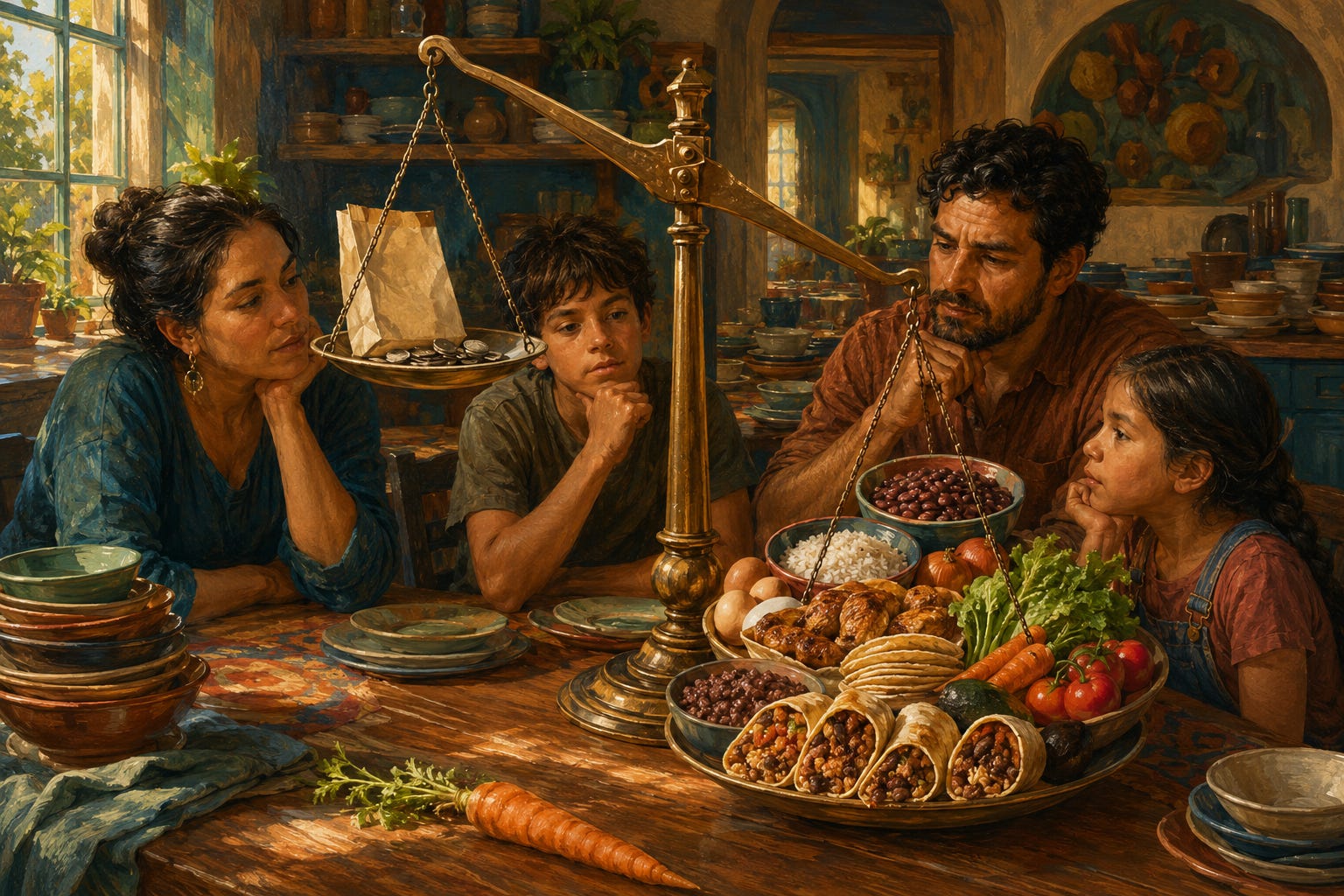
A guy on TikTok says you can't feed a family of four on $300 a month unless you're willing to eat nothing but grains and beans. I want to do the math before I do the arguing, because the math changes what the argument actually is.
A burrito costs $2. And not the ascetic version, either—beans, rice, avocado, tomatoes, onions, lettuce, the whole thing, no meat, no fish, no chicken thrown in, protein coming entirely from the beans and rice pairing. That's a real, satisfying meal, not a grim ration, and it's already carrying the extra naughty fee of an avocado tax, the guac upcharge every Chipotle regular knows by heart. It also happens to be the better choice for the planet, since skipping the meat is the single biggest lever anyone has for cutting their own food footprint. Add real protein back in, ground beef or chicken, and the price climbs to roughly $3 to $3.25 a burrito once you account for raw cost and cooked yield. I'll run both numbers.
At $2 a burrito: four people, one each, one meal: $8. Three meals a day: $24. Thirty-one days: $744.
At $3.25 a burrito, with meat added: four people, one each, one meal: $13. Three meals a day: $39. Thirty-one days: $1,209.
Flip the math around and cook for one instead of four, and the same logic runs in the opposite direction. Budget $20 a day for one person, shopping and cooking at home instead of eating out, and that's $600 a month. At that budget, a single person can eat an actual steak-and-shrimp dinner, real cuts, not a garnish spoonful, every single night and still have room for breakfast and lunch. Surf and turf, home-cooked, daily, for a month, on less than what the USDA says a family of four needs just to survive on beans and rice.
Even the working professional who thinks they're eating responsibly is inside the same trap, just at a higher price point. I worked on K Street in the mid-2000s, and the daily cap for a sandwich-chips-drink lunch at the office was around $6 to $8. Run that through twenty years of inflation and it lands at roughly $10 to $13 in today's money, which is almost exactly what a bowl costs now. Chipotle, Sweetgreen, Cava, Chopt: the whole genre has a real name now, "slop bowl," social media slang that made it into the New York Times as shorthand for the assembly-line pile of rice, protein, and sauce that gets called a salad or a burrito bowl once it's fifteen dollars and comes in a compostable container. A Harvard food sociologist put the actual math on it plainly: once a bowl runs $60 to $70 for a family of four, you're past the point where the "healthy, responsible" choice and the "just cook rice and broccoli at home" choice have anything to do with each other. That's the K Street junior-executive baseline, the same self-image of eating well that a family on food stamps gets accused of not affording, except the executive's version costs three or four times what the family's actually would, and nobody calls it a crisis. They call it lunch.
Now put a family of four on the other end of the spectrum: never cooking, never buying groceries, living entirely on restaurants, delivery, and the prepared-food aisle. McDonald's, four Big Macs: about $24 a meal. Golden Corral dinner buffet, the same family: $50 to $70 a night. Applebee's $9.99 combo deal, four of them: $40. A large delivery pizza or two, easily $30 to $40 with tip. And that's before DoorDash: menu prices alone run 10 to 20 percent above in-store, and once the delivery fee, service fee, and tip stack on top, the all-in cost of a DoorDash order runs 50 to 75 percent higher than the identical meal picked up yourself. A $40 in-restaurant dinner becomes a $65 to $70 delivery order without a single ingredient changing. Even the low end of that lifestyle, one fast-food run and one delivery order a day, blows past a thousand dollars a month before the family has eaten a single vegetable that wasn't a garnish.
That's the actual Delta: $744 to make burritos for a month, or somewhere north of $1,500 to $2,000 to never once touch a stove. Nobody in America is comparing $300 to the burrito math. They're comparing $300 to the DoorDash math and calling the difference a moral failing of the country instead of the math it actually is. Dignity, in the version everyone's actually arguing for, has to be pumpkin spiced. It has to arrive in a bag with a receipt stapled to it. A home-cooked burrito, no matter how good, doesn't count, because somewhere along the way, convenience got rebranded as the floor instead of the extra.
Run it the other way and the government agrees with me. The USDA's own Thrifty Food Plan, the lowest of its four official tiers, the one that assumes every meal is cooked from scratch with zero takeout and zero convenience food, puts a real family of four at close to $1,000 a month. Three completely unrelated ways of pricing a month of food, one built out of $2 vegetarian burritos, one built out of $3.25 burritos with real meat in them, and one built out of federal nutrition data, all land in the same neighborhood: $700 to $1,200. None of them lands anywhere near $300.
So the guy in the video is right. $300 a month, three meals a day, four people, doesn't work. The arithmetic doesn't close, and no amount of budgeting skill gets $744 down to $300.
Here's where it gets interesting: once you settle the actual number, watch what the argument does next. Nobody doubles down on $300. Nobody says the real number is $500 or $600, splitting some honest difference. The objection moves. Suddenly it's not about survival anymore, it's about what survival should include. What about snacks. What about treats. What about the birthday cake. One TikTok comment I saw argued every family, no matter what, deserves a fresh Cobb salad. Not canned tuna, not a can of beans dressed up with an onion. A cold-prepped, restaurant-tier Cobb salad, every day, as the baseline.
Nobody in this argument thinks the family goes hungry on rice, beans, and eggs. They think it isn't fun enough. That's not a poverty argument. That's a deliciousness argument, wearing a poverty argument's coat because the poverty argument gets more sympathy.
Go back eighty years and the actual floor for what an American family ate looks nothing like $744 worth of ground beef with nothing added. WWII rationing put meat behind a ceiling so low that meatloaf, oatmeal and breadcrumbs stretching a small ration of ground beef into a family-sized meal, became the defining dish of the era, taught in government pamphlets and home-economics classes as a patriotic act. Sliced bread itself got rationed in January 1943. Some Americans ate horse meat because beef ran out. That's the actual historical floor. Nobody today, at any income level, needs to cut their burger with oatmeal to make it to Friday. The $744-a-month floor isn't the bottom. It's already a staggering upgrade from the bottom, and it's the bottom we're currently calling a crisis.
The number was never the disagreement. Everybody, eventually, agrees the number is somewhere around $700 to $1,000, not $300. The real disagreement, the one nobody wants to say out loud, is whether that $700 has to come with a Cobb salad attached to count as a solved problem. And that fight, the fight over garnish instead of survival, is the kind of fight only a country that has already solved hunger gets to have.
No posts
Comments
Nothing yet. Say the first thing.
Sign in to join the conversation.