
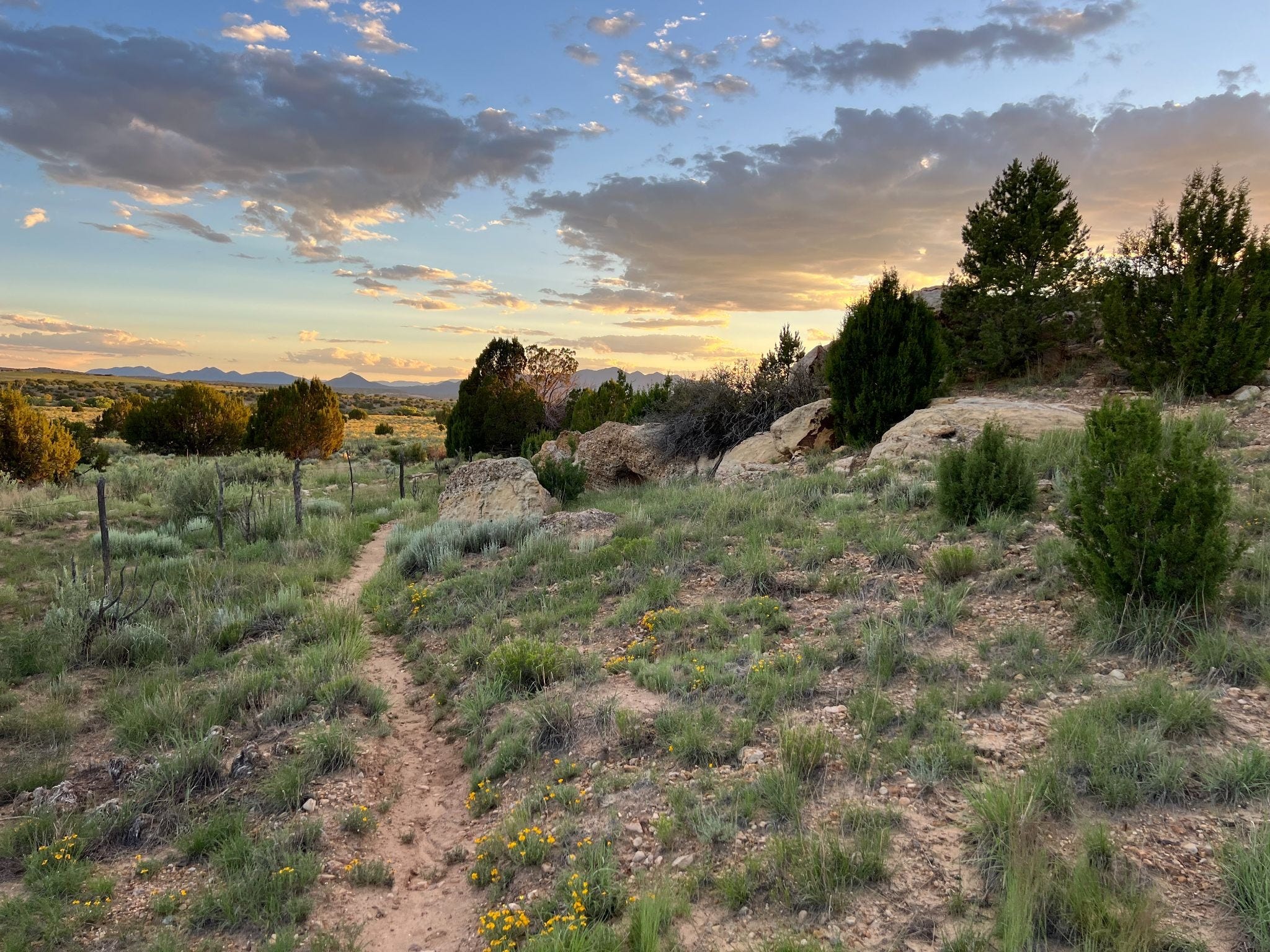
Rising Circle Ranch is 2,566 acres of high desert grassland dotted with junipers and cholla cactus. Relative to the rest of the desert, it is a lush place, though relative to most other places, not so much. A rare swath of riparian zone threads the ranch, with huge old cottonwoods and an arroyo that sometimes becomes a river. It’s a part of the Galisteo Basin, and so the ranch used to be at the bottom of an inland sea, and the vastness of the place still feels oceanic. You can feel deep time there.
Out on the ranch, I start to notice the ho-hum everyday mysticism of the interconnection of all things. Not in a disembodied, heady kind of way, but in a bread and breath kind of way. Everything has evolved to give life to everything else, and nothing is unnecessary. Packrats and pronghorns, coyotes and corn. Peaches and dirt. That kind of mysticism.
When we’re in the classroom, we often say that the land is one of the greatest teachers during our weeks together at MEA. This is true. The land holds an abundance of metaphors that are uncannily apropos to who we are as parents, partners, and leaders. The land speaks to transitions, to regeneration, to transformations.
But the land is also itself. Not a metaphor for our human concerns, but a vast and powerful presence that is much larger and more ancient than any of us. The awe I feel when walking on the land quickly begins to feel, well, sacred. It is easy, when wandering on the ranch, to slip into a state of beholding.
The practice of beholding in the western contemplative tradition is to see the sacred in the specificity of beauty and nature. Beholding is a mindfulness practice, and can also be thought of as a form of wordless prayer. It involves focusing on the natural world with an attentive gaze, a gaze not just with the eyes, but with one’s whole being. “Once we decide to behold,” says Franciscan Friar Richard Rohr (and MEA guest faculty member), “we are available for awe and wonder, to be present to what is, without the filter of our preferences or the false ledger of judging things as important or not important. A much broader, much deeper, and much wider field of perception opens up, becoming an alternative way of knowing and enjoying. The soul sees soul everywhere else too,” he writes, “‘deep calls unto deep,’ as the psalmist says (42:8). Center knows center, and this is called ‘love.’”
The land is also for belonging. Out on the land, you quickly see the place functioning as a living system. The famous quote by John Muir, “When we try to pick out anything by itself, we find it hitched to everything else in the Universe,” lands not as a metaphor, but as a statement of fact. Everything out there depends on everything else.
We humans used to be hitched to place like that.
Until just a moment ago in our evolution, humans would have been profoundly connected to the place they are from. We had our attachment to our place, our family, our group. Our survival was dependent on those deep, interwoven attachments. Extensive knowledge of place was essential for finding food and surviving weather.
When you start to think about it that way, the word “I” starts to feel less like a lone, autonomous body with all its inner workings, and more like a series of ever-expanding nested spheres of relationship. In my mind I see a diagram in which identity, intimate relationships, family, home, community, and place hold us in ever-wider circles of belonging. Our circles overlap and merge with the concentric circles of everyone and everything else. We are stitched tightest to those closest to us, but ultimately stitched to everything. This is how the web of the world is woven, I think.
I’m coming to believe that our modern loneliness epidemic has something to do with our modern freedom to untether ourselves from that ancient web of life– those deep and necessary bonds to place and all the experience of belonging that radiates out from there.
That feels like a pretty big thing to say. I’m not proposing a solution, but it’s profound to get a glimpse of what it might feel like to be held by a natural system. I’ve started to consider that it might be an ancient and natural experience to feel held by the place we live. What used to be a birthright is now such an extraordinary privilege. I’m not sure why I find this so much easier to glimpse when I’m out on the ranch. Perhaps it is the space and starkness, the relative simplicity of the landscape. Its subtle friendliness. Or it could be that I move slower when I’m on the ranch and can finally see what was always there, the simple elegance of place. Place not as something to be consumed, but something to develop a relationship with.
Relationship with the conversational-height piñons and junipers along the soft dirt paths. Relationship with the monsoon thunderclouds gathering in the afternoons, the sudden rain and lightning, and then rainbows and extraordinary sunsets. Relationship with the cottonwoods and arroyos and the migrations of robins and hummingbirds and buzzards. Relationship with the jackrabbits and coyotes and the Summer Triangle spinning slowly across the sky above the summer grasses. And everything else.
How extraordinary to feel the ho-hum everyday interconnection of all things and let them hold you.
Amie Tullius is a Santa Fe–based writer and Experience Facilitator at MEA. She is completing a memoir about spending a thousand days in the Santa Fe National Forest—a spiritual inquiry into home, belonging, and the soul of place. Through writing and facilitation, she creates space for connection, play, and deep attention. Her work returns again and again to relationship—with place, with one another, and with the living world. If you would like to experience the land and practice beholding, consider joining Amie at MEA Santa Fe’s ranch for her 3-Day Landscapes of Silence retreat September 17-20.
No posts
Comments
Nothing yet. Say the first thing.
Sign in to join the conversation.