
I am now settled in Palo Alto, my new home base, as I begin my JD at Stanford Law School and a PhD in History tomorrow. It may take a while for me to find a rhythm again but I hope to continue the Daily and Weekly newsletters as before. I have enlisted the help of an RA, Christine, which may make the continuation of the newsletter in its current form more sustainable. Thank you to those I met on my tour of the U.S. east coast for your insights, and for all your suggestions on how I could improve and maintain this newsletter. Thank you.
Highlights
Taiwan charges 9 for smuggling chips. Taiwan charged nine people for allegedly smuggling banned Nvidia chips to mainland China. The indicted people are former employees of Nvidia and Super Micro and are alleged to have shipped or attempted to ship 130 Nvidia B300 servers to China via Japan and Indonesia. This comes as the US put pressure on partners to close chip export control loopholes. When will they close the ‘rent chips overseas’ loophole?
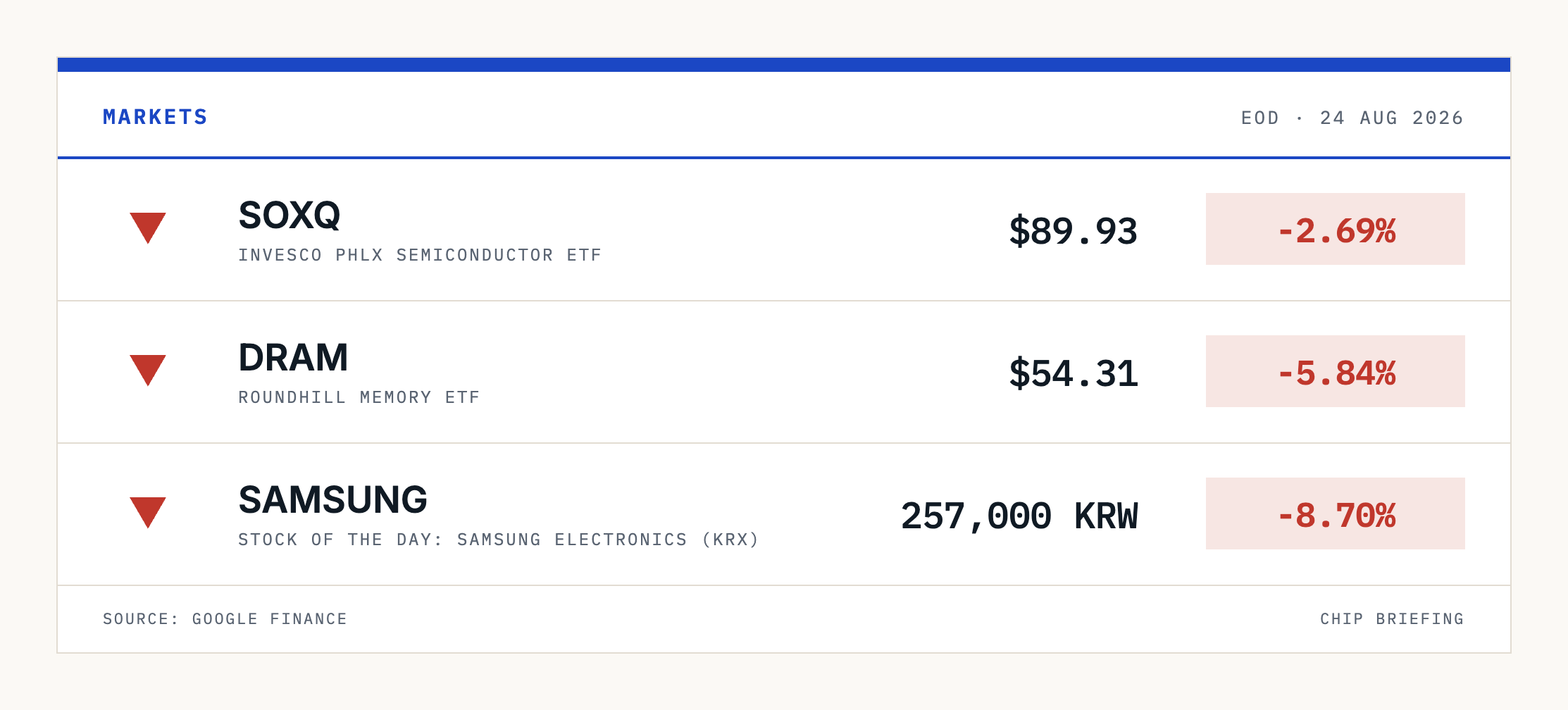
Samsung down. Samsung Electronics was down over 8% during trading after investors were disappointed that the ~US$80 billion returned to shareholders was not enough.
Xiaomi’s in-house phone chip. Xiaomi, a Chinese tech giant, unveiled their own chip to put in their smartphones. The so-called Xring O3 SOC is made on TSMC’s 3nm process, not quite as advanced as Apple’s chips but slightly ahead of Huawei’s. Xiaomi used to use Qualcomm chips.
Thanks for reading.
1.1
WSJ (08/24): Taiwan Charges Nine in Connection With Smuggling of AI Servers to China
Taiwan prosecutors charged nine people, including former employees of Nvidia and Super Micro Computer, with aiding the shipment of advanced artificial-intelligence servers to China, as Taiwan tries to limit technology reaching the mainland.
The indictment charges eight of the individuals with crimes including breach of trust and forgery. One individual was charged in connection with allegedly siphoning funds from a company involved in the case.
Two of those charged made false claims to secure approval for the purchase of 130 AI servers from Super Micro equipped with high-end Nvidia chips, including by saying the hardware would remain at a facility in Taiwan, prosecutors in the port city of Keelung said Monday.
1.2
Bloomberg (08/24): Taiwan Indicts Nvidia Manager Following Chip Smuggling Probe
Taiwanese prosecutors indicted a senior Nvidia Corp. manager as part of a group that allegedly smuggled advanced AI chips into China, according to people familiar with the matter, advancing the island democracy’s first known crackdown on the black-market trade of such accelerators.
Nvidia’s employee, surnamed Chang, is alleged along with eight others to have organized the shipment of 74 servers containing high-end B300 chips into China via Japan and Indonesia, circumventing US trade restrictions. Bloomberg was unable to reach him after he was initially detained last month.
The group attempted to also smuggle another 56 servers, which were seized by Taiwanese authorities, according to the indictment. Beside the Nvidia worker, Taiwan indicted two senior employees of Super Micro Computer Inc., which manufactured the hardware in question, said the people, who asked not to be named in order to identify defendants that the indictment didn’t name in full.
1.3
SCMP (08/24): China’s advanced chip supply to surge by 2035 despite equipment bottlenecks, Goldman says
China is on track to dramatically slash its deficit in advanced chips over the next decade as domestic foundries rapidly scale up production, though the weak link of lithography threatens to keep full semiconductor independence out of reach, according to US investment bank Goldman Sachs.
The supply of wafers made using 7-nanometre and below advanced processes is projected to grow at a compound annual rate of 46 per cent between 2025 and 2035, far outpacing the 17 per cent growth expected in domestic demand, Goldman analysts said in a report on Monday.
That would narrow the gap between domestic supply and demand to 34 per cent by 2035, from 92 per cent in 2025, according to the investment bank. China’s advanced-node wafer supply is expected to reach 410,000 wafers per month by then, compared with demand of 619,000 wafers.
1.4
Korea JoongAng Daily (08/24): Korea plans 820 trillion won ‘super budget’ focused on AI and youth
Korea is preparing what officials are calling an unprecedented “super budget” for 2027, with total spending set to rise more than 12 percent to over 820 trillion won ($592.6 billion) as the government funnels booming semiconductor-driven tax revenue into artificial intelligence, regional development and youth support, according to exclusive reporting by the JoongAng Ilbo.
Related ministries on Sunday said that the government is in the final stages of coordinating the budget. If the plan holds, it would represent an increase of more than 90 trillion won from this year’s 728 trillion won, the largest single-year jump on record.
2.1
Reuters (08/24): Samsung Electronics shares skid as record shareholder returns disappoint
Samsung Electronics fell over 8% in early trade on Monday after the company’s record $79 billion shareholder-return plan disappointed investors who had expected a larger share of Samsung’s AI-fueled cash windfalls and greater clarity on share buybacks.
Samsung and rival SK Hynix last week announced major shareholder return plans, following mounting pressure from investors to return some of the gains from their record-breaking profits as the AI boom drives demand for chips.
2.2
Chosun Ilbo (08/24): Chipflation Drives Silicon Wafer Price Surge Across Sizes
The impact of rising prices due to increased demand for artificial intelligence (AI) semiconductors is now affecting silicon wafers, the most fundamental stage of chip manufacturing. “Chipflation” is influencing silicon wafers, the base material for semiconductors.
According to Taiwan’s Economic Daily on August 24, major Taiwanese silicon wafer companies, including GlobalWafers, Formosa Sumco, and Wafer Works, are currently negotiating price increases with their clients. Due to recent chipflation, the Taiwanese wafer industry is seeing price hike movements for the first time in over three years. Some 12-inch wafer products have already seen double-digit price increases.
Silicon wafers are circular discs made by slicing high-purity silicon ingots thinly and polishing their surfaces. Semiconductor manufacturers draw circuits on these discs to produce memory and system semiconductors. As a foundational material at the starting point of semiconductor manufacturing, changes in order volume and prices are used as leading indicators of semiconductor production and operational rates.
3.1
Bloomberg (08/24): Xiaomi Develops Its Own AI Mobile Chip in Challenge to Qualcomm
Xiaomi Corp. launched a mobile processor for its marquee devices, putting pressure on Qualcomm Inc. and MediaTek Inc., which for years supplied the key component to the Chinese company.
The Xring O3 system-on-a-chip advances Xiaomi’s in-house semiconductor design efforts with more power-efficient image processing and better artificial intelligence capabilities, the Beijing-based company said in a post on Chinese social media platform Weibo on Monday.
Xiaomi’s new silicon is made using a 3-nanometer fabrication process, according to a WeChat post by founder Lei Jun. That’s closer to the node used for Apple Inc.’s most recent A19 Pro chips and well ahead of its biggest home rival Huawei Technologies Co.’s in-house designs. Xiaomi has contracted Taiwan Semiconductor Manufacturing Co. to manufacture the chips, Reuters reported.
–
Cover Photo by Timo Volz on Unsplash
No posts
Comments
Nothing yet. Say the first thing.
Sign in to join the conversation.