
Highlights
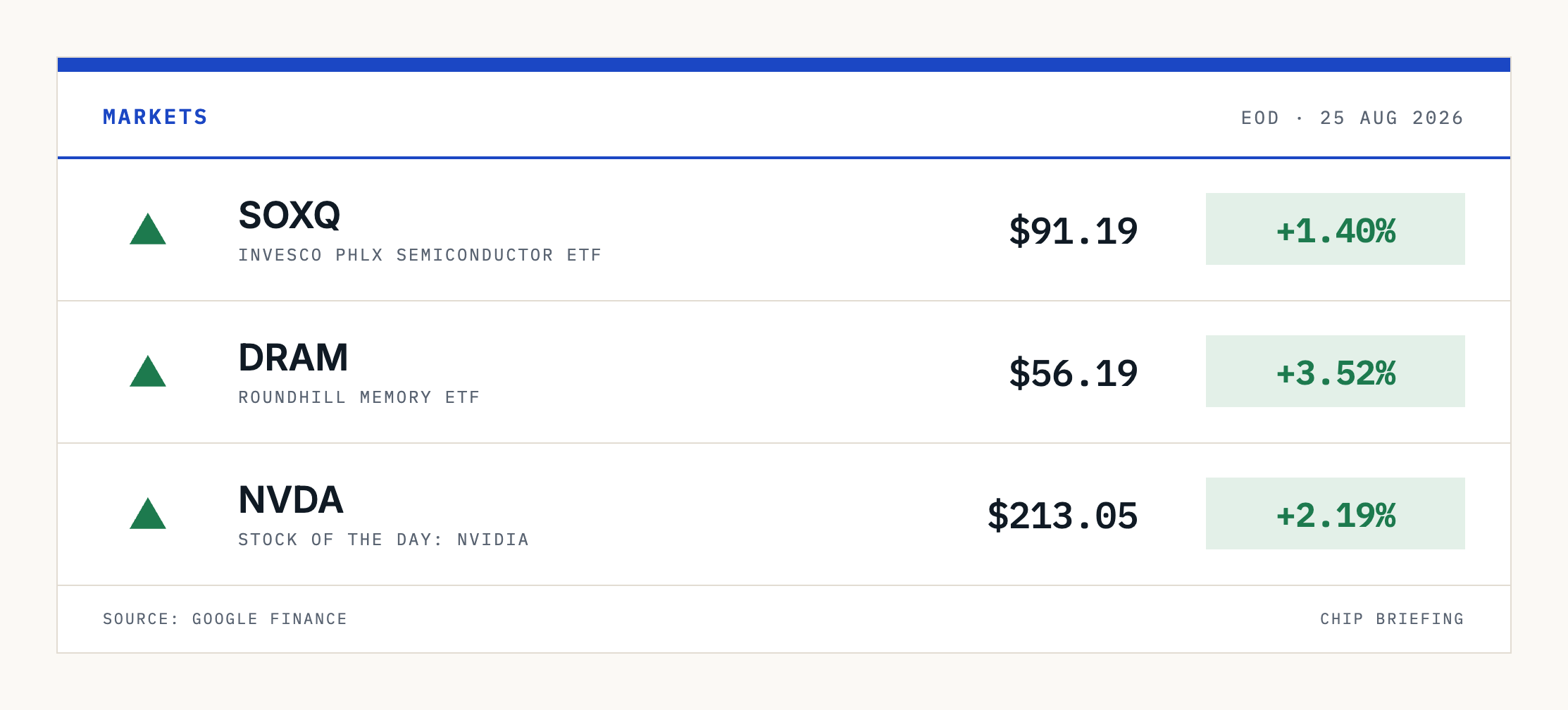
OpenAI’s Jalapeno performs. OpenAI’s in-house chip, which is called Jalapeno, is reportedly better than Nvidia’s Blackwell chips by some metrics. This is a surprising win for OpenAI, which has only just made their first chip with the help of Broadcom and some poached chip talent. Moreover, Nvidia will shortly be out with their next-gen Rubin chips, which promises even greater performance. Nonetheless, the Jalapeno chip is both speedier and more energy-efficient. This marks yet another sign that the inference chip market will become more fragmented. All eyes on Nvidia’s earnings results later this week.
China’s Enflame to IPO. Chinese AI chipmaker Enflame is expected to IPO in Shanghai later this year. Chinese tech companies, but especially chip firms, have found great success on the stock market over the past year. CXMT had a stellar IPO pop most recently, as did robotics maker Unitree. There are many Chinese companies making AI inference chips, much like the US, especially given the absence of American chips being sold to China.
China’s chip self-sufficiency. Of course the primary driver of the chip industry in China is politics. Semiconductor self-sufficiency is a key goal for the Chinese government. An article today shows that China was only about 8% self-sufficient for the advanced nodes (7nm or less) in 2025. Estimates suggest that China will be 66% self-sufficient by 2035. That’s 10 years away, which is a long time, and doesn’t strike me as particularly rapid progress? I would think that China would become more self-sufficient and earlier.
Thanks for reading.
1.1
Chosun Ilbo (08/25): SMIC-Led Expansion to Boost China’s Advanced Chip Self-Supply to 66%
As demand for artificial intelligence (AI) semiconductors rises, China is rapidly expanding its advanced process production capabilities, leading to a significant increase in the domestic supply share of 7-nanometer (nm) and below wafers over the next decade. The self-supply ratio, which stood at approximately 8% of demand in 2025, is projected to reach around 66% by 2035.
On August 25, according to Chinese economic media Caixin and Hong Kong’s South China Morning Post, SCMP, Goldman Sachs recently reported in a study that the supply shortage rate for advanced 7nm and below wafers in China is expected to decline from 92% in 2025 to 34% in 2035. By 2035, domestic supply is anticipated to increase to 410,000 wafers per month out of a total monthly demand of 619,000 wafers.
The growth rate of supply is projected to far outpace demand. Goldman Sachs estimated that the supply of 7nm and below wafers in China will grow at an annual average rate of 46% from 2025 to 2035. During the same period, the demand growth rate is expected to be 17%. Demand for AI server wafers is projected to increase by an annual average of 42%.
2.1
Chosun Ilbo (08/25): Memory Semiconductor Sales to Quadruple This Year, Gartner Says
Amid soaring demand for semiconductors driven by expanded investments in artificial intelligence (AI) data centers, forecasts suggest this year’s memory semiconductor sales will reach four times their level from a year ago.
Market research firm Gartner announced on the 25th that global semiconductor sales are projected to grow 92% to 1.5552 trillion dollars (approximately 2,150 trillion Korean won) this year, up from 809 billion dollars last year. It further anticipates growth to 1.9399 trillion dollars in 2027.
2.2
Bloomberg (08/25): SK Hynix Union Rejects Preliminary Wage Hike Deal, Report Says
SK Hynix Inc.’s union rejected an agreement that would have raised salaries and paid out a portion of bonuses in company shares, Yonhap News reported.
Union members voted down a tentative collective bargaining agreement between union leaders and management, with 50.08% voting against the deal, the local outlet said, citing industry sources. The union, which has rejected such preliminary agreements in past years, is expected to resume negotiations with management, Yonhap said.
The spurned agreement had featured a 6.3% salary raise, as well as employee performance bonuses that would have paid out 40% in cash and 60% in company stock. SK Hynix shares, which have shed roughly 45% from their peak in June, fell as much as 6.8% during Tuesday morning trade in Seoul.
3.1
Bloomberg (08/26): OpenAI Claims Its New Chips Can Outperform Nvidia Processors in Tests
OpenAI said that its new Jalapeno chips performed better than Nvidia Corp.’s current lineup during testing, underscoring the company’s progress developing AI processors in-house.
In the tests, the Jalapeno processor led in two categories: the amount of AI work it could handle per unit of power and its speed at returning responses. The semiconductor was measured against Nvidia’s GB300, which was the leading option on the public benchmarking system used in the test, OpenAI chip chief Richard Ho said in an interview Monday.
The maker of ChatGPT plans to start using the new chips to support its artificial intelligence models later this year, part of a broader push to build its own AI infrastructure. It joins a stampede of companies working to develop homegrown AI chips — a field currently dominated by Nvidia.
3.2
Reuters (08/25): AI chipmaker Enflame sets subscription date for near $900 million Shanghai IPO
Enflame Technology, one of China’s leading AI chipmakers, will open share subscriptions on September 2 for its 6 billion yuan ($892.21 million) IPO on Shanghai’s tech-heavy STAR Market, a regulatory filing showed late on Monday.
The chipmaker, backed by technology company Tencent Holdings will issue 43.04 million new shares, representing a 10% stake in its enlarged share capital of approximately 430 million shares, with preliminary price consultations set to begin on August 28, the filing showed.
3.3
Korea Economic Daily (08/25): Samsung mass-produces Nvidia’s inference chip Groq 3 LPU, boding well for foundry turnaround
Nvidia Corp. has begun mass production of its Groq 3 LPX inference accelerator, a specialized artificial intelligence system designed to speed up AI agent workloads. The move marks a significant milestone for Samsung Electronics Co.’s foundry business as the foundry unit seeks a return to profitability this year.
3.4
WSJ (08/25): One of Taiwan’s Biggest AI Winners Isn’t a Chip Maker
The artificial intelligence boom has put the spotlight on tech companies, but one of Taiwan’s biggest AI winners has nothing to do with chips—it’s a furniture-component maker whose founder is now Taiwan’s richest person.
King Slide Works makes components like cabinet hinges and drawer slides. It also makes the rails used in AI server racks. That may sound mundane, but the rails support extremely heavy servers while keeping them cool. Any malfunction could cost millions.
3.5
Bloomberg (08/25): Indian AI Data Center Firm Orders 9,000 Nvidia Vera Rubins
AM Intelligence, an Indian AI infrastructure company, has ordered 9,000 Nvidia Corp. Vera Rubin systems, seeking to become one of the first adopters of the advanced computing platform in Asia.
Servers equipped with the rack-scale systems are slated to come online next year in southern India, the Hyderabad-based company said in a statement Tuesday. Customers include major cloud-service providers, AI labs and organizations aiming to develop homegrown Indian AI models, it said.
3.6
Chosun Ilbo (08/26): Samsung and LG Push FC-BGA Production to Meet AI Substrate Shortage
Recently, hybrid packaging—such as NVIDIA’s latest AI accelerator “B200,” which densely mounts GPUs and high-bandwidth memory (HBM) on a single board—has become mainstream.
Consequently, the shortage of high-performance substrates capable of stably supporting massive chipsets has intensified, leading to a surge in substrate prices.
In response, domestic component companies like Samsung Electro-Mechanics and LG Innotek, which previously focused on mobile parts, are shifting toward substrates for servers and AI applications.
–
Cover Photo by Mariia Berezovsky on Unsplash
No posts
Comments
Nothing yet. Say the first thing.
Sign in to join the conversation.