
On the morning of August 19, 1948, Shanghai woke up to queues.
They formed before dawn outside the banks, outside the gold shops, outside anywhere that might be exchanging the old currency for the new. People carried bags of fabi, the paper money that had been the Nationalist government’s currency for more than a decade. The government had just announced that fabi was being abolished. There was a new currency: the gold yuan. And for a brief window of time, perhaps a few days, perhaps a week, you could exchange your old notes for new ones at the rate of three million fabi to one gold yuan.
Three million to one. Let that number sit. That was how far the fabi had fallen.
The queues were orderly at first. People were hopeful. The government had promised that this time would be different. The new currency was backed by gold and silver reserves, and it was to be stable. The inflation that had been destroying their savings for years was finally going to stop. Chiang Kai-shek’s own son, Chiang Ching-kuo, had been sent to Shanghai personally to enforce the new regulations. If the Generalissimo’s son was in charge, surely this was serious.
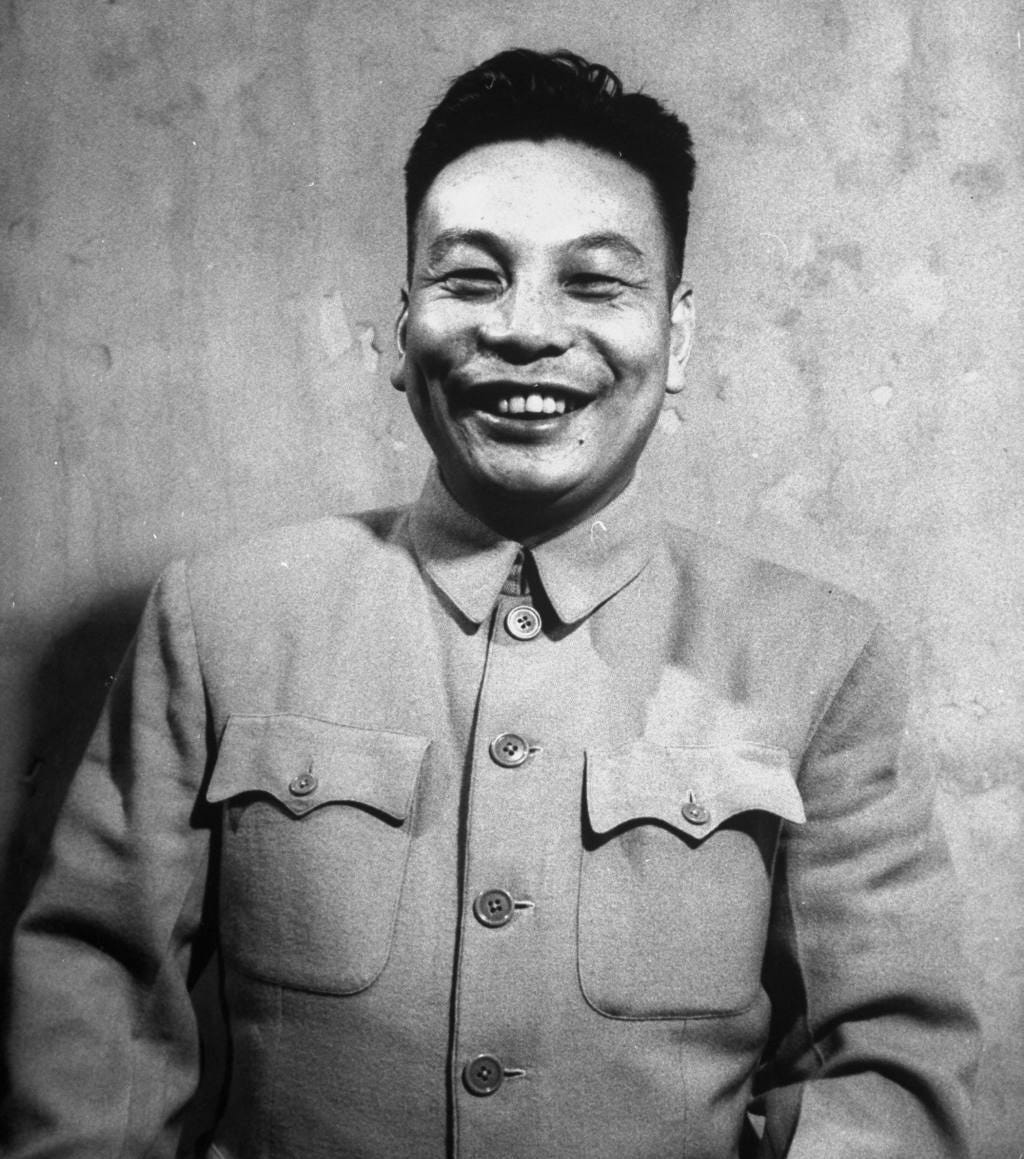
Within ten weeks, the gold yuan had lost nearly all its value. The last currency reform of the Nationalist government had failed. And with it, the last serious chance of maintaining the urban support that Chiang needed to survive.
I’ve written about the KMT’s economic collapse before. But it’s worth a reminder, because the Gold Yuan Reform makes no sense without it.
The fabi, the Chinese word means roughly ‘legal currency’, had been introduced by T.V. Soong in 1935 as a modernising reform. It replaced the patchwork of silver coins and regional currencies associated with the decentralized Warlord Era economy. It was, at its introduction, a genuine improvement. It was backed by foreign exchange reserves held in London and New York and it gave China a unified national currency.
Then the war with Japan started in 1937, and the fiscal discipline became impossible. The Japanese occupied the coastal provinces that generated most of the government’s customs revenue. The KMT retreated inland to Chongqing, losing its tax base and its access to the foreign reserves that backed the fabi. To pay for the war, the government did what governments throughout history have done when they run out of money and run out of credit. It issued more.
By 1945, prices in Nationalist China had risen somewhere between one thousand and two thousand times their pre-war level. The urban middle class: professors, civil servants, teachers, professionals, had seen their real incomes collapse to a fraction of what they had been. The Lianda professors who had walked their library books to Kunming on foot were now selling their furniture to eat.
But the war ended in August 1945. Japan surrendered. Surely now, with the fighting over, there was a chance to stabilise.
There wasn’t. The civil war resumed. The KMT was spending enormous sums on its military campaigns against the Communists. It had lost Manchuria’s revenue base to Soviet stripping and Communist control. It was still incurring debts and issuing money. By 1948, the fabi had depreciated to the point where three million of them were needed to buy one of the new gold yuan coins. A currency that had started as a credible medium of exchange had become an instrument of daily impoverishment.
The Gold Yuan Reform of August 1948 was a currency replacement. You could not fix the fabi. There were too many of them, they were too worthless, and too many people had stopped trusting them. So, the government would simply abolish it and start over.
The new gold yuan was to be backed by gold, silver, and foreign exchange. The government promised to hold the line: no more than two billion gold yuan notes would be issued. The exchange rate against the US dollar was fixed at four to one. There would be strict price controls. Anyone caught hoarding gold, silver, or foreign currency, instead of exchanging it for the new notes as required, would be subject to prosecution.
This last provision was meant to be the teeth of the reform. The government understood that people had been fleeing the fabi for months, maybe years, converting paper money into gold, silver, and foreign currency as fast as they could. Those private gold and silver hoards were, in a sense, a parallel monetary system. They were a store of value that people trusted when they couldn’t trust the government’s paper. If the gold yuan was going to work, the government needed to break that parallel system. It needed to force people to surrender their hard assets in exchange for the new paper and then convince them that the new paper was worth holding.
To enforce all of this in Shanghai: the financial heart of Nationalist China, the city with the largest concentration of gold and silver, the city where private hoarding had been most systematic, Chiang Kai-shek sent his eldest son.
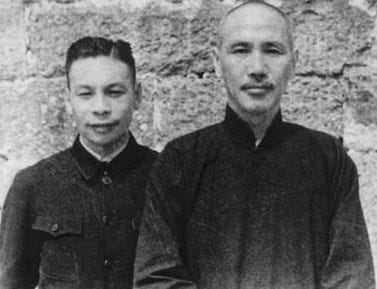
Chiang Ching-kuo is worth introducing properly, because he will be important. Also, because his Shanghai campaign was one of the more dramatic episodes of the civil war’s final year.
He was Chiang Kai-shek’s son by his first wife, not by Soong Mei-ling, who was the famous Madame Chiang. He had been sent to the Soviet Union as a young man, partly as a political hostage during the first period of KMT-Soviet cooperation in the late 1920s. He had spent twelve years there. He had joined the Soviet Communist Party. He had married a Russian woman. He had worked in a factory in the Ural Mountains. He had, by some accounts, publicly denounced his own father during the April 1927 massacre of Communists. That was politically necessary since he lived in the Soviet Union at the time. When Stalin finally allowed him to return to China in 1937, he was a complicated figure. He was a man who had genuinely lived inside the Soviet system, who spoke Russian fluently and who had experienced both the promise and the reality of Communism from the inside.
He had since rebuilt his relationship with his father and had become one of the KMT’s more effective administrators. He would eventually, decades later, as the leader of Taiwan in the 1970s and 1980s, be responsible for lifting martial law and beginning Taiwan’s transition to democracy. That is a story for much later. In August 1948, he was thirty-eight years old and he had been given an almost impossible task.
He arrived in Shanghai with genuine energy and a streak of populism that was unusual in the KMT. He dressed simply. He travelled without a large entourage. He set up a special economic crimes court that could sentence offenders quickly. He announced that no one was above the law. Not the rich. Not the connected. Not the foreign.
And for a few weeks, it seemed like he meant it. His agents seized hoarded goods: gold bars, silver, foreign banknotes from warehouses and safe deposit boxes. They arrested speculators. They shot a handful of black-market dealers, publicly, as a warning. Shanghai’s business community was genuinely frightened. The queues at the banks were long but the mood, initially, was of cautious hope.
Then his agents moved against the Yangtze Development Corporation, a company with large stockpiles of goods that should have been declared under the new regulations. The Yangtze Development Corporation was controlled by David Kung: the son of H.H. Kung and Soong Ai-ling. That made him Chiang Kai-shek’s nephew by marriage. He was part of the Generalissimo’s own family.
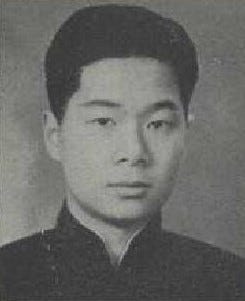
Chiang Ching-kuo arrested him anyway.
Comments
Nothing yet. Say the first thing.
Sign in to join the conversation.