
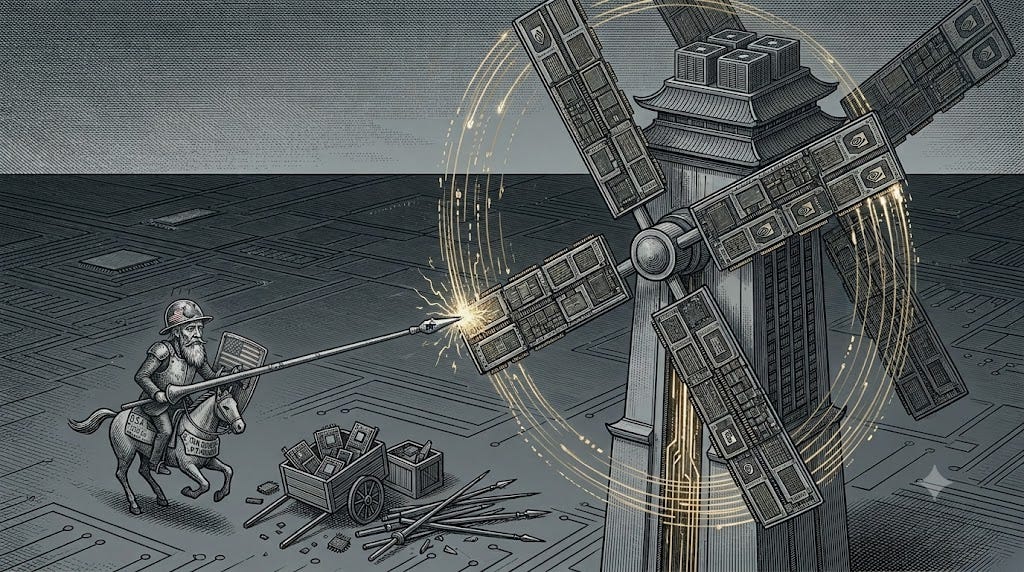
The US just cracked a $2.5 billion case of Nvidia AI chips smuggled into China in violation of export controls. Taiwan, for the first time, invoked its own criminal law to make arrests on its own soil. Washington and its think tanks say the “small yard, high fence” is working: SMIC’s most advanced process costs 40 to 50 percent more than TSMC’s, at a third of the yield; Chinese AI firms are forced onto Huawei’s second-tier chips, forced to rent offshore compute at a premium, forced to smuggle; DeepSeek’s servers throttle under load, Zhipu-Qwen has cut new-user registration to a fifth of capacity. A new Chip Security Act moving through Congress would lock down the chips, choke off the smuggling, tighten the siege, hold China back — until America’s compute, software, and APIs embed first into the global market. The wall should rise faster, and higher.
But that same month, China ordered two million H200s anyway — Nvidia’s entire inventory is seven hundred thousand. The $2.5 billion seized is a rounding error inside China’s shopping list. And two million is only part of what “China bought.”
What is Washington’s wall holding back — the chips, or the truth?
Truth is that China does not care about the wall America is straining to build. Because behind China stands System B — a supply-chain network already stretched across the whole planet. The wall can fence in China; it cannot fence in the limbs China has spread across the world. China has no shortage of ways around it.
Top-tier chips — wanted, by any means. Liaw’s $2.5 billion is the number that got caught. ByteDance alone budgeted $14 billion for Nvidia chips in 2026. China ordered two million H200s this year; Nvidia’s entire inventory is seven hundred thousand. The $2.5 billion seized is a rounding error inside a rounding error. And that is only the commercial channel. Bloomberg reported that at least seven Chinese universities with military ties are sourcing H200s — among them Beihang and Northwestern Polytechnical, the blacklisted “Seven Sons of National Defense” — through open public tenders. Blacklisted defense schools posting public bids for banned chips. What customs catches is always the dumbest channel, the careless one that left the ledger and the luxury car in the trunk. The ones that get caught are the dumbest batch. The smart ones never make the headlines, because they are not caught.
Domestic substitutes — also wanted. Jensen Huang said on CNBC in May that Nvidia’s share of China’s AI accelerator market fell from roughly 95 percent to zero, with Huawei stepping in; the Ascend line projects $12 billion in revenue for 2026. America reads this as “China forced onto inferior substitutes” — forced, the friction working. But China is not forced into either-or. It raises the top-tier and the substitute together: Nvidia runs the models it cannot afford to fall behind on today; Ascend grows the chain that cannot be choked off tomorrow. Two stacks of compute, one demand. System A’s capital would run the numbers and cut one, because redundant investment is waste. System B does not cut.
The narrative of self-reliance — also wanted. The same month its share fell to zero, Chinese state media announced: China won the chip war, Huang himself admits China can do AI without American chips. And when Bloomberg exposed the Japan smuggling route, Chinese media fell silent in unison; the foreign ministry spokesman dismissed it in two sentences — “this is not a diplomatic matter, I am not aware of it.” Loudly declaring self-reliance, quietly buying the very chips it says it does not need. In System A’s eyes this is contradiction, bluster, a slap to its own face. In System B, the winning narrative steadies the home front and the negotiating table, the chips quietly feed the compute — both wanted, no conflict.
The deadliest one — the wall cannot stop it by design. Last June, four Chinese engineers flew from Beijing to Kuala Lumpur carrying hard drives full of training data, rented some three hundred Nvidia servers in a Malaysian data center to run training, and brought the model home. The Wall Street Journal was explicit: this violates no law. In China you cannot import the chip, but you can export the data, train abroad, and import the model back. The controls govern the movement of chips; they cannot govern the movement of data and models. Chips are atoms — customs can stop them. Data and models are bits — they travel by fiber, and customs cannot stop light.
And that is only renting someone else’s land. China is building its own. “Compute going out, models going out” — these words are written into the National Data Administration’s Digital China Development Report, an officially named new sector. The Digital Silk Road, in the State Council’s definition, explicitly includes “building and equipping data centers,” and China has signed memoranda with seventeen countries. It builds cloud in the Middle East, data centers paired with solar plants in Africa. Using the two things it never lacks — construction capacity and cheap power — it builds a new continent of compute in places American jurisdiction cannot reach, then flies the data over and the models back.
Build the wall as high as you like; it governs whether chips cross China’s customs. But China does not intend to bring the chips through customs at all. It sends the data to compute centers it built in third countries, driven by its own power. The water did not just flow under the wall — the water dug itself a new river.
Four mouths, open at once. Force the gate, feed its own, hold the narrative, build the road. Choke any one, the other three keep feeding; and the last one, you cannot choke at all.
America looks at these four mouths and can only explain them as greed, chaos, strategic incoherence — you went self-reliant, so why keep buying; you are still buying in secret, so how dare you claim you won. The explanation is deeply wrong, because it assumes this is contradiction.
Redundancy is the first operating law of this machine. System B’s manufacturing operating system breaks into four letters — R.I.C.E., Redundancy, Integration, Compute, Evolution — and the leading R is this. It is not the opposite of efficiency; it is another kind of efficiency: not the optimum of any single path, but the survival of the whole network. Nuclear power — China runs the domestic Hualong One, France’s EPR, America’s AP1000, Russia’s VVER, and its own high-temperature gas-cooled reactor, all at once. Other countries bet on one line; China bets on all of them, knowing most lines will sit idle. New energy — wind, solar, hydro, nuclear, storage, ultra-high-voltage, six paths laid at once, never wagering which will win, because what it wants is to hold whichever wins. Industry after industry, the same shape: do not choose, want it all, accept overcapacity, never bet.
On System A’s ledger, this is waste — capital wants returns, wants the redundancy cut. But System B’s capital is not allocated for returns; it is allocated for survival. The cost of redundancy is something only a system that does not ask for returns can afford. So America’s tools all swing through empty air: tariffs, controls, entity lists, each one assuming that manufacturing scarcity will force the other side to choose. But cut off Nvidia, and it runs smuggling, self-supply, and road-building three ways at once — it is not choosing. The friction did not become its pressure to choose. It became its electricity bill — and it never lacks electricity.
The wall did not stop the chips. It stopped something else. Nvidia’s China share fell from 95 percent to zero — that is a $50-billion-a-year market American firms handed over for nothing; the compliance cost of the controls is folded into the price of every AI server, paid by everyone who uses the cloud, who uses a model. America meant to slow China down. The one paying first is itself.
Tariffs, controls, entity lists — every tool assumes a designer sits across the table, one that can be commanded, cut off, made to weigh trade-offs. But this machine has no designer. It grew. It has no head to sever — wherever you strike, that is not the head.
The verdict of this war is never delivered on the battlefield. It is delivered on the ledger. Customs won — every smuggling seizure is its trophy; the ledger lost — the compute that machine wanted arrived, not one chip short, from the smuggler’s hidden compartment, from the Ascend line, from the Malaysian server room, from the “compute going out” written into a white paper. Total victory on the battlefield. Total defeat on the ledger.
America levels its lance and charges, in earnest, at the windmill. The windmill does not fight back. It only turns — turning every gust that blows against it into its own electricity.
Comments
Nothing yet. Say the first thing.
Sign in to join the conversation.