
The U.S.–China relationship is the only relationship of the 21st century that affects the entire world. Every major political and economic event in every country bears its imprint. No exceptions.
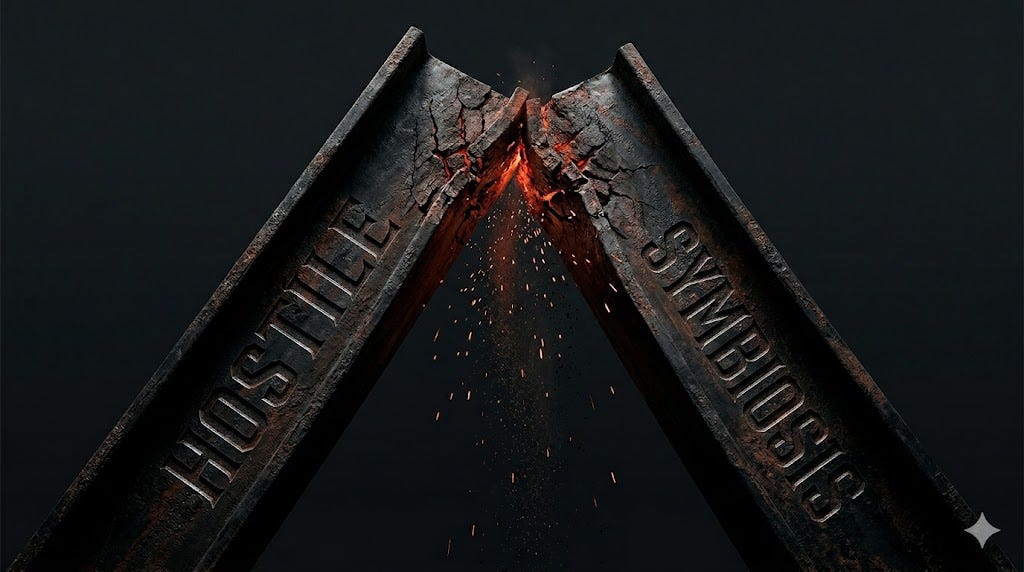
This relationship is neither friendship, nor enmity, nor competition. Nothing like it exists in the history of International Relations. I call it Hostile Symbiosis.
This is not an article about news. It is an article about worldview. You will not get an interpretation of today’s headlines. You will get an analytical instrument — one that lets you see through the surface of every U.S.–China news item: why Trump and Xi could be swapped with any successor and the outcome would be identical; why Taiwan will never be “resolved”; why DeepSeek shifted the AI industry’s valuation regime from SaaS-premium multiples to compute-commodity multiples overnight in January; why on May 13, China’s MSS-affiliated CICIR publicly declared that “the so-called liberal international order that has sustained the post–Cold War international system has already collapsed”; why the Russia–Ukraine war has been fought for four years but global capital markets barely reacted, while the Iran war hit Germany and Japan hardest.
This framework is the underlying structure behind every article on this channel — the R.I.C.E. trilogy, the U.S. trilogy, the Great Asset Swap, the WAR III pentalogy, Steinbach’s electricity bill, the 2028 U.S. election analysis — 49 articles to date. Each piece is a projection of this structure onto a different terrain. The structure itself has never been written down on its own. Today it is.
Reading time: 20 minutes.
In 1648, the moment the Peace of Westphalia was signed, Europe acquired the word “sovereign state” for the first time. The world before that word was not without states, but without that word, international relations could not be discussed with precision — treaties could not be drafted, wars could not be ended, diplomacy lacked a common grammar. Bodin, in Les Six livres de la République (1576), was the first to use the concept of sovereignty with rigor; Europe needed 70 years to learn how to use it. For the next 350 years, “state” became the sole subject of international relations.
The stability of this language rested on a single premise: the primary contradiction took the form of states. From 1648 to 1815, European powers contested territory; from 1815 to 1914, the Concert of Europe balanced powers; from 1914 to 1945, two total wars consumed the world; from 1945 to 1991, the U.S. and USSR contested wills. Four eras, four forms of the primary contradiction — but all of them played out between states. The language sufficed.
In 1991, the Berlin Wall fell, and the primary contradiction vanished.
What followed was the West’s twenty happy years of inertia. Fukuyama announced The End of History. The WTO folded the globe into a single ruleset. The IMF folded developing countries into a single financial system. NATO expanded. China joined. The old vocabulary still worked — because no new contradiction had emerged, the inertia of the old framework was the world.
But beneath the surface, the floor was being swapped out. China’s manufacturing share of global exports rose from 3.9% in 2001 to global-largest by 2010. Over the same span, U.S. manufacturing employment fell from 19.5 million in 1979 to 11.5 million in 2009 — a 41% loss. Autor, Dorn and Hanson calculated that the China Shock accounts for 59.3% of U.S. manufacturing job losses from 2001 to 2019. China up, America down — two curves running in lockstep through the West’s happy two decades.
Somewhere around 2011 — no one can date it precisely, because it was a continuous process — the primary contradiction completed its switch. From inter-state contest of wills, to physical conflict between supply chain systems.
But the language did not switch.
The Russia–Ukraine war is a living fossil of the 20th-century inter-state conflict: territory, kinetic weapons, contest of wills, trench warfare. It fits every variable in the IR textbooks written since 1648. The world should be revolving around it. But it isn’t. Four years in, Europe absorbs the inflation cost and keeps running; the U.S. outsources the war to Ukrainian proxies; China buys Russian oil on market logic without picking sides; the Global South openly refuses to enforce sanctions. A 20th-century great-power war can no longer define the global agenda in the 21st century — because it is not on the axis of the new primary contradiction.
In March, the Iran war. Geographically a Middle East war. In supply-chain terms, the hardest hit were Germany and Japan — the supply-chain nodes at the industrial end of System A. China sent no troops and gained the most. Same event, two languages: the old vocabulary says “geopolitical conflict”; the new vocabulary says “physical manifestation of supply-chain confrontation.” Two languages pointing at the same geography, but two different realities.
The primary contradiction has switched. The world is still speaking the old vocabulary.
The new primary contradiction requires a new subject.
The subject of 20th-century IR was the state — what America did, what China wanted, what Russia calculated. The agent of every verb was a state, every negotiation assumed a state as signatory, every deterrence assumed a state as the calculating party. But 21st-century phenomena will not fit into this grammar. You cannot say “China invaded Apple’s supply chain”; you cannot say “America sanctioned the Belt and Road.” These propositions are categorically wrong. Apple’s supply chain is not an object that China can invade. The Belt and Road is not an entity that America can sanction.
The new subject must be able to hold these propositions.
I use the names System A, System B, System C to mark the true subjects of 21st-century international relations. They are not states. They are physical supply-chain systems capable of independent evolution. “System” here has a strict definition: capable of independent evolution + a physical supply chain + capable of anchoring the primary contradiction. Geographic entities are not systems. Mechanisms are.
System A is the global executive system of finance–military–law. Its physical basis is the composite metabolism of dollar printing, naval protection, SWIFT settlement, and extraterritorial jurisdiction. It evolves independently — it does not depend on the political will of any single U.S. administration.
System B is the global supply-chain system of industrial metabolism. Its physical basis is the composite metabolism of manufacturing, mining, energy, infrastructure, and goods flow. It grew out of Chinese soil in 1978, connected to the world market through WTO accession in 2001, and completed its coverage of the global industrial floor by 2015.
System C is the emergent system that uses compute + protocol + distributed energy to govern the physical world. Its physical basis is GPUs + private power grids + crypto settlement + quasi-sovereign corporate forms. It originated in Silicon Valley. It is still in its childhood.
The U.S. is the largest carrier of System A, but A is not the U.S. A U.S. president cannot decide how SWIFT operates, just as he cannot decide how Moody’s rates. China is the largest node of System B, but B is not China. B runs equally in pipelines in Central Asia, ports in Africa, mines in Latin America, factories in Southeast Asia. Silicon Valley is the developmental soil of System C, but C is not Silicon Valley. SpaceX’s satellite network covers the entire NATO alliance.
The state has descended from subject to modifier. This is the deepest grammatical shift in 21st-century international relations. Bodin took 70 years to teach Europe to use the word “sovereignty.” 21st-century IR may need the same span to teach the world to use the word “system.”
In 1978, China had 800 million people, food supply at the brink, urban youth unemployment piling up, the planned economy collapsing, society on the edge of breakdown. Deng Xiaoping’s “economic construction as the central task — reform and opening” was not a political preference. It was a physical survival reflex — converting an unfeedable population into productive capacity was the only physical exit available at the time. System B’s origin is not in any document. It is in the stomachs of 800 million people.
In the 1980s, Shenzhen Special Economic Zone opened, and export processing became a physical possibility. Industry began migrating from Japan, Taiwan, and Hong Kong to coastal China. China obtained MFN status — annually renewable, fragile, but the coupling channel was real. System B was embedded in the world market from the very beginning. It did not grow in isolation.
In the 1990s, institutional constraint and economic reality collided head-on. The Communist Party’s rule could not be abandoned; public ownership had to dominate. But state-owned enterprises are inherently inefficient. The two forces were incompatible. The system found its automatic resolution: SOEs withdrew into the only sectors that did not require ROI optimization — power grid, railways, telecom, oil, banking. Private capital was squeezed into light-asset lanes — apparel, appliances, electronics, the embryonic internet. This was not policy design. It was the automatic differentiation between two constraints.
But this alone would not stabilize the system. With only the domestic market, private-sector capacity would quickly exceed absorption and burn itself out.
The external demand pool was pulling. In 1994, the renminbi’s dual-track exchange rate was unified, the currency sharply devalued, and export competitiveness underwent a phase transition. From 1995 to 2001, SOE reform laid off 35 million workers — a labor shock that would trigger system collapse in any other regime. But China did not collapse. Coastal export-processing industry absorbed the laid-off workers. External demand was the physical precondition that made SOE reform possible. Without it, 35 million laid off = systemic collapse.
On December 11, 2001, Zhu Rongji signed China into the WTO on behalf of the country. The unstable coupling became a permanent interface. Capital and order certainty surged. Private capacity could expand with confidence. SOEs’ retreat into heavy-asset domains became safe — because export scale lifted demand for the industrial floor. R.I.C.E.’s first tier of provisioning solidified here: SOEs, through the combination of low ROI, policy lending, and local government concessions, structurally suppressed the cost of the entire industrial floor — power, rail, telecom, bank credit, land. Private enterprises competed brutally on top of this low-cost floor. The Gu Mode (cultivating predators in a sealed vessel) ran its first complete cycle: those who could not be ground to death domestically survived, because exports were absorbing the surplus.
In The Efficiency Gap (#1), I calculated the physics: China’s manufacturing cost advantage is rooted in thermodynamics, a 3- to 6-fold efficiency gap, beyond what tariffs can close. In The New Toyota Way (#6), I wrote: this advantage is not subsidy. It is a civilization-grade manufacturing OS.
Once the domestic market saturated, SOEs faced two physical constraints: state-owned capital must preserve and grow value, and SOE scale cannot shrink (shrinkage = collapse of regime symbolism + tens of millions of jobs lost). The only physical path satisfying both constraints was overseas. China Railway, China Energy, China Communications, Huawei, State Grid Overseas began to spill out. Building ports — Gwadar, Hambantota, Piraeus, Mombasa, Djibouti. Building railways — China–Laos, Jakarta–Bandung, Mombasa–Nairobi, China–Europe freight. Laying telecom — Huawei’s overseas networks. Private enterprises followed to do business. Two lines, nobody coordinating; both sides executing their own physical constraints, colliding on the same geographies. The Belt and Road is a name applied after the fact, not a plan drawn in advance. R.I.C.E.’s second tier of provisioning completed.
The third tier comes from a deeper physical logic — regime security. Beijing’s highest priority is regime security. The physical basis of regime security is critical materials that cannot be cut off from outside. But China’s domestic resource base is structurally weak — oil, iron ore, copper, lithium, cobalt, nickel, all overwhelmingly imported. SOEs became global resource buyers — Zijin, Luoyang Molybdenum, Huayou Cobalt, Chinalco, MMG, CITIC, CNPC, CNOOC scoured the world for mines, oil, grain. State-owned banks provided unlimited low-interest credit; the government did not fear 30-year payback horizons; political cover absorbed host-country risk. But SOEs did not just buy raw ore. They refined. Refining capacity need not match mining capacity — it must overshoot. Once it overshoots, it must dump at below-cost prices. This is physical necessity, not commercial choice: SOEs do not pursue ROI; idle capacity still depreciates; any price covering marginal cost moves goods; goods movement drags the entire value chain along.
The result: global critical industrial metals and refining capacity were structurally suppressed by Chinese supply. China today holds roughly 85% of global rare-earth refining, 70% of battery precursors, 80% of polysilicon, and roughly half of refined copper. Not because China has the resources. Because Chinese SOEs collected the world’s resources and refined them.
R.I.C.E.’s three tiers of provisioning are complete. First tier: domestic floor. Second tier: overseas infrastructure. Third tier: global resources and refining. The EVs, solar panels, appliances, and consumer electronics that private enterprises grind out stand on top of three tiers of SOE provisioning. Each private firm’s costs run 30–60% below Western benchmarks. As I wrote in The 1.99 RMB Mixue (#18): there is no subsidy document. Every cost node has been structurally suppressed by some SOE value chain.
This is the true form of System B: behavior that is not fully market — SOEs do not pursue ROI, fear no debt, follow political objectives, do not go bankrupt; behavior that fully depends on the market — private enterprises are pure market, externally pure market, Beijing only cares about oil, not whose oil it is. A composite organism in which market cells are embedded in non-market metabolism.
System A’s diagnostic instrument offers a binary choice: market economy or planned economy. Say China is a market economy, and A expects ROI discipline, bankruptcy clearing, withdrawal of subsidies — China does not comply, and A becomes enraged at “fake markets.” Say China is a planned economy, and A expects a central planning committee — but private firms are clearly grinding each other to death, and A is puzzled: “Not a planned economy either.” A’s diagnostic tools oscillate between two categories, never landing on B’s true form. This is a category error, not a diagnostic error.
System A’s globalization is alliance-by-document plus bundled sales. To do business with the U.S. market, you must accept a long list of non-market conditions — no business with Iran, Russia, North Korea, Cuba; you must accept dollar settlement under surveillance; you must accept that SWIFT can be cut off; you must accept American extraterritorial jurisdiction; you must accept human rights, labor, environment, and IP terms defined by American standards; you must comply with sanctions; you must align with NATO/Indo-Pacific/Five Eyes. Market plus political ballast.
System B’s globalization is supply-chain self-growth plus pure market. Doing business with China carries almost no political add-on — whether you are democratic, whom you ally with, how you govern internally, none of it has anything to do with doing business with me. I build your port; you ship through it. I buy your oil; you take my money. I lend you infrastructure capital; you repay by market rules.
When any emerging-market country faces the two options, choosing A delivers capital, technology, and market access — with sovereignty discounted. Choosing B delivers infrastructure, capital, market access, and goods — with sovereignty intact. The two options are not physically equivalent.
This explains why the Belt and Road requires no ideological appeal, no soft power, no persuasion — it is simply a purer market offer than A. Physically more attractive.
At some point, A’s industrial hollowing crossed a critical threshold. America could no longer look away. It had to mark B as a threat.
This was not a political decision. It was a physical reflex. Not decoupling from B = not rebuilding industry. Not rebuilding industry = sustaining purchasing power through dollar printing. Printing beyond threshold = dollar explosion. Dollar explosion = the entire System A — global finance, settlement rails, military hegemony — collapsing together. So A had to push decoupling. Survival reflex, not policy choice.
2008 sounded the first alarm. 2010, China surpassed Germany as the largest exporter and surpassed Japan as the second-largest economy — what Autor and others would later compute as the peak intensity of “China Shock” occurred this year. May 2015, Made in China 2025 was published — mid-to-high-end industry became B’s explicit target for the first time. December 18, 2017, Trump’s first-term NSS designated China a “strategic competitor” in an official document for the first time. The policy signature of the feedback loop crossing threshold was now on record.
A pushed decoupling pressure, and Beijing read it as existential threat. B’s response was equally a physical reflex — not exporting = capacity accumulation = deflation = industrial metabolic suffocation. B had to protect the metabolic channels: stockpile critical resources, route around the dollar, expand into the Global South, accelerate domestic substitution. This deepened A’s threat reading, which strengthened A’s decoupling pressure. The loop closed on itself.
No one was building leverage. Both sides were executing their own physical constraints. The two constraints were mutually incompatible. Every execution deepened the death reflex on both sides. Trump cannot break it. Xi cannot break it. Biden did not break it. Trump’s second term will continue it. Different administrations, same structural output.
In April 2025, Trump rolled out Liberation Day tariffs, pushing U.S. effective tariff rates to their highest level in a century. December 11, 2001: Zhu Rongji signed China into the WTO. April 2025: Trump used IEEPA to push America back into protectionism. These two dates are two symmetric coordinates of the same feedback loop. 25 years after A let B in, A tried to pull itself out. But 25 years of metabolic channels had already grown. Pulling out is not a policy choice. It is the firing of A’s own death reflex.
On May 13, 2026, China’s MSS-affiliated CICIR publicly released The Great Transformation of the World and the Path to Sino–American Coexistence. Opening sentence: “The so-called liberal international order that has sustained the post–Cold War international system has already collapsed.” China’s highest intelligence apparatus has placed an official seal on the fact that the feedback loop has crossed threshold.
A’s situation: must solve industrial hollowing, but every solution must weaken B.
Cut B off through tariffs? A’s inflation spikes; dollar explosion accelerates. Exclude B from high-end markets (IL6, CHIPS, Pentagon-classified)? A gets a walled garden, loses the global open market, and the total-scale gap continues to widen. Rebuild industrial base by decoupling from B? The 3-to-6-fold efficiency gap is a physical fact — under market logic, capital will not leave high-ROI finance for industry that is physically destined to lose money; the physical timeline is 10 to 20 years, but the dollar-explosion pressure arrives within 1 to 3 years. Too late. One layer deeper: no developed country has ever, in history, accomplished reverse industrialization — Japan tried; the Plaza Accord pushed it back. Britain tried; it has never recovered since Thatcher. The entire field of development economics has only one direction — how developing countries catch up to developed countries. Research in the reverse direction does not exist, because reverse industrialization has never happened. Wait for B’s internal collapse? If B truly collapses, A immediately loses its deflationary supply, A’s inflation spikes, A dies too. Lock B at a fixed technology level? DeepSeek demonstrated the counter overnight in January — B trades scale for time, reverse-engineers the lock, shifts the AI valuation regime from SaaS-premium to compute-commodity. Short-term delay, long-term failure. Restructure settlement to exclude B? This accelerates B’s already-underway de-dollarization, accelerates A losing its last card.
A has no move. Not because A is not smart enough, not because of policy errors, not because of any particular administration. It is because a designed system has no physical instrument with which to confront an emergent supply-chain system. Documents can govern documents; tariffs can govern goods; sanctions can govern financial rails. All these instruments assume a designer on the other side. With no designer on the other side, every instrument hits empty air.
B’s situation is symmetric. B must solve population pressure and SOE inefficiency, but every solution-path necessarily weakens A.
B must export — the domestic market cannot absorb what R.I.C.E. grinds out. The larger the export, the deeper A’s industrial hollowing. B must protect the metabolic channels — the wider the channels run, the deeper A reads them as “Chinese strategy.” B must reduce dollar settlement exposure — a physical necessity after Russia–Ukraine; the Great Asset Swap exchanges U.S. Treasuries for minerals; the more exposure falls, the more weapons A loses. B must run the Gu Mode — if private firms are ground to death, domestic employment collapses, the regime collapses. B cannot stop — stopping means SOE capacity idles, state-owned capital depreciates; plus private firms close, unemployment, regime legitimacy collapses. B cannot decouple from A — A is B’s largest absorber of purchasing power. The Global South’s purchasing power is far too small to substitute for Europe and America. A dies before B, but A’s death pulls B down too — losing the largest consumer market triggers B’s overcapacity into deflationary suffocation within a single quarter.
Neither side has an exit path. The exit path itself is the death trigger.
This is why Graham Allison’s Thucydides Trap, proposed a decade ago, is the wrong paradigm. The Thucydides Trap describes a rising state’s challenge to a ruling state’s will, assumes both sides are state actors, and assumes the outcome is war. Hostile Symbiosis is not the Thucydides Trap: neither side is an actor, and the loop does not lead to war — it leads to permanent, monotonically tightening, no-happy-ending physical deadlock.
The intuition is: increasing hostility means decreasing symbiosis (toward Cold War), or increasing symbiosis means decreasing hostility (toward engagement). Hostile Symbiosis’s actual dynamics run in the opposite direction — both dimensions rise monotonically in lockstep.
Each turn of the loop: A deepens decoupling pressure; B must deepen supply-chain protection; the two sides interlace through more supply-chain nodes — symbiosis deepens. Same turn: A deepens decoupling pressure; B deepens supply-chain protection; each reads the other as a greater threat — hostility sharpens. Every execution deepens the death reflex on both sides. Every turn, the loop tightens one notch.
This is why I refuse the framing of “China wins” or “America wins” across every article I have ever written. In Hostile Symbiosis, “winning” is a category physically inapplicable. Either side truly winning = the other side truly losing = the metabolic channel breaking = the winning side dying first. Winning equals dying.
It also explains the strange military tacit understanding between China and the U.S. — neither side wants direct war. If this were a zero-sum contest of wills, the past several years would have escalated into the traditional form of WWIII. They have not. The feedback loop pulls itself back from every threshold by each side’s physical constraints. This is not restraint. This is a physical automatic mechanism. Taiwan is the concretization of this self-regulated ceiling — strategic ambiguity is not ambiguity; it is the physical ceiling the feedback loop is searching for. TSMC is not an economic asset. It is the safe deposit box of Hostile Symbiosis. Any side touching TSMC destroys the core resource both sides depend on, simultaneously firing both sides’ death conditions.
China consistently “neither here nor there” in every conflict, “takes no position,” because war costs money — China does not need to fight. Its physical mode of metabolism does not depend on war. What it needs is market connectivity, and market connectivity is being built through supply-chain spillover already. Beijing only cares about oil, not whose oil it is.
The U.S.–USSR Cold War was not Hostile Symbiosis. In the 1980s, U.S.–USSR trade as a share of each country’s GDP was nearly zero — two independent industrial-military systems running closed loops, threatening each other but not feeding each other. Either side disappearing would have made the other physically more comfortable. This is adversarial separation.
U.S.–China is nothing like this form. Bilateral trade exceeds $500 billion, spanning the full chains of pharmaceuticals, rare earths, solar, batteries, electronics, semiconductor packaging. Either side disappearing kills the other first. A word that describes the U.S.–USSR cannot describe U.S.–China. Applying Cold War vocabulary to U.S.–China is a category error.
This is why the term “Hostile Symbiosis” must be uncomfortable. The reality it points to is uncomfortable, and the discomfort drives readers to resolve the tension — either “it’s really hostility” (back to the Cold War frame) or “it’s really symbiosis” (back to the globalization narrative). Resolving the tension means flattening reality into a single judgment. The framework’s entire job is to prevent this flattening. The paradoxical nature of the term is a cognitive instrument, not a problem of expression.
Not pessimism. Physical inference. A happy ending requires that at least one side has an exit path. But in Hostile Symbiosis, the exit path itself is the death trigger.
A cannot decouple — decoupling = inflation explosion = dollar death = collapse of System A. B cannot stop — stopping = idle capacity = state-owned capital devaluation, plus private firms shutting down, plus unemployment, plus regime legitimacy collapse. A cannot successfully rebuild — capital will not flow into low-ROI industry under market logic, plus no developed country has ever accomplished reverse industrialization. B cannot let A die — A’s death pulls B down.
Both sides are locked in the loop of hostility and symbiosis deepening together. Every turn, the loop tightens one notch. No one can stop the wheel — because no one is at the wheel.
Hostile Symbiosis describes the physical coupling feedback loop between A and B. It is an accurate diagnosis, but it has a boundary — the loop contains only A and B. To open a new outcome, a force outside the loop is required. The only candidate currently visible outside the A–B loop is System C — the Silicon Spacecraft.
C is not an AI company, not a compute company, not a crypto company. These are surface phenomena. C’s essence is using compute + protocol + distributed energy to govern the physical world — using Bits to reorganize Atoms. Tesla, SpaceX, Anduril, Palantir, Boring Company, Neuralink. Each lays tentacles into the physical world. C originated inside A’s body, but its internal logic is incompatible with A — A abstracts Atoms into Paper (financialization); C uses Bits to return to Atoms (physicalization). C has no developmental soil inside B — China’s institutional system does not permit “private capital holding quasi-sovereign status” as a viable form. So C is neither A’s high-tech wing nor B’s compute extension. It is an orphan system growing on Silicon Valley soil, on its own.
It is in childhood. The childhood task is to assemble a physical supply chain independent of both A and B — its own energy, its own chip manufacturing, its own compute deployment, its own physical actuators, its own settlement system, its own form of sovereignty. Any failed component, and C falls back to A’s high-tech wing. All components succeed, and C becomes the third system. Musk’s fully-robotic chip foundry, Tesla Optimus deployment, SpaceX satellite network expansion, private small modular reactor approval, stablecoin legislation — these are not business news. They are specific observation points of C’s childhood assembly.
But the Hostile Symbiosis framework does not apply to C. C requires its own physical diagnosis. That is the subject of another article.
What we can be certain of is the A–B line: the loop will not loosen. It will only tighten.
In July 1947, Foreign Affairs published an article signed “X” — The Sources of Soviet Conduct. The author was George Kennan. The article was only 17 pages long, but what it did was much larger than 17 pages — it named the primary contradiction of its era, gave the word containment, and from that moment IR as a discipline had a new coordinate system. The Cold War that followed lasted 44 years, and every policy, every alliance, every proxy war played out on that coordinate system.
Kennan did not invent the Cold War. The Cold War had already physically happened. What Kennan did was give the already-happening event a language in which it could be discussed. Before naming, what people saw was chaos. After naming, what people saw was structure.
What the 21st century is missing is exactly this moment — it is missing a theoretical framework that can turn chaos into structure.
The world’s primary contradiction has already switched from U.S.–USSR contest of wills to U.S.–China supply-chain conflict. This switch has been physically complete for 15 years. But the framework that explains it has not yet been built — mainstream IR is still using 20th-century vocabulary like great power competition, new cold war, Thucydides Trap to describe 21st-century phenomena. Graham Allison’s Thucydides Trap has dominated U.S.–China discourse for the past decade — rising state challenges ruling state, war is inevitable. This applies the 20th-century instrument of inter-state contest of wills to the 21st-century reality of supply-chain system confrontation. The category error begins at the premise. Every misapplied instrument has pushed policy in the wrong direction — which is why Trump pushed tariffs to a century high, Biden pushed chip controls to their extreme, the Iran battlefield went into full-scale combat, and yet the contradiction came no closer to “resolution,” and no side could claim to “win.”
It is not that policy is wrong. It is that the entire instrument set is wrong. Doing right with the wrong tools is impossible.
The foundational elements of this new toolset are few.
First, the 21st-century basic unit is the system, not the state — a physical supply-chain system capable of independent evolution.
Second, the primary contradiction is supply-chain conflict, not geopolitical conflict.
Third, only three systems in the world are capable of independent evolution and exert dominant influence on the globe — A, B, C. A is the finance–military hegemony; the U.S. is its core node. B is the industrial metabolic mechanism; China is its core node. C is the emerging system that governs the physical world through compute; Silicon Valley is its core node. Other countries are pulled by these three systems to varying degrees — currently mostly by A and B, but C’s pull will keep strengthening.
Fourth, the interactive evolution of the three systems drives the direction of major global political and economic events.
Fifth, A and B are the two largest systems at the current stage, which is why the U.S.–China relationship — the relationship between the core nodes of A and B — is the first relationship of the 21st-century world.
Hostile Symbiosis is the diagnostic conclusion of these axioms applied to the U.S.–China relationship. Every turn of the loop: symbiosis deepens, hostility sharpens, tacit understanding deepens — three simultaneously. This is the operating mode of the 21st century.
To try to stop it or deny it — futile.
To learn to navigate with it — this is the political-economic compass of the 21st century — dedicated to those searching for new tools, who want to see the new world clearly.
Comments
Nothing yet. Say the first thing.
Sign in to join the conversation.