
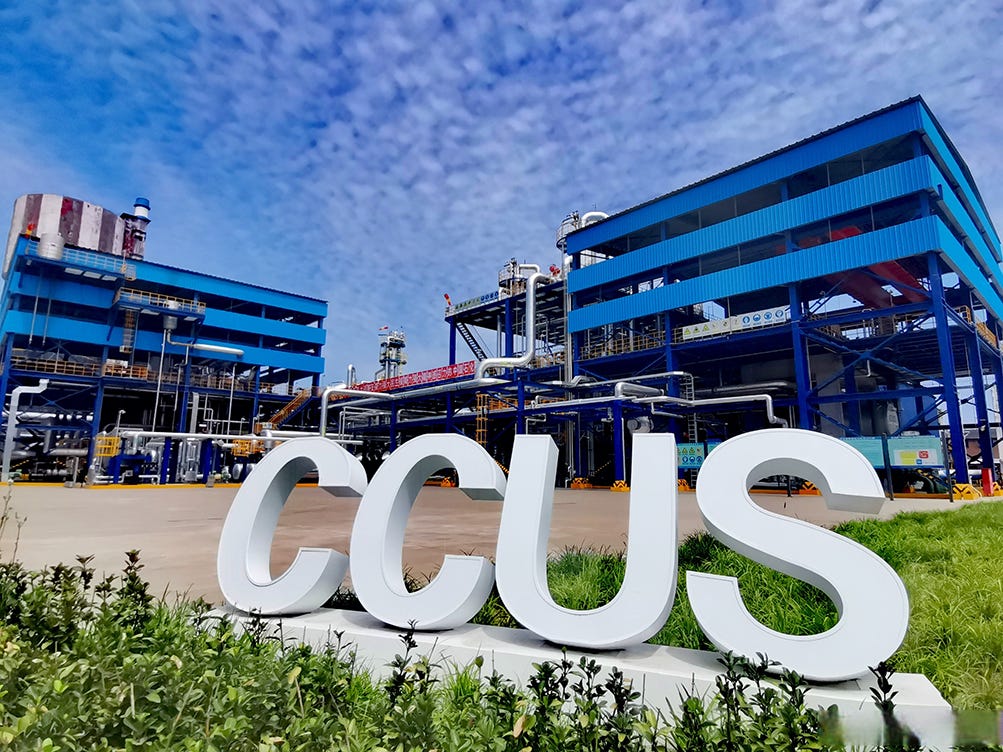
On July 29, Sinopec announced the latest progress at its million-tonne-scale Qilu Petrochemical–Shengli Oilfield CCUS project. By the end of June 2026, the project had cumulatively captured and sequestered more than 2.4 million tonnes of carbon dioxide, while daily oil production in the Shengli Oilfield CCUS demonstration area had increased from 220 tonnes to 506 tonnes.
The project is China’s first million-tonne-scale, full-chain CCUS demonstration project. It includes the country’s first long-distance CO₂ transmission pipeline extending for more than 100 kilometers and connecting Qilu Petrochemical with the Gaoqing production area of Shengli Oilfield.
As of March 28, the pipeline had operated safely and steadily for more than 1,000 days, with cumulative CO₂ injection exceeding 1.3 billion cubic meters. The project has increased energy efficiency by 19% and cut costs by more than 30%, while increasing the crude oil recovery rate by over 15% and improving the first-pass CO₂ storage rate by 20%.
The cumulative capture of 2.4 million tonnes of CO₂ marks a milestone in China’s transition from individual CCUS demonstration projects toward large-scale commercial deployment. It also makes China the third country, after the United States and Canada, to possess full-chain operational capabilities for million-tonne-scale CCUS projects, providing critical experience for the development of future ten-million-tonne-scale industrial hubs.
All equipment used in the project’s carbon capture facilities has been domestically manufactured. Qilu Petrochemical sources the CO₂ from the coal gasification unit at its No. 2 Fertilizer Plant. The CO₂-rich off-gas discharged by the unit represents a high-quality carbon dioxide resource, characterized by large and stable volumes and a CO₂ concentration of up to 90%.
Qilu Petrochemical recovers the CO₂ from the coal gasification off-gas through liquefaction and purification, a process that offers lower energy consumption and reduced costs compared with conventional capture methods.
Sinopec has also developed a range of core technologies for the utilization and geological storage of carbon dioxide. Maintaining a fully closed system throughout the process is essential to increasing both the CO₂ storage rate and crude oil recovery.
At the injection end, Shengli Oilfield developed a fully enclosed, high-efficiency injection technology to address the tendency of liquid CO₂ to vaporize, as well as the challenges associated with metering and distributing CO₂ during simultaneous multi-well injection.
The company has developed a series of injection solution and equipment with independent intellectual property rights, overcoming key technical challenges involving zero-emission operation, low-temperature metering, pressure-specific distribution and separate-layer injection.
At the production end, Shengli Oilfield introduced a fully enclosed gathering, transportation and treatment process for produced fluids and gases. Following water separation, the recovered gas is transported to a reinjection station, pressurized and injected back into the reservoir for secondary enhanced oil recovery and geological storage.
Comments
Nothing yet. Say the first thing.
Sign in to join the conversation.