
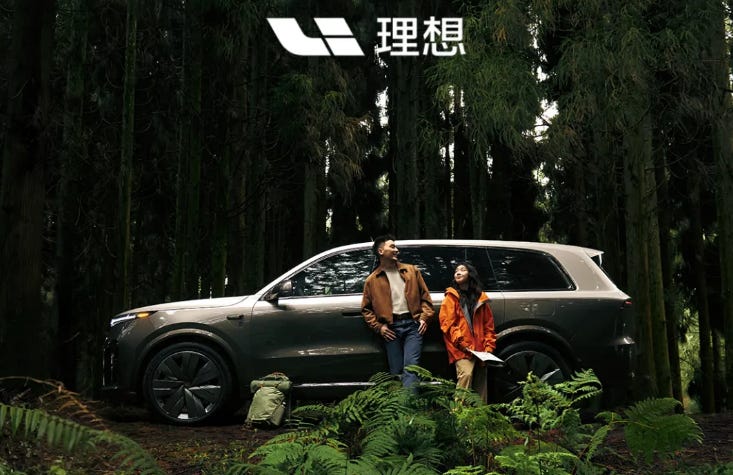
On July 24, 2026, Li Auto (Li Xiang) released a special feature celebrating 300,000 cumulative deliveries of its flagship Li L9, a full-size REEV (Range-Extended Electric Vehicle) SUV.
Rather than focusing solely on sales milestones, the company compared the first-generation L9, the 2025 model, and the newly launched L9 side by side. This is an unusual approach in the automotive industry. Most manufacturers highlight only their latest model, while Li Auto uses the opportunity to explain how its philosophy has evolved over three generations.
The result is less of a marketing campaign and more of a retrospective on how Li Auto now defines a flagship family SUV.
The original Li L9 was built around a simple idea:
Bring features traditionally found in RMB 1 million luxury vehicles into the RMB 500,000 price segment.
At launch, the L9 introduced equipment that was uncommon for family SUVs in China, including:
Air suspension
Compressor refrigerator
Dual large displays
SPA-style massage seats
Throughout the company’s presentation, one phrase appears repeatedly:
“Setting a new industry benchmark.”
This reflects Li Auto’s original ambition.
The goal was not merely to build a premium SUV, but to raise the overall standard for family SUVs in China by making luxury features more accessible.
By the 2025 model year, Li Auto did not fundamentally change the product concept.
Instead, it focused on improving the quality and maturity of each system, including:
Dual-chamber air suspension
52.3 kWh battery
NVIDIA Thor-U computing platform
21.4-inch 3K display
18-point hot-stone massage seats
The transition is clear.
The first generation competed by introducing premium features.
The second generation competed by making those features more refined and more practical for everyday family use.
This marks a shift away from simply accumulating luxury equipment toward building a premium SUV optimized for daily family life.
The newest Li L9 represents the most significant strategic shift.
Instead of emphasizing additional luxury features, Li Auto now focuses on the vehicle’s underlying architecture.
Major hardware upgrades include:
800V active suspension
Steer-by-wire
Rear-wheel steering
EMB (Electromechanical Braking)
These technologies are designed for software-defined vehicles, increasing not only ride quality but also future control flexibility through software updates.
The powertrain philosophy has also evolved.
The original L9 centered on eliminating range anxiety through its REEV system.
The new model introduces:
A next-generation range extender
5C ultra-fast charging battery technology
The emphasis has shifted from simply extending driving range to improving charging performance and overall system efficiency, reflecting the maturation of China’s REEV market.
Perhaps the biggest change is how Li Auto presents artificial intelligence.
The new L9 highlights:
Li Auto’s self-developed M100 AI chip
Maher VLA (Vision-Language-Action) architecture
The difference from the first-generation model is significant.
Initially, having dual NVIDIA Orin chips was itself considered a selling point.
Today, Li Auto places less emphasis on the chip itself and more on how AI coordinates the entire vehicle.
This illustrates a broader industry transition:
From hardware competition
To AI architecture competition
This philosophy extends across the cabin.
Examples include:
Instead of simply offering an in-car refrigerator, the latest model adds:
Freezer capability
Removable cooling unit
Larger storage capacity
The focus is no longer the feature itself but expanding real-world usage scenarios.
The emphasis has evolved from massage functions to four zero-gravity seats, improving long-distance comfort for every passenger.
Rather than competing on screen size alone, the new L9 introduces:
29-inch 6K front display
4K rear entertainment display
The design philosophy has shifted toward optimizing the experience for the entire family.
Across these upgrades, Li Auto appears to be moving:
From adding more equipment
To optimizing the overall user experience
Viewed together, the three generations reveal a clear progression.
First generation:
Democratizing luxury equipment.
Second generation:
Refining and maturing those technologies.
Third generation:
Redesigning the entire vehicle around AI and software-defined architecture.
Because Li Auto presents all three generations together, this strategic evolution becomes unusually easy to understand.
Beyond technology, the commemorative content also highlights numerous third-party recognitions, including:
China Design Gold Award
C-IASI top safety ratings
Five-star C-NCAP safety rating
Healthy Vehicle Certification
AI Cockpit Certification
The presentation concludes with stories from actual owners, featuring:
Family road trips
Camping
Cycling
Overnight stays inside the vehicle
These examples reinforce Li Auto’s core brand message:
The L9 is presented not as a collection of specifications, but as a vehicle designed to support family life.
The 300,000-delivery campaign functions less as a celebration of sales success and more as a summary of how Li Auto has redefined its flagship SUV over the past three years.
The company’s priorities have shifted from:
Luxury democratization
Product refinement
AI-centered vehicle integration
This kind of self-comparison across three generations is unusual in the automotive industry and provides valuable insight into Li Auto’s long-term product strategy.
An additional point is worth noting.
Although the presentation heavily emphasizes AI, software-defined chassis technologies, and next-generation vehicle architecture, the final message consistently returns to one theme:
family experiences.
Technology is presented as a means rather than the end itself.
That positioning has become one of Li Auto’s defining brand characteristics.
At the same time, the commercial environment has changed dramatically.
When the first-generation L9 launched, premium SUVs priced above RMB 400,000 could regularly achieve monthly sales exceeding 10,000 units. Today, the market has become far more competitive, with AITO M9—a premium SUV developed under Huawei’s HIMA (Harmony Intelligent Mobility Alliance) ecosystem—emerging as the dominant player in China’s RMB 500,000-plus SUV segment.
Against that backdrop, Li Auto’s decision to explain how its products have evolved, rather than simply promoting new features, may be just as significant as the vehicle itself. It offers a rare look into how the company sees its own evolution—and how it intends to define the next generation of flagship family SUVs.
No posts
Comments
Nothing yet. Say the first thing.
Sign in to join the conversation.