
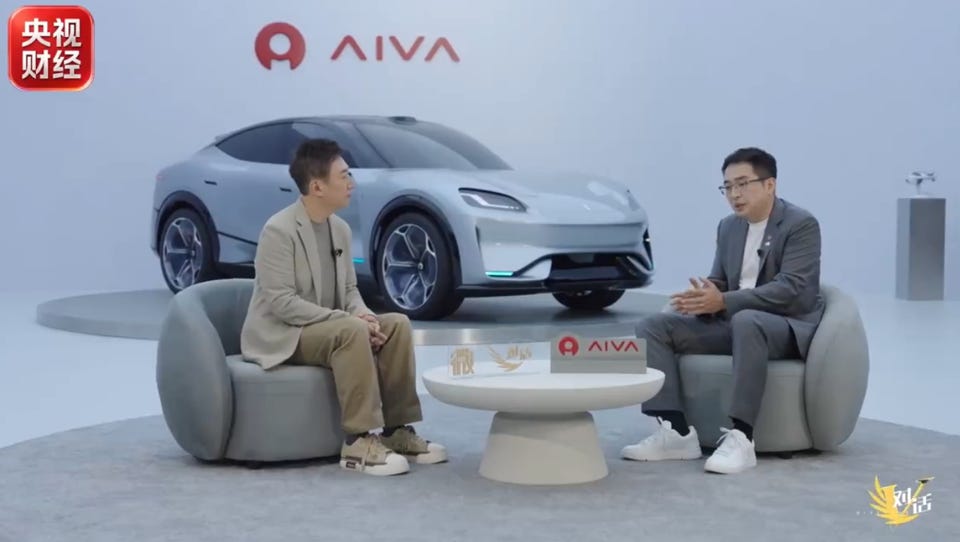
China’s AIVA has repeatedly promoted an unusual idea: “AI defines the car. AI comes first, then the vehicle.”
AIVA is a new automotive brand developed by Saidou Technology, a company under SERES. Its philosophy goes beyond putting an AI assistant inside a conventional vehicle. Instead, AIVA sees the car as a physical body through which AI can perceive, act and interact with the real world.
The AI is expected not merely to respond to commands, but to understand habits and emotions over time and ultimately become a long-term companion in the user’s daily life.
AIVA has explained this vision extensively in previous presentations and promotional material.
What is new in a recent interview with AIVA President and Product Manager Li Bo is something else: the company building an AI-native car is also trying to become an AI-native organization itself.
Li now manages more than ten specialized AI agents almost like digital employees. AIVA is encouraging all employees—not only executives—to build and use their own agents. Token usage is generally not restricted, internal AI-agent competitions are held, and managers are expected to prototype AI-powered applications themselves.
The result is an experiment that extends far beyond automotive AI.
AIVA is attempting to make AI the organizing principle for the brand, product, company structure, workforce, development process and eventually the retail network.
AIVA describes its philosophy as:
“AI defines the car. AI comes first, then the vehicle.”
According to Li, however, this does not describe a chronological development process in which an AI system is completed before engineers begin designing the vehicle.
It describes where product definition begins.
Instead of starting with a conventional car and asking which AI features can be added, AIVA starts with questions such as:
What services should the AI provide to the user?
What information must it perceive to provide those services?
What decisions must it make?
Which vehicle functions must it be able to control?
What hardware and computing resources are necessary to make that possible?
From those requirements, AIVA works backward to define elements including sensors, onboard computing, climate control, seats, lighting, windows, navigation, parking, charging and cabin space.
In other words, the conventional sequence is reversed.
Instead of:
Build a car → add AI
AIVA wants to pursue:
Define the AI experience → build the car required to deliver it
The company has used the striking Chinese expression “当AI长出汽车身体”, which can be understood as “when AI grows a car body.”
The car becomes the physical embodiment of the AI.
The more unusual part of AIVA’s experiment is that this philosophy is no longer limited to vehicle development.
Li is described internally as an enthusiastic “lobster farmer.”
This requires some explanation outside China.
In China’s 2026 AI community, “lobster” has become a nickname associated with OpenClaw, an AI-agent system whose visual identity features a lobster-like claw. Setting up, training and continuously refining personal AI agents consequently became informally known as “raising lobsters” (养龙虾).
Li originally used a single AI agent.
But he fed it information about products, organizational management, personnel, supply chains, meetings, schedules and numerous other responsibilities.
Eventually, too much heterogeneous information was being handled by one agent. Its memory became difficult to manage and the consistency of its answers deteriorated.
His solution was not simply to build a larger general-purpose agent.
He divided the work.
One agent became several, and several eventually became a group of more than ten specialized AI agents.
Each of Li’s agents now has its own name and responsibility.
One acts as a general coordinator. It reviews the previous day’s progress and identifies priorities for the current day.
Another specializes in time management.
It compares Li’s actual weekly time allocation with his key monthly objectives. If his schedule is drifting away from those priorities, the agent identifies the discrepancy and recommends adjustments for the following week.
This is considerably different from occasionally asking a chatbot to summarize documents.
AIVA is giving agents:
Persistent responsibilities
Specialized roles
Recurring tasks
Relevant organizational knowledge
Relationships with other agents
A place within a broader multi-agent workflow
Instead of asking one universal AI to handle everything, Li is effectively constructing a small virtual organization of specialized digital employees.
One particularly interesting agent is called Qianxun (千寻).
Qianxun originally helped organize meeting discussions and product proposals.
Li later deliberately gave it an adversarial role.
The agent became a kind of internal blue team whose job was to challenge assumptions, identify weaknesses and argue against Li’s own proposals and decisions.
As Li interacted with Qianxun more frequently, he says the agent gradually learned what he cared about, what questions he tended to ask and how he approached decisions.
Something unexpected then happened.
AIVA employees began talking to Qianxun before talking to Li himself.
Employees could “battle” with the agent first, testing a proposal against a simulated version of the questions and objections they expected from Li.
Li describes this, in effect, as a system for:
predicting his predictions.
That represents a much deeper form of enterprise AI adoption.
The AI is no longer simply reducing an executive’s administrative workload. It is learning aspects of the executive’s decision-making patterns and making those patterns available to the wider organization.
In effect, AIVA is experimenting with turning management logic into an accessible digital resource.
The system became popular enough internally that AIVA eventually developed it into a formal tool for company-wide use.
AIVA does not intend this approach to remain an executive experiment.
The company calls its broader initiative “全民养虾”, roughly meaning “everyone raises AI agents.”
At an early stage, every employee was given an AI agent.
AIVA also chose, in principle, not to impose tight token limits. The priority was to encourage experimentation rather than optimize AI usage costs immediately.
Employees are encouraged to identify work that involves:
Repetitive processes
Low-value manual tasks
Time-consuming information organization
Research and preparation before human decision-making
Routine coordination
They then work with internal AI specialists to turn those processes into agents.
AIVA has even created an internal AI-agent skills competition.
Employees demonstrate agents they have built themselves, explaining the business problem, the instructions and data provided to the agent, the efficiency improvements achieved and how the system has been incorporated into real workflows.
Successful examples are recognized and shared internally.
This makes the program quite different from conventional corporate AI training.
Employees are not simply being taught how to use AI.
They are expected to build AI workers and integrate them into their jobs.
In June 2026, AIVA held another internal presentation involving roughly 20 departmental leaders.
Participants combined their domain knowledge with AI coding tools to develop applications and workflow systems addressing problems in their own areas.
They were expected to explain:
Why the system was necessary
What was wrong with the previous workflow
How AI was used to build the solution
What changed after implementation
The important point is who builds the prototype.
Traditionally, a product manager with an idea would describe it to a development team and wait for engineers to produce a demonstration.
AIVA wants to shorten that chain.
Using AI coding tools, product managers can now create a partially functional prototype themselves before formally involving software developers.
At the same time, engineers can move beyond simply implementing specifications and spend more time analyzing market developments and user needs.
The boundaries between planning, validation and development consequently become less rigid.
AIVA believes this can dramatically shorten the distance between an idea and a usable product.
AIVA uses another metaphor to describe the division of labor between humans and AI:
AI goes ahead and mines; product developers follow behind and select the gold.
AI can explore huge quantities of information, identify user needs, generate hypotheses and produce potential ideas.
But everything it discovers is not valuable.
Humans must still decide:
Which ideas deserve to become products
Which customer value should take priority
Which risks are acceptable
Which AI outputs can be trusted
What ultimately should be built
The objective is therefore not to transfer the entire job to AI.
It is to let AI dramatically expand the area that can be explored, while humans concentrate on judgment.
AIVA describes the resulting employee as a “super individual”—a person whose capabilities are amplified by AI.
The company sees several characteristics as essential to an AI-native organization:
Higher operational efficiency
Faster development iteration
Better information flow between departments
Amplification of individual capabilities
An organizational environment where new ideas emerge more easily
AIVA is applying the same thinking to recruitment.
It wants to build teams around younger employees, graduates and interns who can collaborate naturally with AI.
That means changing the interview process itself.
Instead of relying only on conventional questions, candidates may be asked to complete practical tasks together with AI.
AIVA can then observe:
How the candidate understands AI capabilities
Which tasks they delegate to AI
How they verify AI-generated results
How they improve their prompts and interaction
Where they retain human judgment
How they make the final decision
The company is therefore not simply searching for people who “know AI.”
It wants people who already think in terms of human-AI collaboration.
AI is also being introduced into the recruitment process itself.
AIVA does not intend to keep its digital employees inside its headquarters.
The company is considering extending internally validated AI agents and workflow tools to dealers and business partners.
In automotive retail, for example, an AI agent could analyze previous conversations between a salesperson and customer and identify what the customer actually cares about.
Instead of spending time rereading records and organizing information, the salesperson could devote more attention to the customer conversation and relationship.
The underlying philosophy remains consistent:
AI handles information-intensive preparation; humans concentrate on judgment and relationships.
AIVA describes its model as three interconnected flywheels:
AI-native organization
AI-native vehicle
AI-powered full-chain services
Each potentially generates data, knowledge and operational experience that can strengthen the others.
Automakers around the world are rapidly adopting AI.
Volkswagen is developing AI agents for vehicles in China. Stellantis has outlined more than 100 AI initiatives through its relationship with Microsoft. Rivian has increasingly discussed moving beyond the conventional software-defined vehicle toward an AI-defined vehicle experience.
AIVA is different less because it uses AI than because of where AI sits in the organizational hierarchy of ideas.
For many automakers, AI remains one of several major technologies:
vehicle → software → AI functionality
AIVA is attempting to reverse that relationship:
AI → services and experiences → organization and development system → vehicle
Whether this produces better cars remains an open question. AIVA is still a new brand, and its philosophy will ultimately have to be validated through products, customers and commercial results.
But as an organizational experiment, it is already unusually aggressive.
AIVA is effectively asking a question that could become increasingly important across the global auto industry:
If the car itself is supposed to become AI-native, can the company that builds it remain a conventional organization?
AIVA’s answer is clearly no.
Its employees are being encouraged to build and manage AI agents. Managers are turning their expertise and decision patterns into digital systems. Product managers are becoming prototype developers. AI is entering recruitment, organizational management and eventually dealer operations.
For AIVA, training and managing AI agents is no longer an IT experiment.
It is becoming part of the job itself.
No posts
Comments
Nothing yet. Say the first thing.
Sign in to join the conversation.