
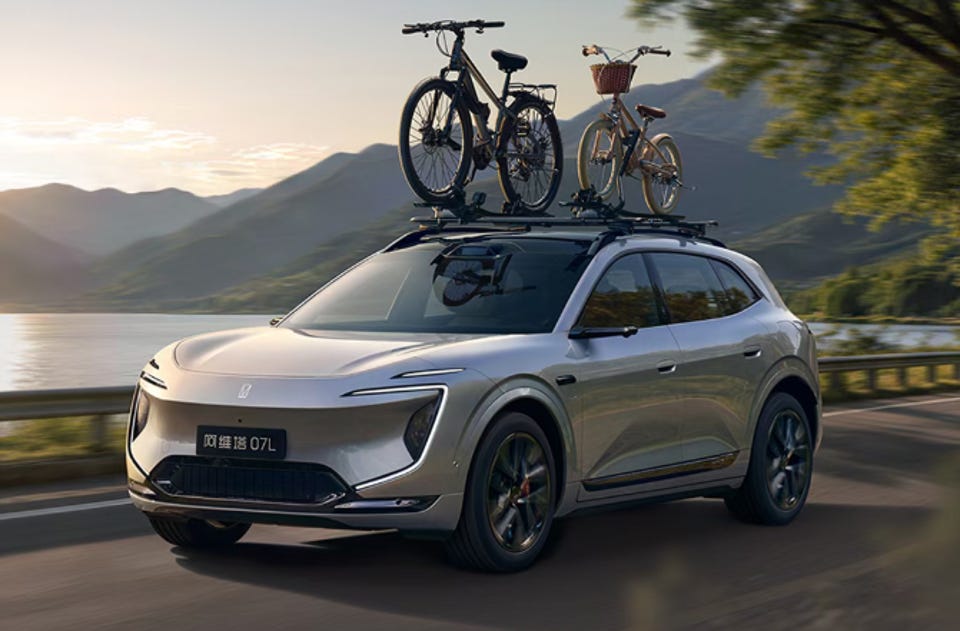
Chinese technology media outlet ITHome reported on August 10, 2026, that Yong Jun, Vice President of Changan-backed AVATR, had made an unusually direct statement about the automaker’s relationship with Huawei.
His message was straightforward: Huawei may be AVATR’s best technology partner today, but that does not mean AVATR must remain tied to Huawei forever.
AVATR has worked closely with Huawei since its creation and uses technologies including Huawei’s Qiankun intelligent-driving system. AVATR is also the second-largest shareholder in Yinwang, the company that operates Huawei’s automotive solutions business.
According to Yong, however, the current partnership model is not a mandatory condition for AVATR’s future.
AVATR intends to retain its own ability to differentiate its vehicles, independently select the best technology partners, and potentially work with companies other than Huawei in the future.
This may appear to be a disagreement between two Chinese companies.
It could represent something much larger.
AVATR’s comments highlight an emerging struggle over who will control the automobile in the AI Vehicle, or AIV, era: the OEM that manufactures and sells the car, or the technology supplier that increasingly determines how the car perceives, thinks, acts and improves.
Yong’s description of AVATR’s preferred relationship with Huawei is particularly revealing.
AVATR would like Huawei to function more like a broadly available technology platform.
In that model:
Huawei provides powerful underlying technologies.
AVATR chooses which technologies to adopt.
AVATR integrates them into its vehicles.
AVATR retains control over product differentiation.
AVATR remains free to select alternative technology partners when appropriate.
What AVATR apparently does not want is a relationship in which Huawei performs increasingly customized development for individual AVATR models until Huawei itself becomes central to defining the vehicle.
The distinction can be summarized simply:
AVATR wants to build differentiated AVATR vehicles using Huawei technology. It does not want Huawei technology to become the primary reason an AVATR is an AVATR.
That distinction could become fundamental to the automotive industry’s transition toward AI.
AVATR has promoted its relationship with Huawei heavily since its establishment.
Yet the brand has not achieved the kind of market breakthrough that might have been expected from combining Changan’s manufacturing capabilities, CATL’s battery expertise and Huawei’s intelligent-vehicle technologies.
That does not mean Huawei’s automotive strategy has failed.
Its clearest success has occurred elsewhere: Harmony Intelligent Mobility Alliance, or HIMA.
HIMA is Huawei’s deeply integrated automotive business model involving multiple Chinese automakers. It currently encompasses five vehicle brands, commonly referred to in China collectively as the “Five Jie,” because each Chinese brand name ends with the character 界.
But even within HIMA, the success is uneven.
AITO, developed with SERES, remains by far the clearest commercial success.
That difference matters when considering AVATR’s position.
AVATR originated under the model once widely known as Huawei Inside, or HI.
Under this arrangement, Huawei is fundamentally a technology supplier, although a particularly important one.
HIMA goes much further.
Huawei is deeply involved not only in core vehicle technologies but also in areas including:
Product definition
Intelligent driving
Smart cockpit systems
Branding
Marketing
Retail
Customer-facing communications
This has created an entirely new relationship between supplier and automaker.
In an extreme interpretation, the participating OEM increasingly resembles the manufacturer of a Huawei-defined automobile.
That raises an obvious question.
If AVATR — which retains considerably more independence than a HIMA brand — is already emphasizing that Huawei must not become indispensable, what are Huawei’s HIMA partners thinking?
Those partners include:
SERES for AITO
Chery for LUXEED
BAIC for STELATO
JAC for MAEXTRO
SAIC Motor for SAIC’s HIMA brand
The issue is especially relevant for HIMA brands that have yet to reproduce AITO’s commercial success.
SERES itself may provide an early indication of what comes next.
Although AITO represents the most successful Huawei-linked automotive brand, SERES is simultaneously developing another AI-oriented initiative through its subsidiary SAITOU Technology.
Its new AIVA project has selected ByteDance’s AI cloud business, Volcengine, as a technology partner.
That does not mean SERES is abandoning Huawei.
It does demonstrate something more subtle: even Huawei’s most successful automotive partner sees value in developing capabilities and partnerships outside the Huawei ecosystem.
That resembles the strategic flexibility Yong is advocating for AVATR.
If SERES is already diversifying its AI relationships despite AITO’s success, it would be difficult to assume that less successful Huawei partner OEMs will indefinitely avoid doing the same.
There is an irony at the center of this situation.
One reason automakers want Huawei is that Huawei’s automotive technology is genuinely competitive.
Huawei has built substantial capabilities across:
Qiankun ADS intelligent driving
HarmonySpace smart cockpit technology
Vehicle control systems
Electric-drive technologies
Digital infrastructure
AI
Its brand also carries extraordinary weight with Chinese consumers.
After years of Huawei’s involvement in automobiles, consumers increasingly understand what a “Huawei car” represents.
And that creates the problem.
Consider AITO.
How much does the typical buyer care that SERES manufactures the vehicle?
How much does the consumer distinguish between AITO’s independent brand identity and Huawei’s identity?
For many buyers, the critical factor is simply:
“This is a Huawei car.”
That is an extraordinary achievement for a supplier.
It is also potentially dangerous for the OEM.
The same problem becomes even more pronounced for automakers whose Huawei-equipped vehicles are less commercially successful.
If multiple brands offer similar Huawei intelligent-driving and cockpit technologies, then simply adopting Huawei no longer creates differentiation.
AVATR’s comments can therefore be interpreted as recognition of a fundamental problem:
If everyone uses the same highly visible technology supplier, the supplier becomes differentiated while its customers become less differentiated.
That is almost the inverse of the traditional automotive supplier relationship.
China’s EV transition has already produced a similar structural change.
The clearest example is CATL.
The battery giant has become one of the most powerful companies in the global automotive industry, generating profits that can exceed those of multiple automakers combined.
Its strategic importance is such that the traditional relationship between OEM and supplier has visibly changed.
Recently, Leapmotor founder Zhu Jiangming personally delivered one of his company’s latest MPVs to CATL’s chairman.
The symbolism is difficult to miss.
For most of automotive history, automakers dominated the value chain and suppliers competed for their business.
The EV era began changing that hierarchy.
The rise of CATL demonstrated that control over a sufficiently important technology could give a supplier enormous leverage over the OEMs it serves.
This may be one of the deeper meanings of the often-used phrase that the automotive industry is undergoing its “greatest transformation in a century.”
The transformation is not merely that combustion engines are being replaced by batteries.
It is also that the century-old industrial structure in which OEMs controlled the market and their suppliers is beginning to fracture.
The battery revolution may only have been the first stage.
A battery remains, fundamentally, a physical component supplied to an automaker.
AI is different.
An automotive AI system can potentially participate in a continuous loop:
Perceive the environment
Understand the situation
Predict what may happen next
Make decisions
Control the vehicle
Collect new data
Learn from that data
Improve driving behavior
Improve in-cabin experiences
Deliver new capabilities through OTA updates
This creates a radically different supplier relationship.
The supplier is no longer necessarily finished once the component has been delivered.
Instead, the AI provider may need to remain involved throughout the vehicle’s life.
And because the vehicle continuously generates data, the supplier can potentially improve its technology after deployment.
The relationship becomes continuous rather than transactional.
This may be the most consequential difference between EVs and AI Vehicles.
In the traditional model:
Supplier → component → OEM → vehicle
In an AI-centric model, the relationship can become:
AI supplier → vehicle → user behavior and driving data → model improvement → OTA update → improved vehicle → more data
Whoever controls that loop acquires something far more valuable than a component order.
It gains a mechanism for continuously improving the product.
If the OEM does not control the loop, it risks becoming dependent on a supplier not only for technology but also for future product development.
The supplier becomes difficult to replace precisely because replacing it could disrupt the vehicle’s intelligence, data pipeline and continuous improvement process.
This is where Huawei represents something potentially more disruptive than CATL.
Huawei is unusual even by global technology-industry standards.
Few suppliers combine comparable capabilities in telecommunications, semiconductors, operating systems, cloud computing, AI, consumer electronics, intelligent driving, electric-drive systems and retail.
Its automotive model may therefore be difficult to reproduce outside China.
But the structural issue is not unique to Huawei.
As cars become AI Vehicles, automakers increasingly need external technologies in areas that directly influence what consumers experience.
The more intelligence moves into AI, the greater the possibility that the technology provider — rather than the automaker — defines the product.
At some point, the question becomes existential:
If the supplier controls how the vehicle thinks, drives, learns and improves, what exactly remains for the OEM to control?
There is historical irony here.
SAIC Motor, now itself participating in HIMA, once publicly resisted a deeper Huawei relationship.
Under its previous chairman, SAIC argued that an automaker could not simply allow an external technology company to provide an integrated solution because doing so risked handing over the vehicle’s “soul.”
The remark was widely debated in China at the time.
The current situation makes it worth reconsidering.
AVATR’s desire to preserve technology choice and product differentiation suggests that the underlying concern never disappeared.
The question was never simply whether Huawei technology was good enough.
It was whether using sufficiently powerful external technology could eventually weaken the OEM’s ability to define its own products.
There is another Chinese automaker taking almost the opposite approach: BYD.
BYD is perhaps the automotive industry’s clearest contemporary example of vertical integration.
It controls major capabilities across:
Batteries
Semiconductors
Electric motors
Power electronics
Vehicle control
Automotive manufacturing
Unlike most Chinese automakers, BYD does not depend on CATL for its core battery supply.
Geely has also been building extensive internal battery capabilities.
It is notable that China’s two largest NEV groups have both sought to reduce dependence on the country’s dominant battery supplier.
That may not be a coincidence.
BYD has historically been less aggressive than some Chinese competitors in advanced driving.
That is changing.
Recent information has revealed substantial internal BYD research into Vision-Language-Action, or VLA, models for advanced driving.
A VLA architecture attempts to connect visual perception, language-based understanding or reasoning, and physical action.
In an automotive context, that could ultimately allow an AI system to:
See the driving environment
Interpret complex situations
Reason about appropriate behavior
Translate that reasoning into vehicle actions
This is particularly interesting because BYD has also worked with external technology companies including Momenta and Huawei.
Its internal VLA research suggests that external partnerships do not necessarily mean surrendering long-term control over the core AI stack.
BYD may be preparing to repeat in AI what it already did in batteries.
The logic would be consistent with BYD’s history.
During the EV transition:
Do not allow a dominant battery supplier to control a critical part of the product.
During the AI Vehicle transition:
Do not allow a dominant AI supplier to control how the vehicle perceives, decides, acts and improves.
That does not necessarily mean every underlying technology must be created internally.
Automakers can still use external chips, foundation models, cloud infrastructure and specialized suppliers.
The more important question is whether the OEM retains control over:
Vehicle data
AI integration
Learning and iteration
Vehicle control
User experience
OTA development
Product definition
This may become the new definition of automotive vertical integration.
AVATR’s comments therefore deserve attention beyond the immediate Huawei relationship.
They point toward a much larger industrial question.
During the EV transition, battery suppliers gained unprecedented power.
During the AIV transition, AI suppliers could gain even more.
Three broad models are beginning to emerge in China:
Huawei model: Build an extremely powerful automotive AI and technology platform and deploy it across multiple OEMs.
AVATR model: Use leading external technology, but preserve the ability to choose suppliers and differentiate the final product independently.
BYD model: Internalize an increasingly large share of the critical technology stack and preserve control through vertical integration.
There is no guarantee that one model will dominate.
But the strategic stakes are becoming clearer.
For a century, the automaker sat at the center of the automotive industry and suppliers operated around it.
EVs began weakening that hierarchy.
AI could overturn it.
AVATR’s statement that Huawei is today’s best choice but not necessarily a permanent one may therefore be more than negotiating language between partners.
It could be an early sign of OEM resistance in the AI Vehicle era — an attempt by automakers to ensure that, even as cars become intelligent machines, the company whose badge is on the hood still controls what the vehicle ultimately becomes.
No posts
Comments
Nothing yet. Say the first thing.
Sign in to join the conversation.