
Dear Readers,
This week the numbers and moves reveal a China pushing hard for sovereignty abroad while the fiscal foundation beneath that push quietly gives way. Beijing hunts offshore capital to plug local government gaps, both PMI indices slip into contraction for the first time since the COVID lockdowns, Merz maps out Europe’s next move using China’s own technological dependencies, DeepSeek breaks ground on a 1-gigawatt AI hub in Inner Mongolia, and Chinese electric trucks reach European roads through an Austrian assembly loophole. While Beijing extends its industrial and technological reach across continents, a 31.5 percent crash in land-sale revenues at home forces the state into corners it has avoided for years. Follow me through the reports.

Generated by AI (DALE-E3)
These reports demand hours of digging, cross-checking, and plain writing to reach you clear and sharp. If they sharpen your view, keep them coming strong.
Subscribe now and go paid if you can. Every dollar buys more depth and keeps the flow independent.
Share this edition with someone who needs the unfiltered read. Drop a comment below with your take. Your moves keep the lights on and the conversation alive.
Start with the fiscal emergency that no official narrative admits. China Closes Offshore Tax Loopholes: Target Capital Flight details how Beijing is imposing a 20 percent annual tax on all income generated inside offshore trusts, regardless of whether distributions are made to beneficiaries. The trigger is a 31.5 percent year-on-year collapse in land-sale revenues in the first half of 2026, the primary funding source for local governments. A 90-day amnesty window runs until October 22, inviting citizens who opened offshore trusts between 2023 and 2025 to declare holdings without penalty. The investigation into beverage tycoon Zong Qinghou’s estate, which revealed a hidden offshore portfolio of roughly 2.1 billion US dollars, shows the scale of what Beijing is now targeting. The clamp does not signal a new policy posture; it signals a fiscal system running out of alternatives.
This fiscal tightening at the top of the wealth pyramid occurs against a backdrop of broad economic contraction at the base.
For the first time since the COVID lockdowns, both the official manufacturing PMI and the official composite PMI entered contractionary territory simultaneously. China Reports Weak PMIs: Manufacturing Loses Steam tracks how the official manufacturing PMI dropped to 49.2 in July, while the non-manufacturing PMI hit 49.0, its lowest reading since the lockdown period. The construction sub-index fell to 47.0, reflecting the persistent drag of the real estate collapse. Even the private S&P RatingDog PMI, which held slightly positive at 50.9, registered its first decline in purchasing volumes since November. State-led high-tech investment is not large enough to offset the weight of a collapsing property sector and weak consumer spending. The bifurcation is structural, and it is widening.
China Reports Weak PMIs: Manufacturing Loses Steam
·
Aug 3
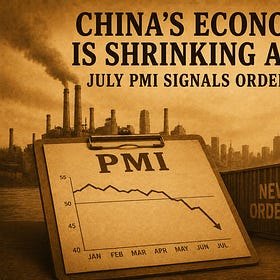
In July, conditions for China’s manufacturing sector deteriorated noticeably and fell short of expectations. Both the official gauge and the private S&P RatingDog PMI pointed downward. While the official purchasing managers’ index is signaling contraction again, the private index remains above the expansion threshold of 50 points.
Such structural weakness at home is precisely what European policymakers are now mapping as strategic leverage.
European leadership is no longer debating whether to push back. China’s Pain Points: Merz Prepares for a Trade War examines how Germany has identified specific technological choke points in Chinese semiconductor manufacturing, particularly the dependency on European high-precision optics and specialized equipment. Cutting maintenance and software updates for that equipment leaves Chinese production lines inoperable within weeks, with no formal sanction required. Germany has lost more than 400,000 export-linked jobs since its China trade peaked in 2021. Merz is pushing for a new Plaza Accord to address the yuan’s systematic undervaluation. Europe is moving from passive protection to active power politics, and the leverage it holds is real.
China’s Pain Points: Merz Prepares for a Trade War
·
Aug 4
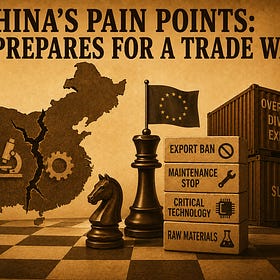
Chancellor Friedrich Merz is apparently systematically mapping China’s economic vulnerabilities through the National Security Council and examining which of them could be used to counter the growing pressure from Beijing. Only months ago, Merz spoke of a strategic partnership. Today he is probing where the Chinese economy could be put under pressure in …
These external pressure points explain the urgency behind China’s drive to build compute sovereignty before the next wave of restrictions lands.
Out of US chip sanctions and funding pressure comes a concrete infrastructure response. DeepSeek’s Green AI Datacenter in Inner Mongolia describes a planned 1-gigawatt datacenter in Ulanqab, where electricity costs 0.32 yuan per kilowatt-hour and the grid mix exceeds 80 percent renewables. DeepSeek raised 7.4 billion US dollars in June 2026, valuing the startup at up to 59 billion US dollars. China’s total datacenter power demand is on track to reach 289 TWh by 2030, accounting for 2.3 percent of national consumption. The Ulanqab project remains smaller than the 3 to 5 gigawatt facilities US rivals are building, and the financing gap for comparable scale is enormous. The strategic logic is clear: build sovereign compute capacity before the next constraint closes the window.
DeepSeek's Green AI Datacenter in Inner Mongolia
·
Aug 6
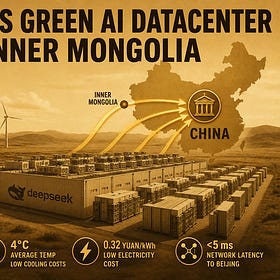
DeepSeek is planning a gigawatt-scale datacenter in Ulanqab. Powered by renewable energy from Inner Mongolia and running on its own hardware, the Chinese AI company is taking the fight to US rivals.
Such sovereign infrastructure plays abroad are matched by a quieter kind of market adaptation in Europe’s own logistics halls.
Finally, the story that shows how European trade policy is undermining its own intent. Made in Austria: China Electric Trucks Take Europe explains how Chinese manufacturers ship Semi Knocked Down kits to Austria, assemble them locally, meet EU rules of origin, and sidestep import duties entirely. The Windrose Global E700 sells for approximately 250,000 euros, which is 30 percent cheaper than comparable models from Mercedes or Volvo. SuperPanther has a delivery target of 16,000 electric trucks to Europe by 2030. Already 30 percent of new heavy-truck registrations in China ran on alternative drive in the first half of 2026. European cities pushing for zero-emission logistics zones are inadvertently accelerating the market entry of exactly the competitors their tariff policy was designed to slow. The misreading is not accidental; it is structural.
Made in Austria: China Electric Trucks Take Europe
·
Aug 7

On July 27, the first eTopas electric truck from the startup SuperPanther, founded only in 2022, rolled off the line at Steyr and was handed over to launch customer DHL. Additional customers with confirmed orders include Gress Speditions, Temmel, and the LONtEX Group. The first vehicles will operate in Germany, Austria, the Netherlands, Poland, and the …
Beijing clamps down on offshore capital because land revenues have collapsed 31.5 percent, not because the fiscal architecture is sound. The simultaneous contraction of both official PMI indices exposes the gap between the state’s high-tech narrative and the economic reality most citizens live in. Against that weakening base, Europe is shifting from reactive protection to active pressure, mapping the exact maintenance dependencies that freeze Chinese semiconductor lines without a single formal measure. DeepSeek’s Inner Mongolia datacenter is a direct answer: build sovereign compute capacity before the next restriction lands. Yet even as China positions for technological self-sufficiency, its manufacturers quietly assemble electric trucks in Austrian halls, routing around tariffs that Europe’s own climate mandates have made redundant. China advances on technology and trade corridors abroad, while the fiscal floor it stands on cracks beneath the weight of that ambition.
Which development stands out most to you?
Share it in the replies. Your read steers the next course. Until next week.
No posts
Comments
Nothing yet. Say the first thing.
Sign in to join the conversation.