
On July 27, the first eTopas electric truck from the startup SuperPanther, founded only in 2022, rolled off the line at Steyr and was handed over to launch customer DHL. Additional customers with confirmed orders include Gress Speditions, Temmel, and the LONtEX Group. The first vehicles will operate in Germany, Austria, the Netherlands, Poland, and the Czech Republic. SuperPanther plans to deliver 100 to 200 vehicles by the end of the year, and up to 16,000 electric trucks are targeted for Europe by 2030.
Since March, the Austrian contract manufacturer has also been assembling semi-trailer trucks for Sinotruk, one of China’s largest commercial vehicle manufacturers. The vehicles in question appear to be modified MAN trucks. The connection makes sense, given that MAN supplies Sinotruk with components for its trucks. Production at Steyr completes a circle, as the Upper Austrian plant was originally built by MAN. The Sinotruk models are manufactured not only as battery-electric vehicles but also as diesel variants. 600 to 800 units are planned for the EMEA region this year, covering Europe, Africa, and the Middle East.
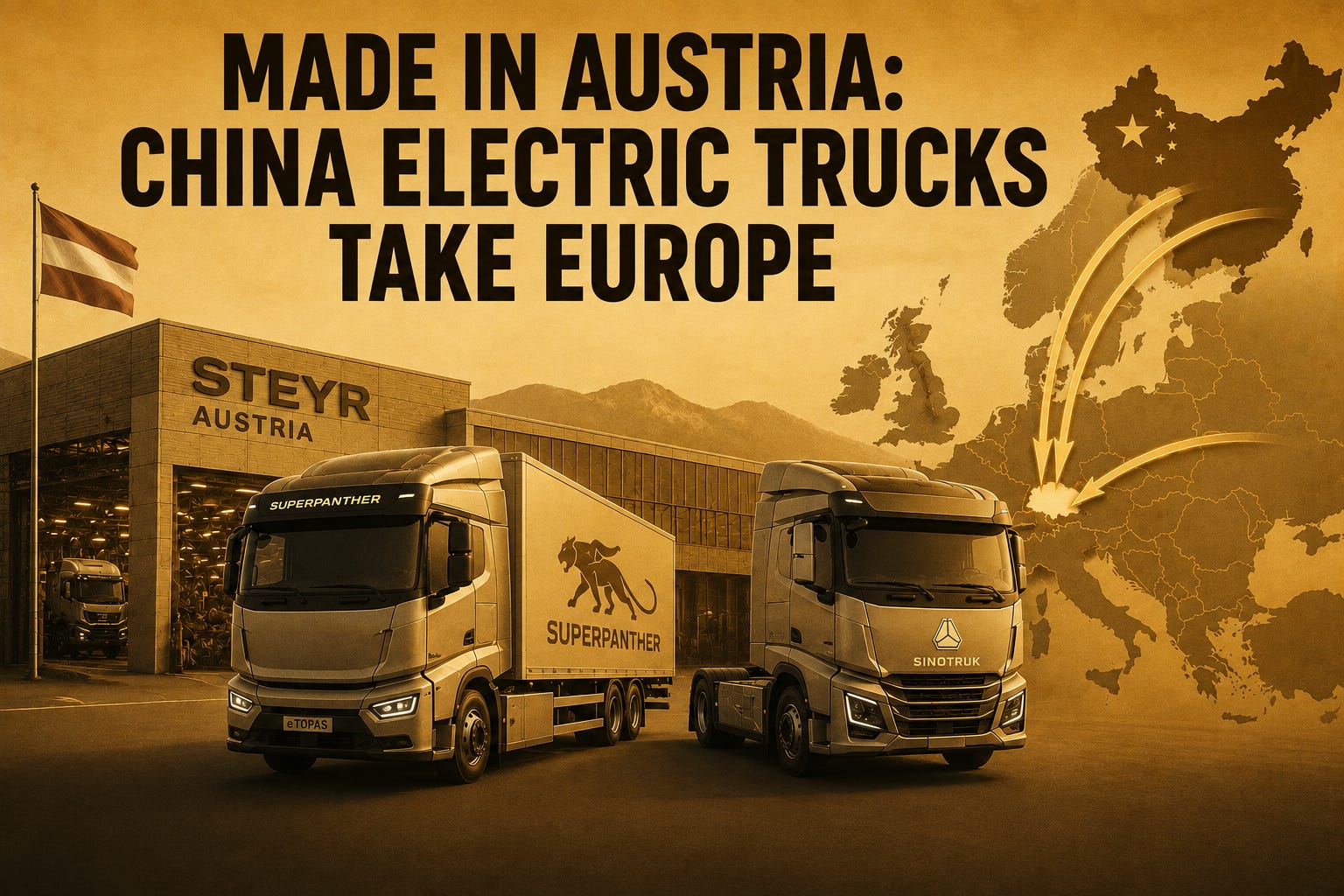
Generated by AI (DALE-E3)
Both Sinotruk and SuperPanther supply so-called SKD (Semi Knocked Down) kits, partially pre-assembled modules shipped from China and assembled at Steyr for the European market. The kits are assembled locally into road-ready electric trucks, fitted with European components, inspected, and delivered. Both manufacturers plan to transition at a later stage to CKD assembly (Completely Knocked Down), where trucks arrive in individual parts and are fully built in Austria. That approach creates more employment at Steyr, since cabin production and painting would also be carried out locally.
By assembling in Austria, the vehicles meet EU rules of origin and thereby avoid EU import duties on Chinese commercial vehicles. Steyr is not alone: BYD produces in Hungary, and Windrose assembles trucks in Antwerp. The Windrose Global E700, aimed at the European market, was developed in just three years on a budget of around 99 million US dollars and offers a range of 670 km.
At approximately 250,000 euros per unit, the Windrose Global E700 costs around 30 percent less than a comparable truck from Mercedes, Volvo, or MAN. The two Chinese models cover a range from roughly 380 km for the Sinotruk to 500 km for the SuperPanther eTopas. That comfortably covers typical European delivery requirements, which average 143.5 km. According to ING calculations, around 30 percent of all heavy-duty transport operations in the EU are already economically viable for electrification. In China, price parity between diesel and purely electric trucks is nearly reached. Since operating costs for battery-electric vehicles are lower, thanks to reduced maintenance needs and cheaper electricity, they are already the more economical choice in the Chinese market.
The key driver in Europe is the spread of Zero Emission Zones in major cities, such as Stuttgart. Because of the city’s basin geography, which traps air masses and worsens air quality and particulate pollution, diesel vehicles face increasingly strict entry restrictions. Electric trucks, operating emission-free at the local level, are taking over urban supply routes. Other European cities such as Paris, London, and Amsterdam are moving even faster down this path than Germany.
The first wave of electrification is therefore concentrated not in long-haul transport but in regional distribution and urban delivery. In cities with emission-free zones, price alone no longer determines truck purchasing decisions. Companies supplying customers within these zones must adapt their fleets to regulatory requirements. The push for demand is coming less from the market than from European and municipal policy.
This effect is amplified by the EU Eurovignette Directive, which allows member states to set road tolls according to CO2 emissions. For electric trucks, tolls can be partially or fully waived. For daily operations in and around urban centers, this substantially improves the economics of electric vehicles. In addition, electric vehicles improve a company’s overall fleet CO2 rating, reducing future toll costs across the board.
In China, alternative-drive heavy trucks already account for around 30 percent of new registrations in the first half of the year. By 2030, a joint plan from eleven ministries calls for 40 percent of new heavy-truck registrations to use alternative drives, with 20 percent of the existing fleet to be purely electric. In addition, 18 percent of highway freight volume is to run on emission-free corridors. By all current indications, these targets will be met considerably ahead of schedule.
No posts
Comments
Nothing yet. Say the first thing.
Sign in to join the conversation.