
Dear Readers,
This week the five reports converge on the same structural bind. China’s humanoid robot industry claims 85 percent of global shipments on the back of state subsidies, a leading economist argues that AI cannot close the structural employment gap this industrial push creates, Beijing’s coercive port campaign against Panama ends in a strategic retreat, July economic data reveal high-tech sector output surging as consumer spending flatlines and private investment contracts, and a Plaza Accord 2.0 proposal frames China’s trade surplus as the product of a domestic market too broken to absorb what Beijing builds. Even as the supply side scales at record speed, the demand side is contracting on multiple fronts, and the international system is running out of capacity to absorb the difference. Follow me through the reports.

Generated by AI (DALE-E3)
These reports demand hours of digging, cross-checking, and plain writing to reach you clear and sharp. If they sharpen your view, keep them coming strong.
Subscribe now and go paid if you can. Every dollar buys more depth and keeps the flow independent.
Share this edition with someone who needs the unfiltered read. Drop a comment below with your take. Your moves keep the lights on and the conversation alive.
Start with the fastest industrial land grab of 2026. 85% Market Share: China’s Humanoid Takeover tracks how Beijing turned a nascent hardware category into a supply-chain conquest. Global humanoid robot shipments rose more than 3.7-fold in the first half of 2026, reaching 19,100 units. China captured 85 percent of all deliveries. Unitree posted 220 million euros in revenue last year and 36 million euros in net profit. AgiBot crossed 130 million euros in revenue and delivered 15,000 units by June 2026. Beijing cleared Unitree’s STAR Market IPO in 73 days via a special pre-review mechanism, with offline demand exceeding supply by a factor of 2,760. One structural gap persists. China depends on foreign AI chips and sensors for the intelligence layer, the same bottleneck that caps its semiconductor program. The pattern is familiar. Solar and EVs first, now humanoid hardware, all driven by state subsidies, accelerated capital markets, and a domestic supply chain that foreign rivals cannot replicate quickly.
85% Market Share: China’s Humanoid Takeover
·
Aug 19

In the first half of this year, global humanoid robot shipments rose more than 3.7-fold. With 19,100 units, sales volume significantly exceeded the prior-year period, in which only 5,100 units were delivered between January and June. China accounts for roughly 85 percent of these human-like robots.
This supply-side surge occurs while China’s labor market faces a structural deficit that automation deepens rather than closes.
The official unemployment rate does not capture what is happening. AI Won’t Save China: Top Economist’s Dire Warning examines why China’s high-tech push cannot replace the employment engine the property crash is dismantling. Factoring in discouraged workers who have left the labor force, China’s adjusted urban unemployment reaches 10.2 percent, against an official 5 percent. Youth unemployment officially tops 15 percent. A Chinese cement company employs a median of 20,174 workers. A chip company of comparable economic value employs 830. Fixed-asset investment is now contracting outright, a structural break that has occurred only twice before in the People’s Republic’s history, after the Great Leap Forward and during the Cultural Revolution. State subsidies have mechanized production at the cost of payrolls, severing the link between growth and household income. With 44 percent of urban workers in gig roles without safety nets, no volume of AI spending restores what China is losing.
AI Won’t Save China: Top Economist’s Dire Warning
·
Aug 18
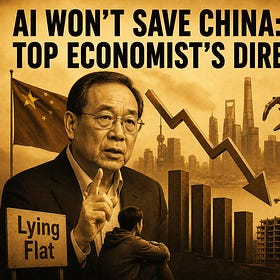
In a lecture delivered at the China Macro-Economy Forum (CMF) at Renmin University by the director of the Academic Center for Chinese Economic Practice and Thinking (ACCEPT) and professor at the prestigious Tsinghua University, shortly before the release of China’s second-quarter
This employment fracture ties into a wider pattern where coercive leverage abroad carries the same ceiling as the economic pressure Beijing fails to convert into domestic demand.
China’s port diplomacy ran into a wall. China Lost Panama: Beijing’s Port Revenge Backfires details the retaliatory campaign Beijing launched after Panama’s Supreme Court stripped a Chinese-affiliated conglomerate of the Balboa and Cristóbal terminal concessions at the Panama Canal. Between March and June 2026, Chinese authorities detained 431 Panama-flagged vessels in Chinese ports under “safety inspections.” Monthly detentions peaked at 140 in May, against a baseline of 21. China was responsible for 91 percent of all such maritime measures against Panamanian ships across Asia-Pacific during this period. CK Hutchison’s subsidiary launched international arbitration seeking over 2 billion US dollars in damages. None of it reversed the ruling. The concessions passed to a Western consortium of MSC, Maersk, and BlackRock. Beijing’s campaign closed with a damaged reputation in the Global South, the region it presents as the alternative to Western conditionality.
China Lost Panama: Beijing's Port Revenge Backfires
·
Aug 21

The ruling by Panama’s Supreme Court sends the power struggle between China and the United States over port terminal control into its next round. After Panama’s Supreme Court revoked CK Hutchison‘s concession to operate the two terminals at Balboa and Cristóbal, and the new operators,
This geopolitical setback occurs alongside a domestic picture the July data make impossible to ignore, where high-tech output surges and the broader economy does not.
The July numbers do not describe a transition. China’s AI Hype Can’t Hide the Domestic Slump shows the widening gap between state-directed high-tech output and private economic activity. Semiconductor production rose 20.7 percent year-on-year. Industrial robot output climbed 30.2 percent. NEV production jumped 29.9 percent. Against this, only 4 of 70 tracked cities saw new-home price gains in July, and not a single city recorded a year-on-year increase in the resale market. Real estate investment fell 19.2 percent from January through July. New construction starts declined 24.0 percent. Developer funding shrank 20.3 percent. Nominal retail sales grew 0.6 percent in July, flat in real terms against 0.5 percent inflation. Overall fixed-asset investment contracted 6.7 percent through July. Private companies cut equipment spending by 9.4 percent. Household borrowing has declined for 16 consecutive months. The state grows one economy while the private sector deflates another.
China’s AI Hype Can’t Hide the Domestic Slump
·
Aug 19
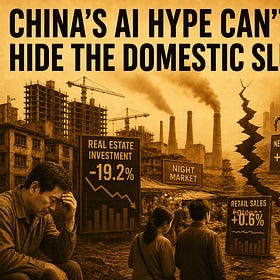
Beneath the polished surface of artificial intelligence and technological progress, reality paints a far more nuanced picture of China’s current situation. While the leadership is forcing a shift toward strategic future industries, the underlying substance shows considerable drag. A look at the July figures from the National Bureau of Statistics makes c…
This fracture between state-forced output and private-sector contraction adds weight to the Plaza Accord 2.0 debate, which frames China’s surplus as the product of a domestic market too broken to absorb what Beijing builds.
Finally, the global frame that connects all five stories. Global Crisis Made by China: Will Plaza 2.0 Save Us analyzes the case for a coordinated international response to China’s export-displacement strategy. China’s trade surplus grew 20 percent in the early months of 2026, topping an annualized rate of over 1.2 trillion US dollars. The OECD estimates that state subsidies account for 60 percent of Chinese exporters’ market share gains. Economists Brad Setser and Jürgen Matthes calculate a structural yuan undervaluation of 19 percent, with true undervaluation estimated closer to 30 percent. China has built annual NEV production capacity of 55 million vehicles against a domestic market that absorbed 30 million passenger cars in 2025. Germany is losing an estimated 10,000 industrial jobs per month. A Plaza Accord 2.0 targets currency misalignment, but the source of the surplus is structural overcapacity built on subsidized production that a domestic market too broken to consume cannot absorb. Currency realignment alone does not close a factory.
China’s humanoid industry claims 85 percent of global shipments before meaningful demand exists, executing the same supply-chain conquest that reshaped solar panels and EVs before it. Yet the economist’s structural case shows that the subsidized capital model powering this expansion actively destroys the payrolls needed to generate the household income to consume what is produced. Against this, Beijing’s Panama campaign demonstrates that coercive leverage has a ceiling. The terminal concessions are gone, the reputational cost in the Global South is real, and the campaign produced no reversal. The July data close the circuit. Private companies cut equipment spending by 9.4 percent, households reduce borrowing for the sixteenth consecutive month, and not a single city records a year-on-year resale price gain in property, even as state-directed sectors scale at record rates. China scales output at home and abroad with state force, yet the demand needed to sustain this, on domestic markets and in the global system pressed to absorb its surplus, is not forming.
Which shift stands out most to you? Share it in the replies. Your read steers the next course. Until next week.
No posts
Comments
Nothing yet. Say the first thing.
Sign in to join the conversation.