
The government in Beijing is responding to the economy’s persistent weakness with new measures to stimulate domestic demand. Deputy Finance Minister Liao Min announced on Friday at a press conference that an expanded support package had taken effect retroactively from August 1. The new stimulus package focuses primarily on higher interest-rate subsidies for micro and small businesses as well as for private consumers.
The state program has already supported the issuance of new loans worth roughly 3 trillion US dollars in the first seven months of the year, an increase of just over 4 percent compared to the same period last year. The current stimulus package builds directly on these existing structures.
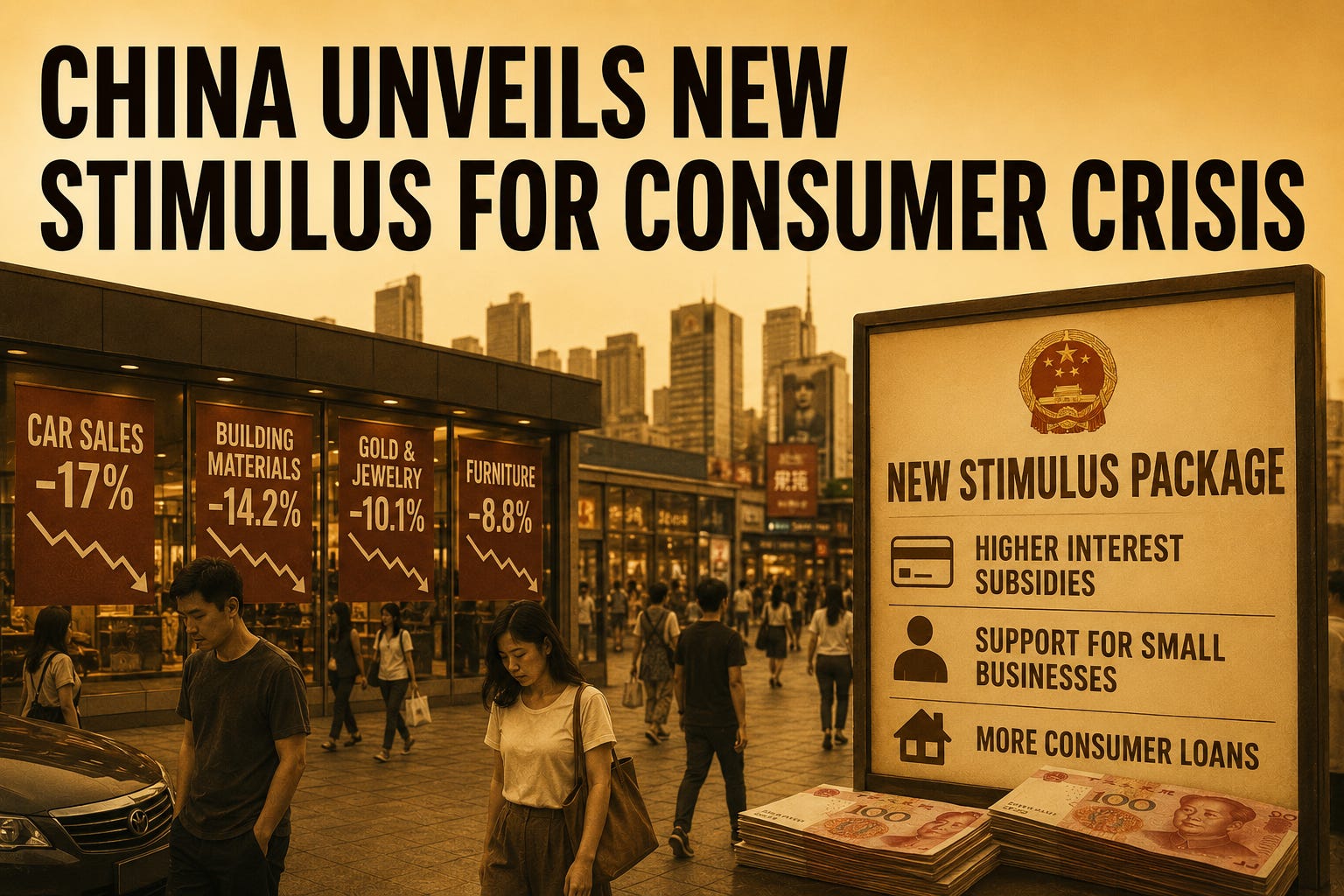
Generated by AI (DALE-E3)
The focus is not on new direct transfers to private households but on an expansion of existing credit instruments. In addition to certain bank loans, installment payments via credit cards for car purchases and renovations will now also be subsidized. Working capital loans for small and medium-sized enterprises fall under the expanded provisions as well. The Finance Ministry is thus primarily trying to extend the reach of measures that have so far been limited in scope.
For implementation, the pool of participating financial institutions has been expanded from roughly 100 to around 400. In addition to state banks, the network now includes local banks, private banks and foreign institutions with a credit rating of at least AA+. Credit ceilings are also moving upward. The eligible amount for small and medium-sized enterprises rises from roughly 7.4 million to around 11 million US dollars, while service-sector companies can now claim up to roughly 2.9 million US dollars compared with 1.5 million previously. For private consumer loans, the ceiling on the interest-rate subsidy rises from approximately 440 to around 740 US dollars. Many observers are skeptical, however, that this expanded stimulus package will achieve the broad impact sought.
Against the backdrop of the latest consumption figures, the limits of the policy intervention become clear. According to data from the National Bureau of Statistics published on August 15, retail sales in July grew by just 0.6 percent year on year in nominal terms. Accounting for consumer price inflation of 0.5 percent, real growth is barely positive. The weakest areas were precisely those that were supposed to benefit most from existing consumption programs. Car sales fell 17 percent, building materials 14.2 percent, gold and jewelry 10.1 percent, and furniture 8.8 percent. Even the new Chinese stimulus package is unlikely to trigger a turnaround in these sectors in the short term.
Two key metrics, net household borrowing and the gap between income growth and consumption expenditure, reveal how little confidence the population currently has in the economic outlook. Rather than taking out new consumer loans, households repaid a net 165 billion US dollars by mid-year. At the same time, disposable income rose 5.2 percent in the first half of the year while private consumption expenditure increased by only 3.7 percent. A growing share of additional income is thus flowing not into spending but into savings.
The effectiveness of the scrappage program is waning further, as the car market makes plain. Despite an expansion of the measures, car sales fell by a double-digit percentage in July. Even though the program triggered roughly 178 million purchases this year alone, with a subsidy volume of around 27.6 billion US dollars generating total sales of roughly 194 billion US dollars, the effect is running out of steam. That a purely credit-based stimulus package can remedy this is widely considered unlikely, since households merely bring forward purchases they would have made anyway.
Liao Min also highlighted the orientation of the 15th Five-Year Plan, under which spending on education, social security, healthcare and housing is set to rise to around 1.8 trillion US dollars this year. Despite this announcement, a substantial share of government support continues to flow into infrastructure, industry and the stabilization of local government finances. The latest stimulus package fits this pattern. Beijing continues to follow the old playbook, yet the numbers show that its effectiveness is declining. This is especially the case given that local governments are heavily indebted and new loans are servicing interest rather than funding new investment.
The underlying problem of China’s domestic demand thus persists. Private households have rising incomes but less wealth. The decline in property values, which hits the consumption-oriented middle class hardest, combined with poor labor market prospects and a broadly pessimistic outlook, is eroding consumer confidence. Without direct wealth support, this stimulus package too will dissipate against the worries of consumers.
With the measures just announced, it is confirmed that the Politburo views the figures on economic growth and the general economic environment as bad, but not yet bad enough to consider a change in policy. The Chinese stimulus package on the table provides clear evidence of that.
No posts
Comments
Nothing yet. Say the first thing.
Sign in to join the conversation.