
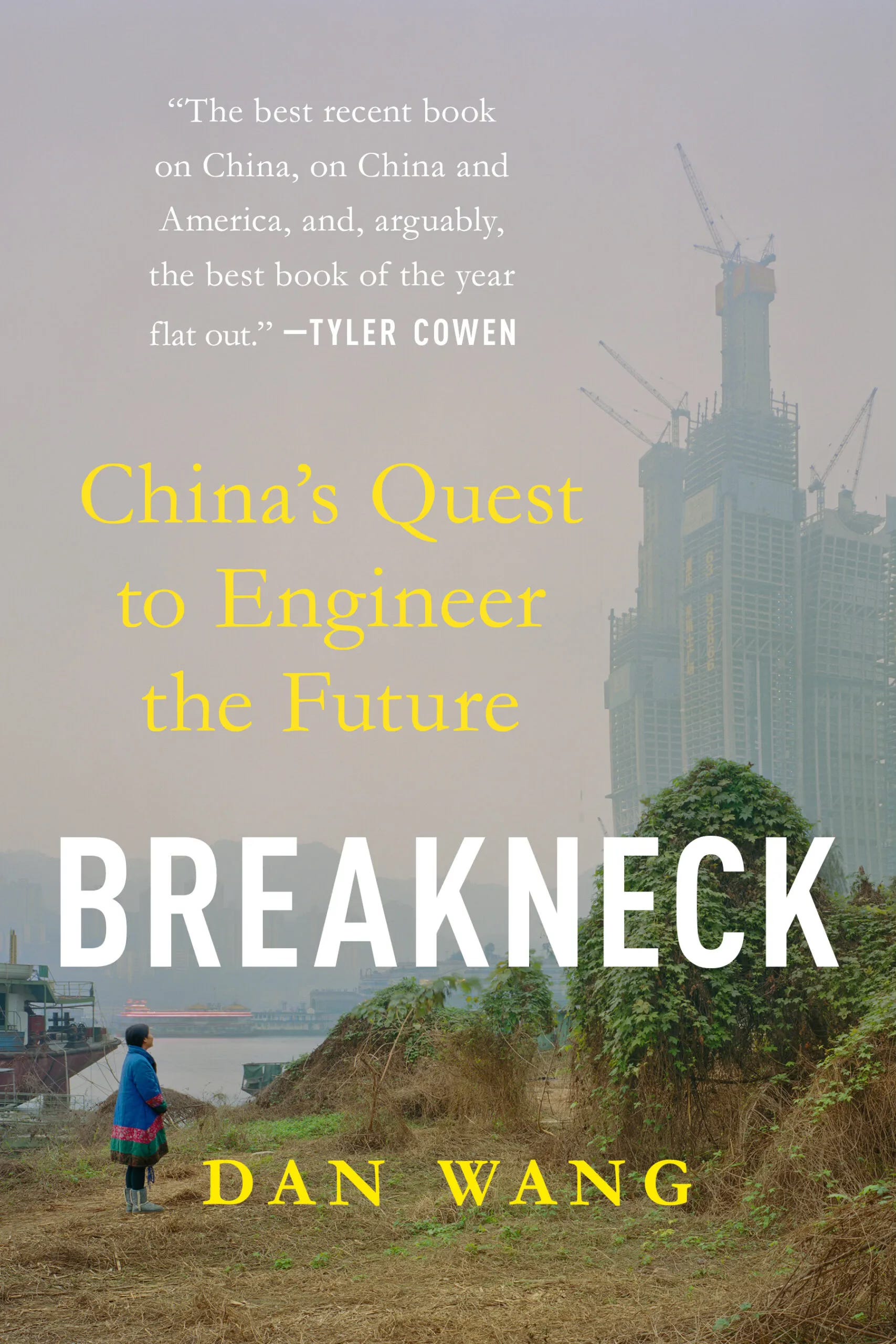
Review of Breakneck: China’s Quest to Engineer the Future by Dan Wang. W. W. Norton, 2025.
It is an improbable combination: part treatise on the failures of the United States and China’s governing pathologies; meditation on the lingering traumas of China’s one-child and zero-Covid policies; and deeply felt memoir; woven together with elegance and erudition. And yet, Dan Wang has brought all of this together in a singularly compelling and thought-provoking work.
Wang, a former analyst for the research firm Gavekal Dragonomics, made a name there and with annual letters on his personal website that were as astute as they were literary. “The ultimate contest between China and the United States will not be decided by which country has the biggest factory or the highest corporate valuation,” Wang writes. “This contest will be won by the country that works best for the people living in it.” He sets up a contrast between America's “lawyerly society,” so obsessed with proceduralism that it obstructs progress, and China’s “engineering state,” which has reduced governance to an optimization problem that leaves extraordinary collateral damage in its wake. (His denunciation of America’s lawyerly society is all the richer for it having been written while a fellow at Yale Law School.)
Wang takes issue with an America that has forgotten how to build and make things, charging that the benefits outsourcing delivered for “Apple’s shareholders has been a loss for American power” and the departure of manufacturing “has created economic and political ruination for the United States.” He laments a system that simultaneously builds too little housing and infrastructure at too great a cost, which drives distrust in government. And yet, he notes, China, blinded by monumentalism, remains a country where nowhere is it advisable to drink tap water, “not even Shanghai.”
China and the United States, who Wang asserts are more culturally alike than any other two peoples, would benefit from being more like the other. But Wang does not linger to offer many practical solutions, instead shifting his attention to the horrors of China’s one-child policy and the parallel crises of faith that accompanied the failures of both countries’ responses to Covid. America’s federal government, apart from a successful moonshot on vaccinations, largely abdicated responsibility; China turned the failures of an initial cover-up into months of apparent success before imposing brutal lockdowns. At the same time, he cautions against American liberals’ insistence on ‘following the science,’ noting that this is exactly what the Communist Party did - unchecked by the “lawyers interested in protecting rights, economists able to think through social science, humanists who consider ethics, and many other voices in the mix.”
Breakneck takes on its third form as a memoir of his parents’ decision to emigrate when Wang was seven, and the fraught comparisons to their peers who chose to stay behind. Wang expresses embarrassment and guilt for the material and spiritual impoverishment his parents assumed for his benefit, even if his father insists that “most of our classmates would trade places with us.” In these final pages, Wang also sneaks in an entreaty for his parents to give up the Philadelphia suburbs for New York’s Sunset Park, and a reappraisal of Robert Moses in light of the overcorrection his tyranny of engineering caused.
For all its incisiveness and ambition, Breakneck is not without its shortcomings. The foremost is that the US-China competition is a test of systems, not the pathologies that result from them. Wang appears to invert causality when he writes that “the political system of the engineering state rewards construction.” The political system is not subordinate to the engineering state, but rather the cause of it. Marxism-Leninism is predicated upon a belief in its scientific validity. A system in which leadership promotion is contingent upon growth, however illusory, inevitably leads to an excess of state-directed infrastructure development. Focusing on symptoms of systems risks losing sight of the relative strengths or weaknesses of the broader systems that create them.
Until recently, the United States and China largely competed in parallel rather than directly against one another. Even so, Wang may overstate America’s underperformance. Despite its self-defeating tendencies, the U.S. has delivered remarkable economic growth. Since China joined the World Trade Organization in 2001, America’s real GDP has expanded by $9.3 trillion. That is not the track record of a country that has forgotten how to build—only one that has changed where and what it builds. The boom across the American South is now beginning to compel places like California and New York to reexamine their own competitiveness.
America underinvests in infrastructure, but this stems from a political system that tends to maximize choice over quality. Commuting to New York—by tunnel, bridge, subway, bus, rail, or car—is almost uniformly miserable. And new projects often begin only when supermajorities can no longer ignore that action is overdue, as in the case of LaGuardia’s transformation. Is this inefficient? Certainly. But is it less efficient than the significant share of China’s high-speed rail network that was never likely to be profitable? Not necessarily. And does it matter that America’s inefficiencies tend to result in deadweight losses, while China’s lead to large, systemic financial distortions? Absolutely.
As US-China competition becomes more head-on, some of America’s latent strengths and China’s limitations may become more pronounced. China has also benefited from the ability to make greenfield investments in which it can leapfrog legacy systems countries that developed earlier must work around. This isn’t to diminish China’s accomplishments, but to put them into context. And as Wang’s former hedge fund clients would acknowledge, past performance is not indicative of future results. Wang critiques the lawyerly society for its “systemic bias toward the well-off.” But America’s predisposition towards wealth accumulation, a consequence of its political and legal systems and the discipline of its capital markets, gives it an important latent advantage.
America has consistently proven itself to be what one might call a “second half team,” roaring back after stumbling through the early response to challenges throughout its history. The country overcame initial production hurdles to become the arsenal of democracy during World War II and managed an extraordinary vaccine-led turnaround during the latter half of the pandemic. This happens because it takes time for a democratic society to organize itself. In the absence of crisis, its optimization for self-interest results in the accumulation of greater aggregate resources. But once organized, it can transform that larger pool of resources - and the trust-based systems that underpin decentralized societies - into the needed ends. China, by contrast, operates its steady-state at a degree of overengineering and with such low-trust that makes it vulnerable to breakdown when it is truly tested.
America similarly may be better positioned on manufacturing than Wang anticipates. Yes, it has ceded employment and process knowledge to China. But processes are constantly being reinvented: does one need to know how to carve a statue if you can 3D print one? America’s workers can also benefit from reverse knowledge transfers, aided by generally higher levels of education. Western automakers, for example, are adapting to design and produce cars at “China speed” while still preserving key advantages in brand strength, service infrastructure, and financial discipline that many of their Chinese counterparts lack. Moreover, of the few constraints that do impose themselves on China’s leaders, occupying a massive workforce - even after projected demographic declines - is one of them. America may thus be able to more fully embrace the next horizon of less labor-intensive manufacturing augured by robotics and biotechnology. Beijing’s “control neurosis” may also limit how fully and productively it deploys artificial intelligence.
None of these counteraguments detract from the fact that Wang has written a thoughtful provocation that will resonate with both China hands and laypeople across the American political spectrum. It is the existence and publication in the United States of a work like this, and the debate and reflection it should prompt, that is the strongest argument for why that country, and not China, is the better positioned in the contest between them.
Comments
Nothing yet. Say the first thing.
Sign in to join the conversation.