
The second Trump administration has continued its project of casting doubt on America’s willingness to continue underwriting the global order. What it has not done is articulate a vision for an alternative or, so far, cause more than modest harm to the present one. It has acknowledged the reality of great power competition and prompted speculation about the emergence of spheres of influence, but it has also reaffirmed some aspects of the old order in its belated embrace of Nato and Ukraine. It has also unintentionally reinforced other aspects by driving third countries towards trade liberalization among themselves even as the United States reneges on this principle.
As important as the United States is to the future of global order, its decisions do not occur in isolation. Broader factors are driving shifts in the nature and balance of power and the environment in which the US must make its decisions. Resources, ambitions, alliances, and disrupters constitute four interrelated, if not co-equal, drivers of change. Environmental and resource stress, demographic shifts, and inequality within and across states all constitute resource-driven drivers. The competing ambitions inherent to US-China competition, the expansive visions of civilization states, and a broader values contest exert their own pressures. Military and economic alliances are attempting to reorganize themselves for a new era. And disruption is being driven by technology, governance challenges, and non-state actors.
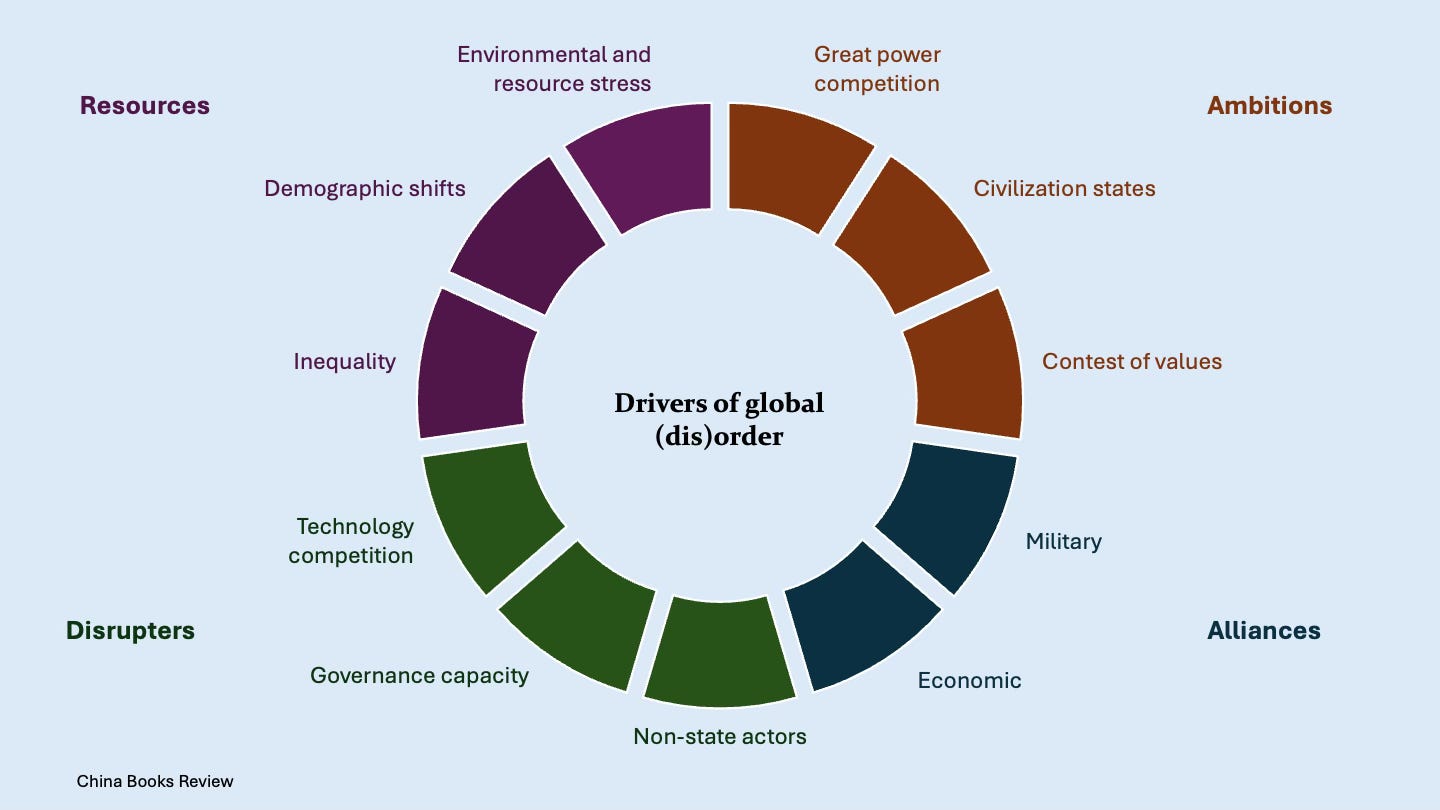
The drivers of global (dis)order
Resources — natural, demographic, and economic — are each determinants of and motivators for power. Environmental and resource stress have the potential to inflame conflict and overwhelm the resilience of governments and societies around the world. But the possibility also exists of a technology-enabled deliverance into abundance, particularly as the marginal cost of solar energy trends towards zero.
Aging, developed countries are being challenged by whether they can successfully absorb new migrants without destabilizing their political systems, while developing countries are straining to maximize their demographic dividend. Beyond natural and demographic resources, the pace and distribution of economic growth is driving populism within and protectionism across borders.
Then there is the question of national ambitions. Great power competition between the United States and China is a multifaceted contest that is not predestined to conflict. The United States has become wary of facilitating China’s rise in the global system and China increasingly exercises its ambitions to rewire the global order in its image. Both countries are racing to reduce vulnerabilities to the other.
In parallel, India, Russia, Turkey, Iran each make civilizational claims that are, if not incompatible with, are at minimum disruptive to the international order. The European Union continues to exercise geopolitical influence well below its economic weight, reducing a potential great power to an inward, values-driven regulatory state. Globally, a broader values contest is also at play. Liberalism and pluralism, and their claims to universality, are in contest with multiple forms of conservatism.
Longstanding alliances, military and economic, are being challenged internally and externally. But their primary purpose - deterrence and advancement at scale - remain sound. In the US system, Nato countries have committed to significant increases in their defense spending. Defense partnerships have also deepened across Asia. As the US instigates the end of the WTO-based trading system, its crude use of tariffs does not diminish the reality of the need to address persistent trade and financial imbalances and Chinese industrial overcapacity. An agreement between the European Union and Pacific trading nations would address a significant gap in a world divided by American security guarantees and Chinese economic dominance. But its significance will remain limited without America’s participation.
China straddles four approaches: growing influence within the system of traditional multilateral “alliances of governance” like the United Nations; leadership of parallel systems anchored by the Belt and Road Initiative; partial manipulation of blocs like the EU through influence on its peripheral members; and enablement of an “axis of upheaval” which includes Russia, Iran, and North Korea in open confrontation with the liberal order. But it ultimately remains devoid of friends worth having, and dependent on its own rapid military buildout, in a wary neighborhood.
Technology competition, weakening state governance capacity, and emboldened non-state actors are the key sources of global disruption. The race for artificial general intelligence will have significant economic, social, and security implications both for beneficiary countries and those at risk of being left behind. Even as states push for “sovereign” AI, the most pathbreaking work is being led by private corporations. The rise of cryptocurrency is also challenging America’s ability to leverage the dollar as a strategic chokepoint.
Many nation-states were already struggling to keep up with demands on their capacity as a result of their failure to modernize. Paroxysms of nationalism are pushing simultaneously for greater devolution of power to sub-scale actors and the sabotaging of supranational governance. At the same time, the influence of corporations and other non-state groups continue to grow. They could be further emboldened if artificial intelligence concentrates power in the private sector or emboldens motivated actors to cause harm.
A picture of the future
Taking each of these drivers, one can articulate a base case for what comes ahead. While each of these drivers impact the other, they do have meaningfully independent through lines. The most significant of these drivers is the trajectory of the United States and the progression of artificial intelligence. The former matters not only because the United States remains the most powerful country, but also the one with the most agency. (Contrast this with China, whose varied challenges are more entrenched or difficult to reverse.) The progression of artificial intelligence is no less significant because the range of possibilities is both so pronounced and uncertain.
Whether through deliberate strategy or residual inertia, the United States can still serve as the foundation of a resilient, if looser, liberal order. Hal Brands writes that global orders “can die of murder, exhaustion, or suicide.” For the US, that means defeat in conflict with China, economic collapse because of its fiscal profligacy, or it committing gross violations of international norms. Across all these dimensions, the US retains control over its destiny. It can achieve a balance of reassurance and deterrence that, in tandem with China’s own evaluation of its interests, can reduce the risk of conflict. The US both undertaxes relative to other developed countries and spends considerably more on healthcare, both opportunities to rightsize its budget. Finally, it retains the possibility of democratic renewal through reforms that reduce polarization and better reflect national consensus.
With respect to AI, holding both existential risk and unlimited abundance at bay, the likelier outcome is one in which AI accelerates growth and whose most disruptive impacts are concentrated on classes of individuals and not systems. Indeed, AI may simply reify them. Such a benign outcome is probable because of the alignment of incentives; the hard work that is already underway on governance, safety, and ethics; and the tendency of decentralized or open source systems to ensure resilience.
Base cases by driver
Resources
Environmental and resource stress - Accelerating adoption of clean and cheap energy may not only arrest the progression of climate change, but also release current resource constraints via vertical farming and desalination.
Demographic shifts - The United States continues to outperform other developed countries in its ability to attract and absorb immigrants; other developed countries accept the economic tradeoffs of stricter immigration in favor of social coherence or pursue an Emirates-style model that forecloses the possibility of assimilation. The trend of significant shares of low-income migrants choosing middle-income countries continues with mixed effects for influence and stability. The risk of intra-state conflicts in developing countries that fail to fully realize the potential of their youth is acute.
Inequality - The recent trend of income convergence between countries and divergence within them could shift as automation enables high-cost countries to recover or maintain production at the expense of developing countries.
Ambitions
Great power competition - China fails to escape the middle-income trap. The preeminent importance it places on maintaining party rule leads to decisions that limit its global power. Instead, China seeks asymmetric forms of influence over regional and global order through institutions like the UN and those of its own creation.
Civilization states - Russia’s structural weaknesses prevail over its ambitions. Other middle power aspirants underperform their potential but can continue to grow more powerful on an absolute basis.
Contest of values - The global divergence of values persists, but this does not lead to a clash of value systems as liberal nations avoid interventionism and statebuilding. American-style culture wars metastasize throughout other democracies.
Alliances
Military - Even partial fulfillment of Nato’s expanded defense commitments will materially enhance its deterrence. US-aligned Asian partners deepen their own coordination and investment short of outright alliance. The current alignment of China, Russia, Iran, and North Korea does not persist as the utility of the latter three states and their willingness to be used by China in its competition with the United States diminishes.
Economic - The American economy holds its own. Selective trade integration continues among trusted partners or in particular sectors. Other countries follow the US in pressing China to arrest its industrial overcapacity. Blockchain and cryptocurrency usage continues to grow, as does bilateral use of the renminbi, but the dollar remains preeminent.
Disrupters
Technology competition - Technological progress continues to drive economic growth, displacing individuals, not systems. Developed states’ power may be weakened by private firms’ control of AI; less developed states may see their capacity enhanced at the risk of potentially entrenching their alignment with the countries of origin for whichever technology they adopt. Fragmentation of the tech stack continues into American and Chinese spheres of influence.
Governance capacity - Democracies continue to prove more resilient than autocracies, even if they may continue to degrade on an absolute basis. Minilateral institutions take precedence over global architectures.
Non-state actors - Non-state actors, particularly multinational corporations, continue to grow in relative influence; intrastate conflicts remain persistent as primary form of conflict; transnational and cyber-enabled crime continues to grow.
Back to the future
These base cases in turn inform which possible scenarios of world order are more or less likely. At one end of the spectrum is an anarchic order in which the global commons evaporates. At the other end exists a form of liberal primacy, if not hegemony, that does not require America’s active leadership. In between these two poles, exist several alternatives: contested multipolarity, regional spheres of influence, and a neomercantilist order that is as capital-driven as it is state-driven.
Assuming the base cases across factors hold, liberal primacy prevails as the most likely outcome of world order. The resilience of democratic societies proves decisive as the pressures of great power competition and civilizational state ambitions recede. Contested multipolarity and spheres of influence remain plausible outcomes, particularly if the US continues to withdraw and rival states harness economic and technological gains to sharpen their power. Another question is whether states are able to maintain an upper hand over the regulation of technology and the coarsening political effects of extreme concentrations of wealth. If not, they may be subverted to serve the interests of capital. An anarchic order remains unlikely barring the simultaneous exhaustion of multiple major powers.
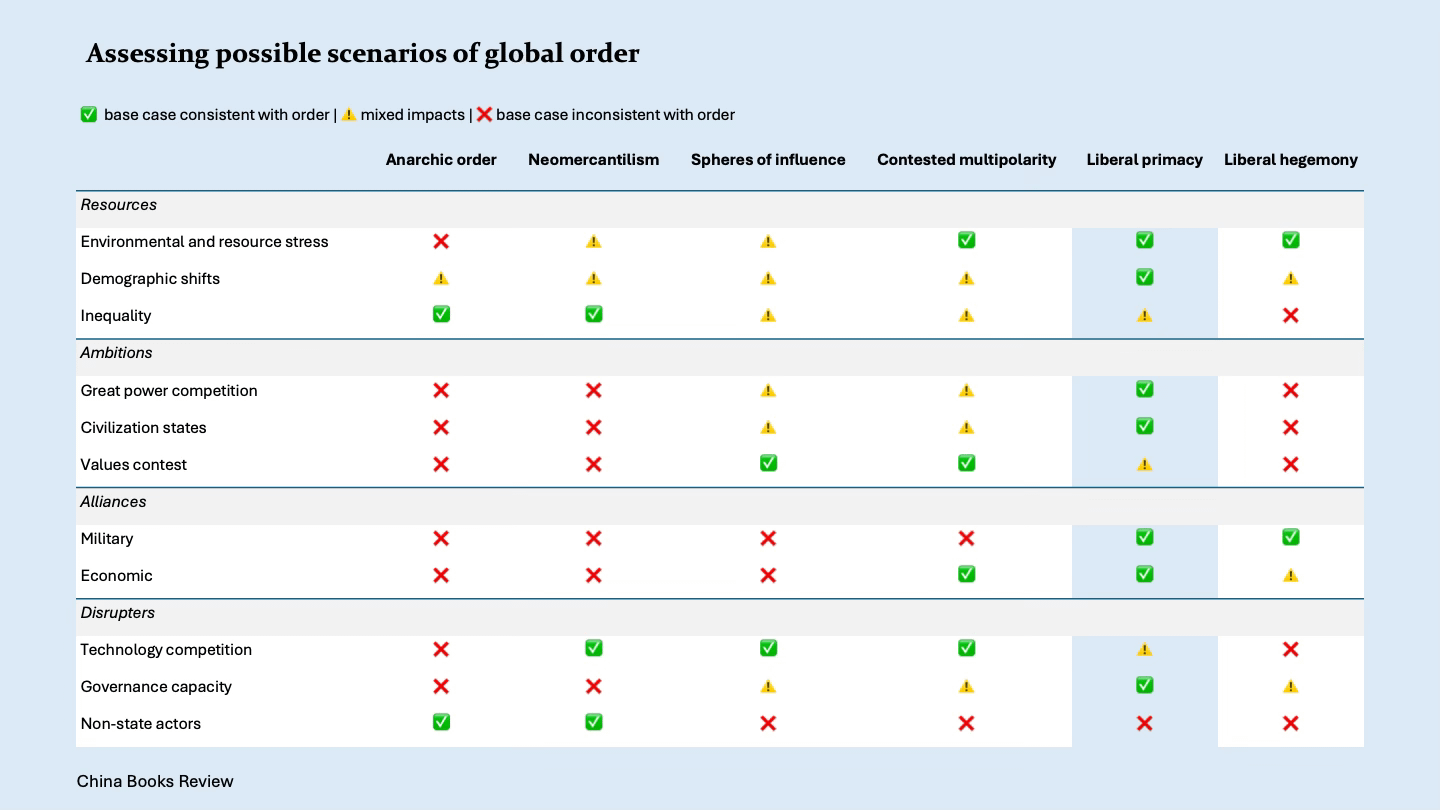
The more things change …
A global order which closely resembles its current form makes sense. That is because it broadly succeeds in maximizing the interests of most actors. Geopolitical actors will seek to maintain a maximally useful network for global flows, while minimizing the risk of coercion. Relatively small shifts in share are all that are needed to transform the United States from hegemon to a “first among equals” status.
This also makes sense for the United States. It can unburden itself of certain responsibilities through redistribution or allowing those least consequential to it to be negatively externalized. At the same time, it maintains the benefits of access to a system that still affords it significant benefits and privileges.
The days of America leading the world out of an expansive sense of its own self-interest may be over. Instead, the world appears to be entering a post-hegemonic liberal order: one willing to accept an America that is less beneficent, so long as it remains relatively open, engaged, and better than the alternatives.
Comments
Nothing yet. Say the first thing.
Sign in to join the conversation.