
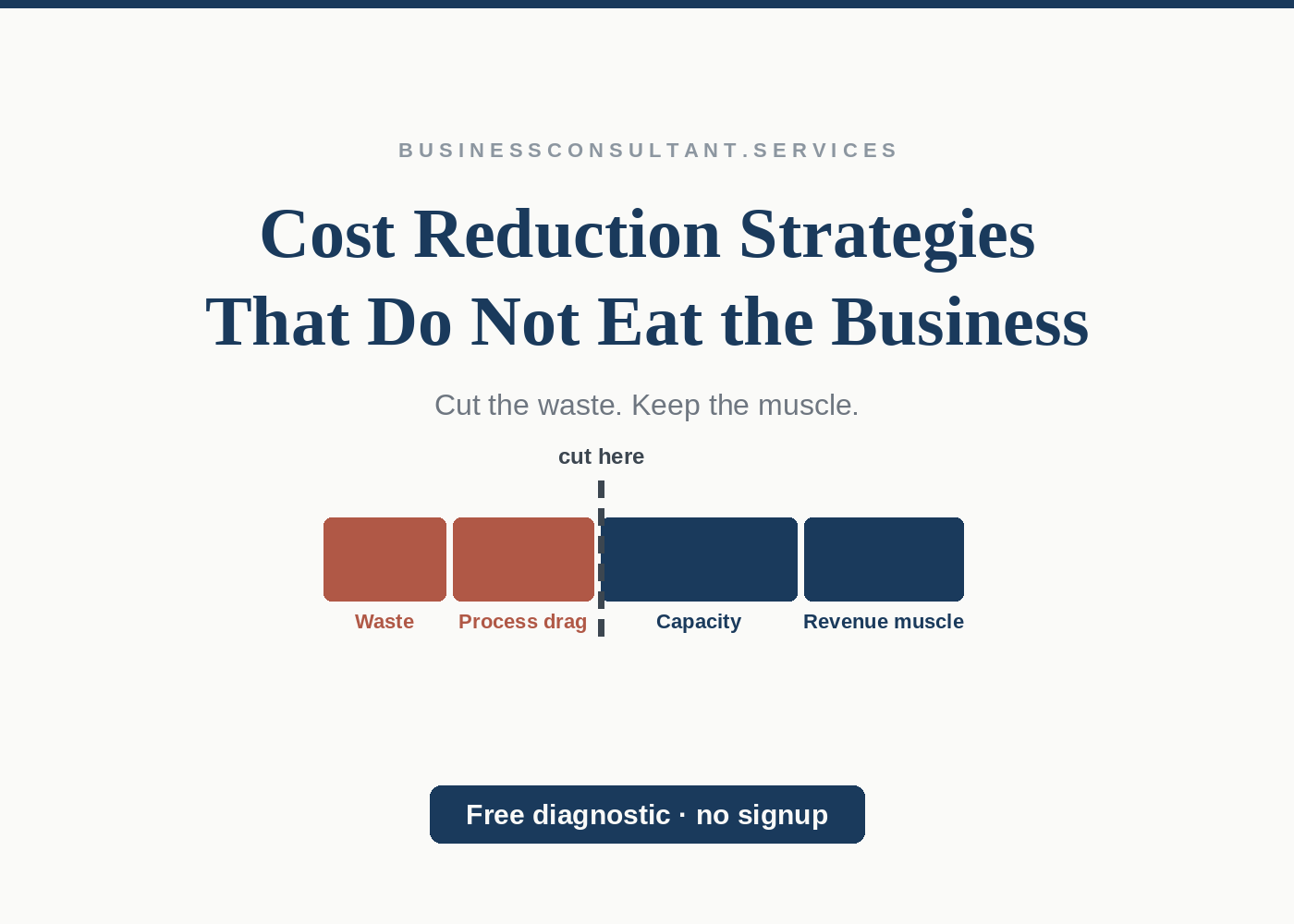
Effective cost reduction removes waste while preserving the capacity that produces revenue. Most cost-cutting programs do the opposite: they cut what is visible and easy, which is usually people and capability, while leaving the structural waste that caused the margin pressure untouched. The difference between the two outcomes is that one diagnosis occurs before the first cut, not after the damage.
With input costs still elevated, energy alone running 15.7 percent above last year, margin pressure is squeezing companies that did nothing wrong. The cutting instinct is correct. The usual sequence is not.
The standard failure pattern is consistent enough to have stages. Margins compress. Leadership announces a cost initiative with a percentage target. Each department is told to find its share. Managers protect their own headcount and cut what is least defended: training, maintenance, the junior roles, and the tools budget. The target is hit. Six months later, delivery slips, quality complaints rise, the remaining team burns out, and revenue falls behind costs.
The program failed at the first step: the percentage target. An across-the-board number treats every dollar of cost as equally removable, which is false in every real company. Some spending is a waste. Some spending is the machinery that produces revenue. A target set before anyone has separated the two guarantees that both get cut.
There is a second, quieter failure. Cost problems are often misdiagnosed as revenue problems, and vice versa. A company whose gross margin erodes while revenue holds flat may have a procurement problem, a pricing problem, or an operations problem that manifests as cost. Cutting expenses treats the symptom. The margin keeps eroding because the mechanism that erodes it was never named. This is the same diagnostic discipline that applies to any operational intervention: pattern first, treatment second, a sequence documented across the six operational patterns that drive most consulting engagements.
Sustainable cost reduction operates through four layers in a fixed order, from the least damaging to the most. Companies that run the sequence rarely need the fourth layer. Companies that start at the fourth layer usually end up needing all of them, twice.
Layer one: procurement and pricing of inputs. The cheapest dollar saved is one a vendor was overcharging. Nobody inside the company has to work differently, and no customer notices anything has happened. Contracts that renewed automatically for years, single-sourced supplies that were never rebid, software seats nobody uses, and shipping terms set when volume was half its current level. Mid-market companies that run a disciplined procurement pass typically find 5 to 15 percent of addressable spend without touching a single internal capability. The work is unglamorous: build the vendor list, rank by spend, rebid or renegotiate the top ten, and cancel the unused. No morale cost, no capacity cost.
Layer two: process waste. Rework, duplicate data entry, approvals that add delay but not judgment, meetings that exist because no system shows status, and handoffs that drop information. Time studies in professional and trade businesses routinely find that a quarter to a third of paid hours are spent on work that produces nothing a customer would pay for. Cutting this waste is both a capacity increase and a cost reduction in one motion: the same payroll produces more output. It requires actually mapping the processes, which is why most programs skip it and go straight to headcount.
Layer three: structural simplification. Products, services, customers, and locations that cost more than they return. Most companies carry a tail of offerings kept for historical reasons, and a handful of customers whose service costs exceed their margins. Killing the tail is a strategy decision, not an expense decision, which is why it needs margin data by product and by customer before anyone votes. The finding is usually uncomfortable: the complexity everyone works around exists to serve revenue that was never profitable.
Layer four: organization. Headcount is last, not because it is untouchable but because cutting it first destroys the information needed to cut it well. After layers one through three, the organization's question answers itself differently. The process map from layer two shows which roles the streamlined workflows actually need. The simplification in layer three shows which functions were serving the unprofitable tail. Cuts made with that information remove positions that the new structure does not need. Cuts made without it remove whoever was hired last, which is how companies amputate the exact capability they will need in the recovery.
Every cost program needs a protected list written before the pressure starts, because under pressure, everything looks optional.
Revenue-producing capacity stays. The salespeople who cover the pipeline, the delivery capacity that fulfills it, and the customer-facing service that drives the referrals. Cutting these converts a margin problem into a revenue problem, which is a trade in the wrong direction.
Maintenance stays, in every sense: equipment, systems, and the boring recurring work that prevents expensive failures. Deferred maintenance is not a saving. It is a loan against next year at a punitive interest rate.
The measurement layer stays. Companies in cost mode are tempted to cut the reporting, tooling, and finance capacity that tells them whether the program is working. A company cutting costs blindly will cut the wrong things with complete confidence.
Training mostly stays, with scrutiny. A leaner team doing redesigned work needs more capability per person, not less. The protected list is not a loophole for pet projects. It is the definition of the machine that the cuts exist to protect, written down while judgment is still calm.
The reason to put diagnosis first is arithmetic. A company at $8M revenue, facing a 4-point margin squeeze, is looking for roughly $320,000. Whether that comes from vendor contracts, process waste, an unprofitable product line, or people producing for four different companies eighteen months later. The first three get stronger. The fourth gets smaller and is usually less profitable because the waste and unprofitable complexity survived the cut.
The diagnosis does not require a six-month engagement. It requires identifying the pattern actually driving the margin pressure. The usual candidates are input costs, process waste, unprofitable complexity, and pricing problems wearing a cost costume. The quieter candidates are the founder-dependency and reactive-operations patterns, which inflate cost structure by forcing everything through too few hands. Reactive operations alone can add 3 to 5 percent of revenue in avoidable expenses, because firefighting always costs more than prevention. Each pattern has a different first move, and the wrong first move is expensive precisely when the company can least afford it.
The pricing candidate deserves special attention in this environment. When input costs rise 15.7 percent and prices rise zero percent, the resulting margin squeeze is not a cost problem at all. It is an absorbed inflation problem. Companies with any pricing power should test pass-through before cutting anything, because a 3 percent price adjustment often recovers more margin than a quarter of expense work. The businesses that refuse this test are usually protecting an assumption about customer sensitivity that nobody has validated in years.
For owners who want a fast outside read, the free diagnostic at businessconsultant.services analyzes a plain-language description of the situation against these patterns. It returns a named diagnosis with one concrete next step. It takes about two minutes, requires no account, and stores nothing: no email capture, no cookies, no database.
Write the protected list first. Run the diagnosis and name the driving pattern. Take the procurement pass, since it is fast, safe, and self-funding. Map the two or three processes where the most hours go, and remove the waste the map exposes. Pull the margin by product and customer, and put the unprofitable tail in front of the leadership team as a decision. Only then look at the structure, with the information the first four steps produced.
Companies that run this sequence report a consistent outcome: the savings target arrives, capacity survives, and the exercise leaves the company simpler and faster than it started. The across-the-board alternative hits the same target once, then pays it back with interest. The repayment arrives as attrition, slipped delivery, and the slow discovery that the cuts removed muscle and kept the fat.
One more discipline keeps the result from evaporating. Cost creep is the default state of every organization: vendors raise renewal prices, canceled subscriptions reappear under new names, and simplified processes grow new steps within quarters. The companies that hold their gains put a standing review on the calendar, quarterly for vendor spend and semiannually for process and product-line margin. The review takes hours, not weeks. Without it, the same program runs again in three years, against the same waste, at the same cost, with less credibility.
Cost pressure is not an emergency. Cutting without a diagnosis is. The margin squeeze names the problem. The pattern underneath it names the fix.
Comments
Nothing yet. Say the first thing.
Sign in to join the conversation.