
Negin had been living in Italy for five years.
Classes organised by the municipality in Milan. Duolingo. She could read a bit, more or less follow a conversation, and understand far more than she could produce. At work, surrounded by Italian colleagues every single day, she was still not speaking.
Less than four months later she told me she had started talking to them. I had not asked. She said it in the middle of a normal exchange, because she was excited about it.
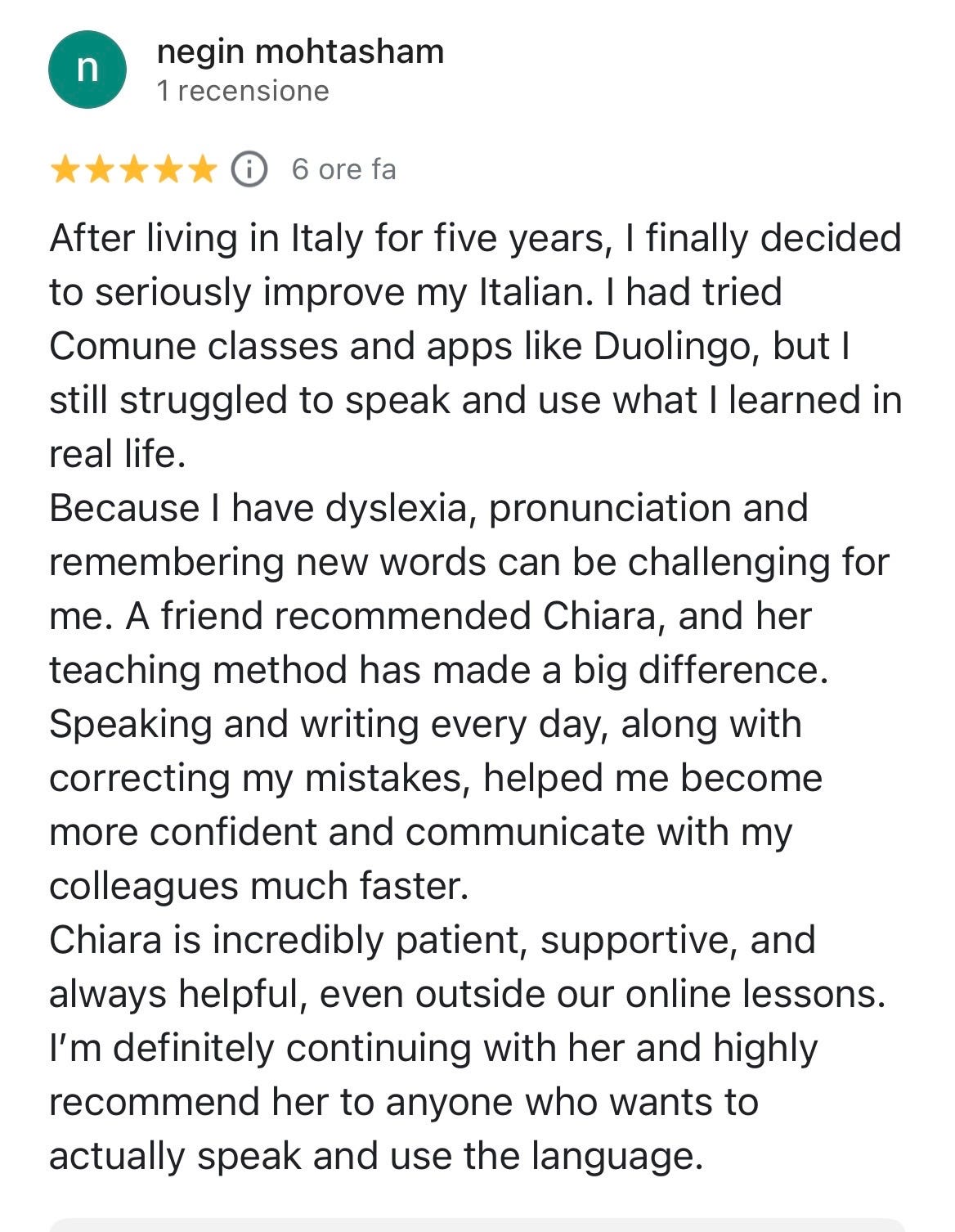
Those five years were not wasted. She arrived with basics. What she had never had was a structure that forced her to produce language on a schedule, with someone correcting what came out.
The short version of what we did:
She wrote a few times a week, in public. A few sentences about her day, posted in my community where other learners could see them. AI correction first, my final check underneath, plus follow-up questions to pull a real conversation out of her.
She came to the live sessions. Conversation, not lessons. I will be honest that this was the smallest ingredient: those meetings were not weekly at the time and she did not attend all of them.
She sent me one voice message a day. One. Three or four days a week. This is the part people refuse to believe. The volume is small on purpose, because the work sits in the re-recording that happens before she sends anything.
I corrected it in whichever language landed fastest. Italian, English or Persian, depending on the topic. A grammar point explained in a language you are still struggling with is a grammar point you will nod at and forget.
She kept texting in between. Small additions, not a second workload.
A full month off WhatsApp. She kept posting on Skool, kept commenting under other people’s posts, kept coming to the meetings. The intensive part stopped. The contact did not.
I now recommend this to almost everyone. Daily correction is genuinely tiring, and people who push through without a break tend to quit rather than pause. The break is also where the corrections get used somewhere light, but long enough to become yours.
She told me about her colleagues after that very first block, before the break was even over.
She is not perfectly fluent. She would tell you that herself. What changed is that she opens her mouth at work now and her colleagues understand her.
The full case study is on my site. It includes the exact recording sequence she used before sending anything, and the one instruction I give people who still cannot bring themselves to speak out loud.
If you have been reading this and thinking “that is exactly me” - you understand more than you produce, you have tried the classes, you are still not speaking when it counts - I have space for one or two people right now.
Not a course, but a structure built around your specific situation, in whatever language you are working on (Italian, French, Dutch) that fits inside a normal day.
If you want to know whether it would work for you, reply to this email and tell me where you are stuck.
Comments
Nothing yet. Say the first thing.
Sign in to join the conversation.