
Back in March, my boyfriend was reading a Dutch sentence out loud to me and it was going (very) badly.
He knew the words. He could have written the sentence himself, correctly, with the right spelling and the right grammar. But when he said it out loud, he was dramatically running Italian intonation and Italian sound patterns over Dutch words. A sentence that was perfectly correct on paper turned into something a Dutch speaker had to work to decode.
If you study your vocabulary, get your grammar clean, then open your mouth and people still say “sorry?”, this post is probably for you.
He put it better than I could when I asked him about it for this post:
“You can have the best vocabulary in the world, but if you don’t go with a certain cadence, you’re incomprehensible.”
That’s why, in that class we had together, I started beating time on the table.
He’s a musician in his free time. Self-taught, never took a course in his life, but he plays.
I reached for this assuming he’d have at least a vague idea of what I was about to do, and I was wrong haha: he had never done solfège at all.
I had, because I’m a slightly less freestyle player than he is. So I ended up teaching him something.
Musicians who learn with a structure don’t only learn rhythm by listening.
They also learn it by moving: hand down on the beat, hand up on the offbeat, over and over, until the length of a note is something your body knows too rather than something you’re trying to hear.
Listening harder may not be enough for language rhythm if you don’t have a trained ear. Your ear can’t hold a sound still long enough to compare it to the next one. It’s gone before you can measure it.
Your hand can hold it. The hand turns a length you can’t catch into a distance you can see.
That’s my theory. It’s also a trick that proved to work with him.
You need one hand, a table, and one sentence.
1. Pick a sentence you can already read. Not a hard one. The point is not to decode it, the point is to feel it. Ours was:
Ik ga frietjes halen (I go to buy fries)
2. Split it into syllables and tap one per syllable. Hand comes down, touches the table, comes back up to the top. That full down-and-up is one syllable. Go slowly and stupidly at first.
ik / ga / frie / tjes / ha / len
3. Find the long one(s). In every language with a length distinction, some syllables stretch and some don’t. In our sentence, they’re the frie, and ha in halen.
4. Give the long syllable the whole movement. This is the entire trick. A short syllable is a point: you say it at the moment your hand touches the table, or at the top of the arc, and it’s over. A long syllable is a distance: you start it as your hand leaves the table and you’re still saying it when your hand reaches the top (or viceversa).
ik (tap) / ga (tap) / friee (tap + long movement) / tjes (tap) / haaaa (the whole movement) / len (tap
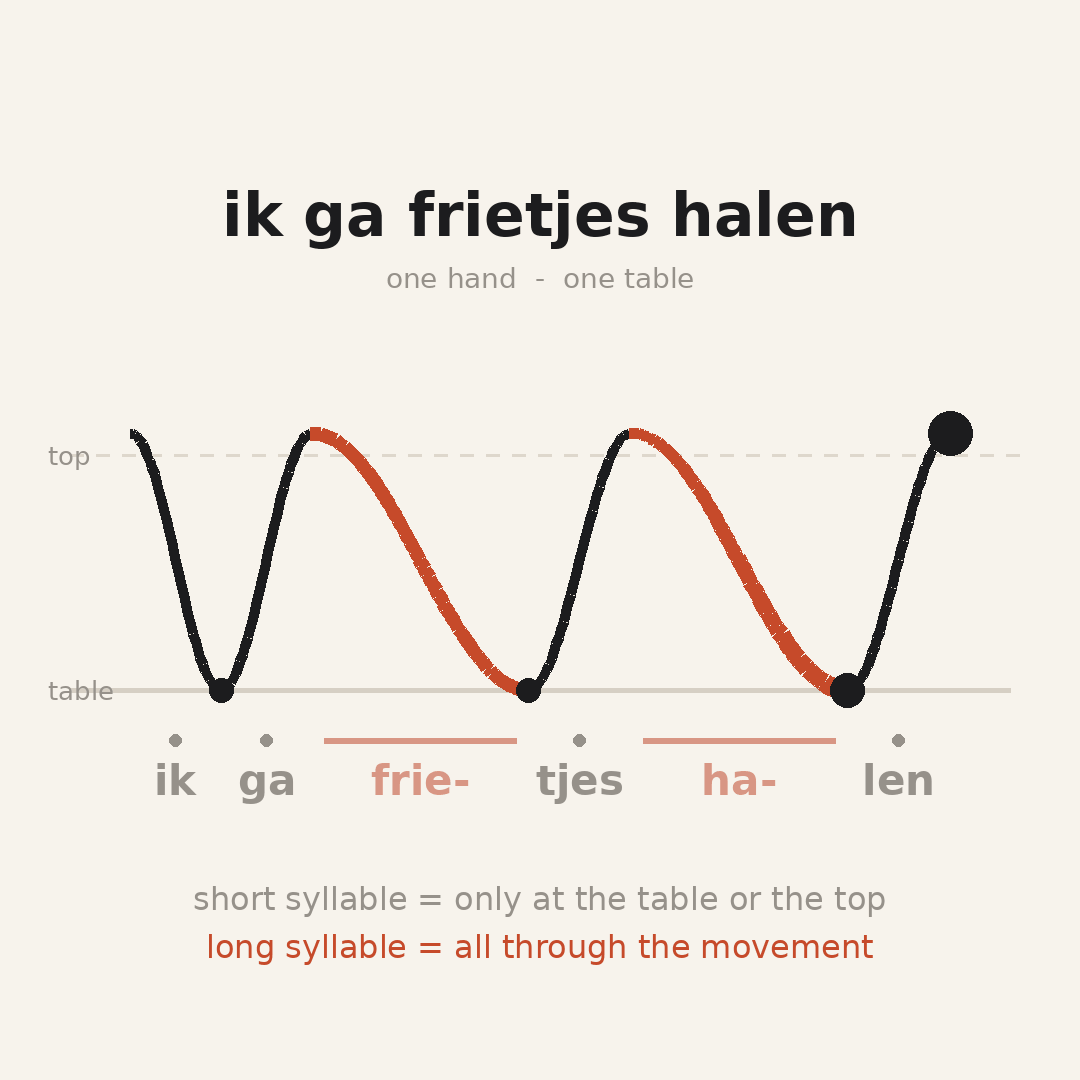
5. Now say the sentence at normal speed with your hand still moving. Smaller movements, faster, but the same proportions. The long syllable still gets more distance than the short ones. That proportion is the thing you’re actually learning.
Do this with five sentences and you’ll start doing it in your head without the hand.
0:00
-0:09
That’s actually a problem for Flemish speakers too who often don’t really catch the right sound patterns in Italian - and I myself struggle to understand their pronunciation when they mess up long and short syllables, for example:
pellicce (fur) vs felice (happy)
pel-lic-ce (short - short + stressed - short)
fe-li-ce (longer - long + stressed + short)
0:00
-0:15
This can be useful also in Italian, French and English, what you tap changes in each one. Italian gives the movement to the double consonant. French saves it for the last syllable of the group. English does the opposite and asks you to shorten. I wrote the full version with the examples for all four languages here: Why People Don’t Understand You Even When Your Grammar Is Correct
I mean solfège in the Italian sense: beating time while you say the notes, down on the battere, up on the levare. It’s purely about how long a thing lasts.
And you don’t need any of that background. He didn’t have it either. Nothing in the five steps above requires you to read music. This works if you can tap a table.
His accent did not improve. He’ll tell you so himself:
“I don’t think solfège can improve the pronunciation of a single word. In fact lately I’m pronouncing them badly. But it evidently makes other people understand you.”
Individual sounds stayed roughly where they were. What changed is that when I make a semi-native friend of mine listen to his voice messages, now he understands him.
He also didn’t believe me at first - of course, nemo profeta in patria… he justified himself like this:
“At a subconscious level it was unacceptable. You think: I can write well, so I must speak well too. And no.”
“It was funny, because I couldn’t accept that there could be rules that simple. And that if you break them or ignore them, you don’t get understood.”
And one last thing he wanted on the record, which I’m including because he’s right:
“On some sentences, solfège is very counterintuitive for me.”
Which makes me think that probably is good to set the right bases mostly. Still, I didn’t have to scold him again lately because he was pronouncing so badly. He thinks about the mistakes he does with the individual sounds, but they disappear in the music of the (understandable) sentences he sends me now.
Take one sentence in the language you’re learning. Tap it out. Find the syllable that stretches, give it the whole movement, and read the sentence back. If you get stuck on which syllable is the long one, the full guide on my site has the rule for Dutch, Italian, French and English, plus the four things that usually go wrong.
Then hit reply and tell me what happened, especially if you have zero musical background.
Doing it with the sentences you write in your journal can be a great starting point.
The Frequency Circle
You write in Italian, Dutch or French a few times a week. I read and respond to every post, personally. Live sessions, minicourses, and other people doing the same thing.$23/month. Start with a free week, but give it a month: write twice a week for four weeks and if nothing has shifted, I’ll refund you.
Already writing daily and want direct coaching? There’s a WhatsApp tier at $93/month, with two weeks free (UNTIL SEPTEMBER 1 - THEN IT’LL GET TO $113). Existing members can switch on any time.
Comments
Nothing yet. Say the first thing.
Sign in to join the conversation.