
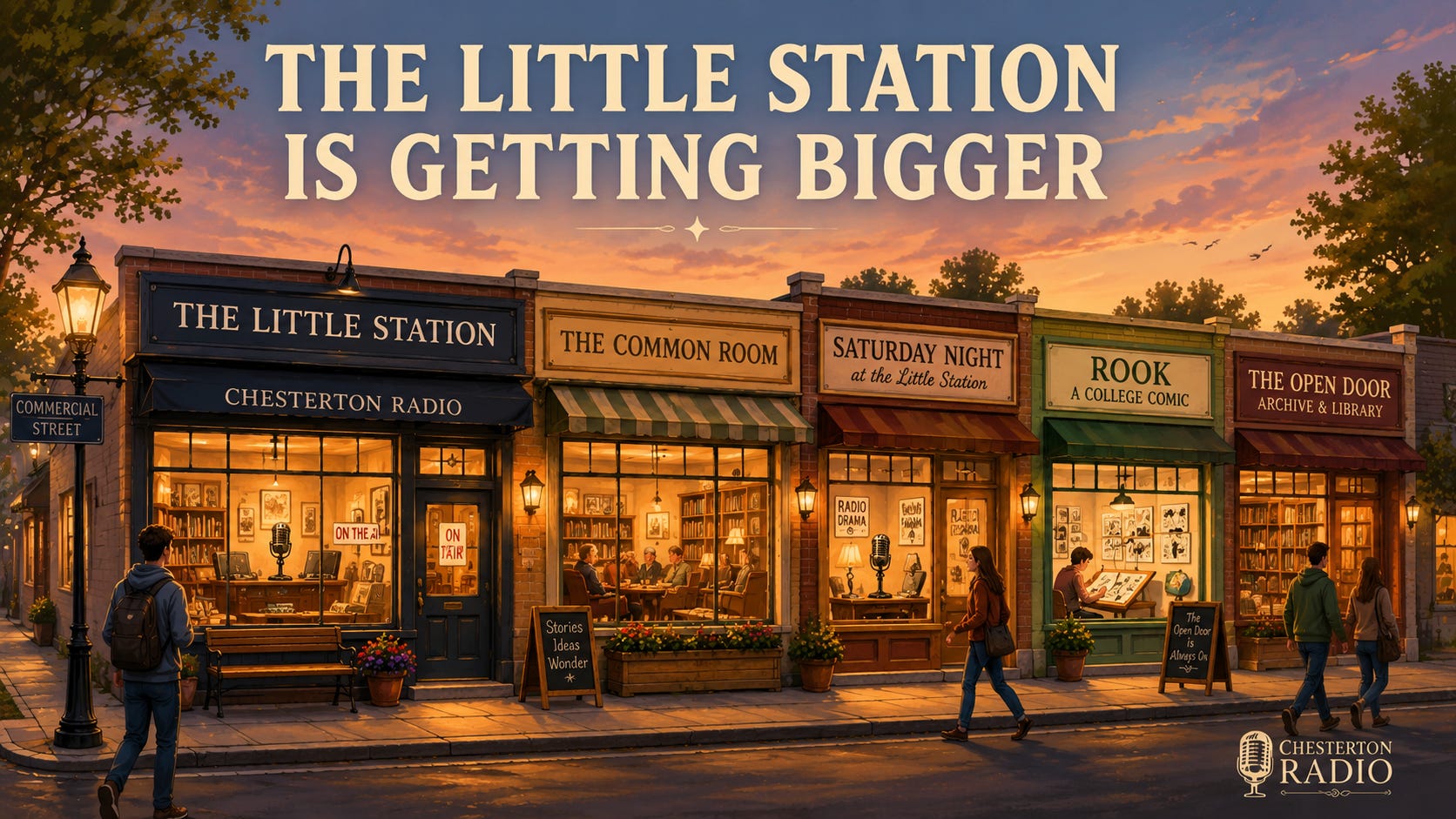
Chesterton Radio started simply enough.
There were old radio programs worth hearing again. Great stories. Great voices. Forgotten performances. Chesterton, of course, but also mysteries, comedies, dramas, books, films, theatre and all sorts of things that seemed in danger of slipping quietly out of the culture.
So we put them on the air.
But lately, something interesting has been happening.
The little station is getting bigger.
Not necessarily bigger in the usual internet sense. I’m not talking about algorithms, subscribers or chasing whatever happens to be trending this week.
I mean the place is getting bigger.
There are more rooms now.
And I’m beginning to think that’s what Chesterton Radio really is.
Not just a YouTube channel.
Not quite a podcast network.
Certainly not a museum of old radio.
It’s becoming a little station you can wander into.
Come through one door and you might hear G.K. Chesterton.
Through another, Humphrey Bogart is standing in Rick’s Café in Casablanca.
Down the hall, someone has rediscovered a BBC play that hasn’t been talked about in fifty years.
Tomorrow it might be The Wind in the Willows, Goodbye, Mr. Chips, Jack Benny, Jules Verne, Broadway, Notre Dame, an obscure radio adaptation—or something we’ve written ourselves.
They don’t seem to belong together.
Somehow, they do.
That’s becoming the idea behind what I’ve started calling the Chesterton Radio World.
And it has several rooms.
This is where the lights come on in the morning.
Scripture. The calendar. A little history. Something happening in the world. And usually a story, program, book or person worth discovering.
The internet gives us an extraordinary amount of information every morning.
Daybreak is an experiment in asking a slightly different question:
What’s worth paying attention to?
Not everything important is new.
And not everything new is important.
This may be my favorite room in the station.
It’s where we sit down and explore something.
Why does Casablanca still work?
What happened behind the making of Pet Sounds?
What was The Desert Song?
Why did Notre Dame cover its Columbus murals?
Who was Saint Roch?
Sometimes we start with an old radio program. Sometimes a movie, book, musical, historical event or person.
Then we start opening doors.
One discovery leads to another.
That’s really what The Common Room is about:
curiosity.
This is something newer.
Instead of only finding forgotten stories, we’re beginning to make some of our own.
The inspiration comes from the great tradition of radio drama—especially those Saturday-night broadcasts where you could turn down the lights, sit back and disappear into another world for an hour or two.
We’re experimenting with original stories designed to be heard.
Mysteries. Strange journeys. Old hotels. Railway stations. People who arrive somewhere they weren’t expecting to be.
Stories that might have been broadcast from a little station late on a Saturday night.
And then there’s a comic strip.
Because apparently every respectable little radio station needs a comic strip.
ROOK follows a group of college students as they negotiate classes, friendships, athletics, professors, dining halls and the strange little absurdities of campus life.
It’s deliberately old-fashioned: black ink, six panels, recurring characters and a joke at the end.
A tiny newspaper comic living inside a digital radio station.
Which makes almost no sense.
That’s probably why I like it.
Behind all of this is the enormous collection we’ve accumulated over the years.
Radio drama.
Comedy.
Mysteries.
Chesterton.
Classic literature.
Forgotten broadcasts.
Performances that deserve another audience.
The Open Door is always on.
It’s the library in the back of the station—the place where you can wander around and discover something you didn’t know you were looking for.
I’m increasingly convinced the wrong answer is:
“A channel that plays old radio programs.”
Those programs remain enormously important to us. They’re part of the foundation.
But the idea is becoming larger.
Chesterton once wrote that “there are no uninteresting things, only uninterested people.”
That’s pretty close to our programming philosophy.
A forgotten radio play can be interesting.
So can a Broadway musical.
Or an old movie.
Or a saint nobody talks about anymore.
Or a college comic strip.
Or an original story about a train arriving at a station where it shouldn’t.
The common denominator isn’t nostalgia.
It’s wonder.
That word has been sitting in our description for a while:
Stories • Ideas • Wonder
I’m beginning to understand just how much territory those three words can cover.
Some rooms are finished.
Some have barely been started.
There are probably doors we haven’t discovered yet.
And that’s part of the fun.
Chesterton Radio doesn’t need to become another enormous media company trying to produce something for everybody.
I’d rather build something smaller and stranger.
A place with personality.
A place where somebody might come looking for Father Brown and accidentally discover The Corn Is Green.
Or arrive for Jack Benny and stay for an original story.
Or read ROOK and wonder why there’s a 1940s radio play playing in the next room.
A place where the past isn’t behind glass.
It’s still talking.
And where occasionally we add a few new voices to the conversation.
So that’s the experiment.
We’re building a little world.
One program, story, character and room at a time.
And the door is open.
I’d really like to know.
What part of Chesterton Radio do you most look forward to?
Daybreak? The Common Room? The old radio archive? Saturday Night at the Little Station? ROOK? The original stories?
And perhaps the more interesting question:
What room should we build next?
Leave a comment below.
You may be helping design the next part of the station.
Chesterton Radio
Stories • Ideas • Wonder
If this little station is worth keeping on the air, please consider becoming a paid subscriber or supporting Chesterton Radio. Independent support helps us preserve forgotten programs, explore remarkable stories and—more and more—create new ones of our own.
No posts
Comments
Nothing yet. Say the first thing.
Sign in to join the conversation.