
You can listen to this episode of Crack the Book on Apple or Spotify!
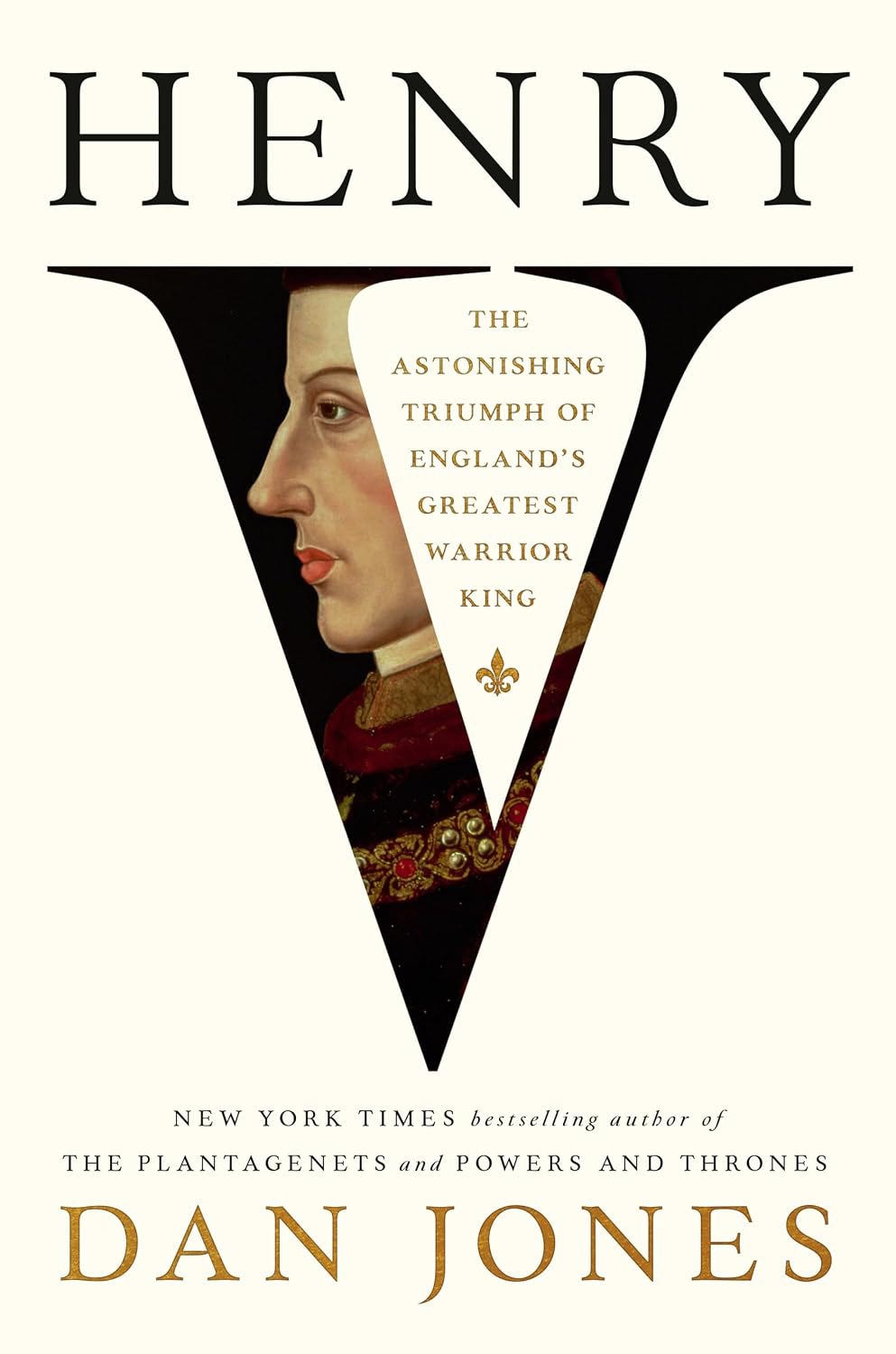
After spending three Shakespeare plays with Henry V, this week’s reading was a bit of a detour. While I was browsing in the Barnes & Noble, one book seemed to be on every table. It must have been inevitable that I would pick up Dan Jones’ Henry V: The Astonishing Triumph of England’s Greatest Warrior King.
This book was an unplanned detour in my “British Reading Unit” project of the summer, but it seemed like a prime opportunity after my truly mountaintop experience with Shakespeare’s Henry. Jones is an historian and television presenter/podcaster in England. He also writes historical fiction, most of it centered on this late medieval period. He had earlier published The Platagenets and The Wars of the Roses. In this book’s introduction, Jones said that he had left a “V-shaped hole” in his series, but wanted to become a better historian before he wrote about Henry V. Was it worth the wait?
I’d say yes, emphatically. This history is very good; Jones’ style is readable and he seems to know his audience very well. One interesting choice he makes is to write the book in the present tense. It gives the story a vitality you can’t get writing in the past tense, especially with a subject who didn’t write much himself.
Unlike most biographies of Harry, we meet him as a child who traveled to France with Richard II to witness peace negotiations, who watched his father push Richard II aside to claim the throne, and who fought at Shrewsbury as a 16-year-old commander of troops. By beginning at the beginning, Jones made room for some of the great stories in Harry’s life that other biographers ignored. (More on that later.)
Harry assumes the throne at 26, when his father dies. He’s single, a great leader, very pious, and focused on reclaiming that which he believes is properly his and his father’s, the throne of France. (That’s what most of the play Henry V is about.) Harry leads the army to Harfleur in France, taking the city after a long and brutal siege. Then he sends off by land to claim Calais. Through bad luck, bad dysentery, and bad intelligence, the English army finds itself bedraggled on a field near Agincourt. This is the site of the battle, a magnificent military victory for England. It leads to a truce with France and the marriage of Henry V and Katherine of Valois. Harry returns home after three years with an amazing victory and a new queen.
Sadly, he dies in battle only three years later, ruling only nine years and leaving an infant son to become Henry VI.
The reason I picked this book up was because I was acting on my belief that good books lead you interesting places. I probably wouldn’t have picked this up but for having fallen in love with Shakespeare’s Harry. Would Jones’ Harry hold up? Who is the ‘real’ Harry, anyway? To find out, I had to be willing for my ideas to be wrong.
The first glaring difference is Shakespeare’s portrayal of Harry’s misspent youth. In fact, he was a diligent student. His chastity was a source of jokes, if not concern, amongst his advisors. He was incredibly pious, even as a young man. And he had no Falstaff to goad him on; Falstaff’s size was possibly lightly based on John Oldcastle but was truly a completely fictional character.
The Battle of Shrewsbury, portrayed in Henry IV Part 1, really did occur, and Hotspur really did die there, possibly by Harry’s hand. But Hotspur was about 18 years older than Harry, definitely not his contemporary as portrayed in the play. Also in that battle, Harry was horrifically wounded, so much so that I was shocked that Shakespeare left it out.
During the battle of Shrewsbury, Harry took a spear to the face, through his cheek and into his brain. While the shaft of the spear was removed, a doctor had to be summoned from London to deal with the metal tip. Harry had to endure its removal and the subsequent packing of the wound against infection for weeks, without any modern painkillers. It boggles the mind. Harry in later years often acted as if he were touched by God in some way. It seems natural that his survival here would have made him believe that.
Another important facet of Harry’s life that was left out of the plays is the intense loyalty of his brothers. Harry had three younger brothers who acted consistently as his close advisors and aides. Considering the amount of court intrigue around earlier Plantagenets, these strong relationships are surprising! Those relationships opened up a lot of information about Harry’s personality as well as his brothers’. It’s not surprising, though, that Shakespeare couldn’t focus on the brothers very much. The play’s action really needs to stay focused on Harry, and too many characters easily get muddled on stage.
But what emerged from the history is much more real, much grittier, than any play could be—and I found the historic Harry to be even more heroic. While I had to be willing to set aside my love for this character, I was glad I had someone else who loved Harry as my guide. Jones is definitely a fan of King Henry V.
But he does not whitewash Harry. His faults, and there were many, are addressed honestly in the history, where Shakespeare chose to soft-pedal those same characteristics.
For instance, Shakespeare made a point of calling out Harry’s love of order, and his insistence on it particularly in battle. In the play, he executes three close ‘friends’ who plotted against him, and he orders his former drinking companion Bardolph executed for theft on the battlefield. Jones points out the true ruthlessness, as more than once Harry killed prisoners who rightfully should have been traded and marched his soldiers harder than might have been necessary. Almost one-third of the army died on the way to Calais.
And there’s ample evidence of inspiration on St. Crispin’s Day at Agincourt. It’s not the eloquence of Shakespeare’s pen, but it’s inspiring nonetheless. Harry was a soldier’s soldier, and his faults even make Harry all the more heroic.
But in the end, Jones can’t inspire my love for his subject. Shakespeare did that. If I had only read this history, I would have come away with an interest in the time and a high regard for the warrior king. But it was Shakespeare who made Henry inspiring, eloquent and brave. Dan Jones just helped me get to know him better.
Is this a book for you? I think it’s excellent, especially if you liked the Henry plays. It’s also a very interesting introduction to this time period. These days it can feel as if we are awash in everything Tudor these days. This is an earlier time, and one that gets overlooked. Just make sure you find your own Monmouth family tree to refer to because there isn’t one in the book.
Shakespeare led me to Jones. Where will Jones lead me? I think, most of all, to more Jones. I would particularly like to read his earlier book in this series, The Plantagenets.
I’m glad I followed my instincts and picked this book up at Barnes & Noble. What’s a favorite “impulse buy” book that you’ve enjoyed lately?
No posts
Comments
Nothing yet. Say the first thing.
Sign in to join the conversation.