
As I continue my season of “Brit Lit,” it’s time to take a look at Bijan Omrani’s God Is an Englishman. Published in 2025, I came across it from a mention on X or a podcast—I’m honestly not sure, but it stuck with me, and when I was putting my English reading list together this was one of the first on the list.
Bijan Omrani is an interesting author. He has a huge background (experience and education) in tracing the cultural history of Silk Road countries. But he’s also a half-Persian, Oxford-educated Anglican with an abiding interest in Christian influence on his native England. He brings authority to his history as well as plenty of personal anecdotes from raising a Christian family in contemporary England.
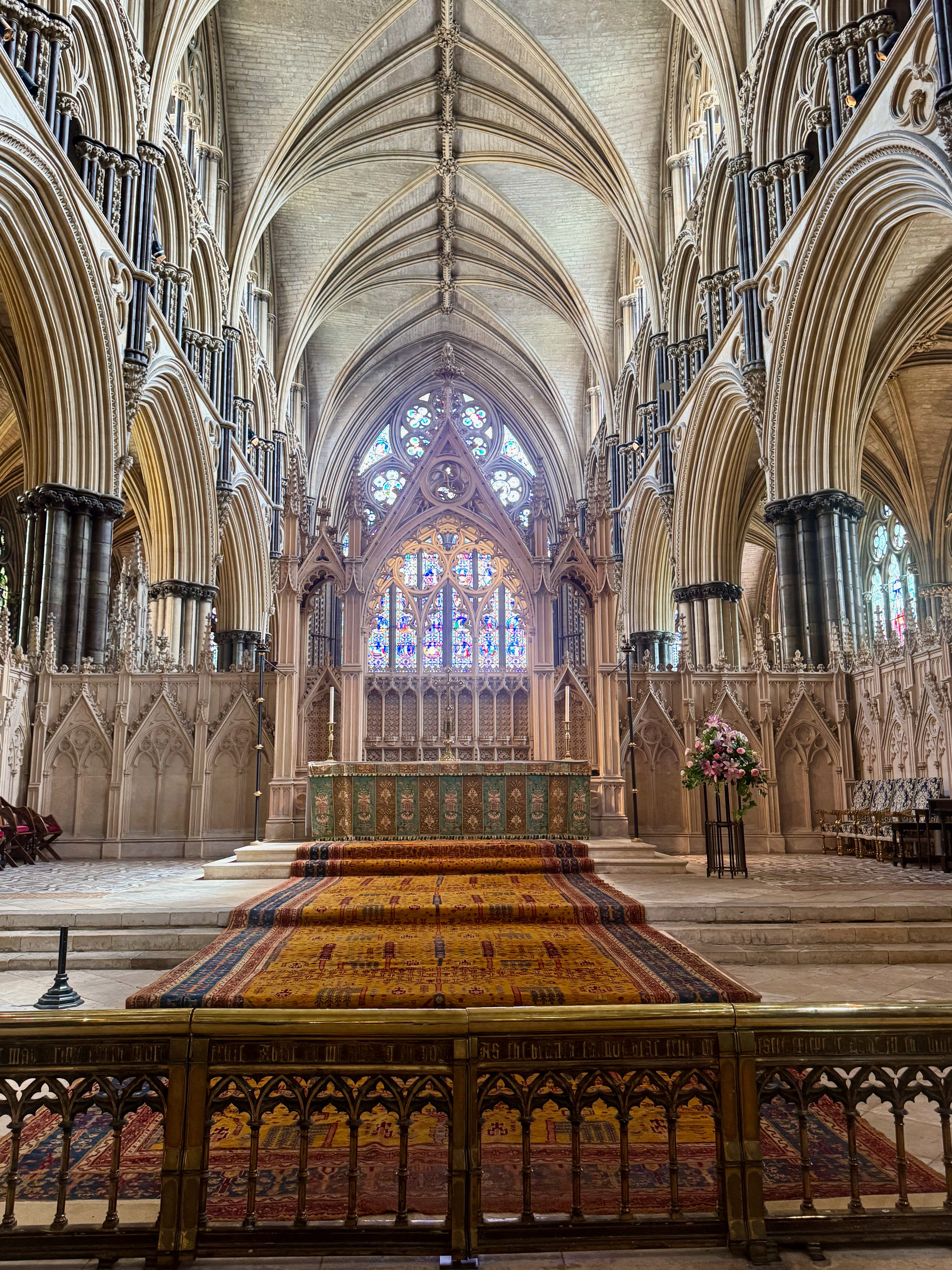
Given that our trip to England was specifically considering the Christian history of England, Englishman felt like an almost preternaturally good fit. How could I not read it?!
If this book sounds a little like Tom Holland’s recent Dominion, you’re not far off. In fact, in the preface Omrani says that he read that book and it made him want to turn to his home country. England, with its own particular history of missionaries and its own particular Reformation, has developed its own particular culture, largely thanks to English Christianity. As the religion wanes right now, he felt that England is at real risk of losing connections to her past. This book is Omrani’s contribution to solving a sad problem.
Unlike Dominion, this book is arranged by topic: music, law, monarchy, art, literature…the list goes on. Each of these topics is like a thread that he traces. It’s like walking through the same timeline but looking at the action from a distinctly different viewpoint each time. At the end, he winds the threads together, like a cord, to discuss where England might go from here.
The overarching main idea of Englishman is that Christianity is inextricably linked to what it means to be English. A society that rejects is underpinnings wholesale, like England appears to be doing right now, can’t expect for that society to continue to march solidly on. The first step, then, is to recognize that English culture is, in fact, distinct from others and that is has its roots in a particular religion, Christianity, that is also distinct from other religions of the world. That means understanding what Christianity really is and how it was lived out through the centuries.
The reason? Much like the “made-up” holidays that replaced the Church’s abundant feast-day calendar after the Reformation and that then shortly thereafter fell by the wayside, England risks losing her intrinsic “Englishness” because no one realizes how they happened in the first place. England wasn’t inevitable—she’s grown out of centuries of people living, working, and worshipping there. And Omrani believes there is something to save.
I make it sound like this is some kind of political book—it absolutely isn’t! Omrani sees that the culture he grew up in, that everyone assumes will always remain, is receding, and he doesn’t want to give it up without understanding what exactly will be lost.
Early on, Omrani discusses Bede’s contribution to English self-identity and kingship. Bede took pains throughout his History to draw parallels between English kings and Hebrew ones. The idea that a virtuous king could prosper a nation, benefitting his subjects, was pretty novel in Europe at the time. Kings were strong men, not virtuous ones. But as Augustine and others brought Christianity back to England in the late 500s, they also brought back the idea of a virtuous servant king. That connection between a ruler’s virtue and his subjects’ prosperity is important—it’s what led to documents like the Magna Carta. In fact, it even shows up as Henry V striving to be a good king even as he is a warrior a century later.
The term “servant leadership” is bandied about so much as a B-school mantra that it’s easy to forget that it has its roots in Christianity, personified as the king who rides in on a donkey.
I don’t want to touch on every cultural thread Omrani considers, but it’s fun to share some of the ideas he develops:
The single most important event in the development of English as a language of literature and song is the translation of the Bible into English. John Wycliffe started translating Bible texts in the late 1300s. This was highly controversial (he got into trouble numerous times with both the local and Roman church), and eventually his copies of the Bible were rounded up and destroyed to the extent possible.
But in the early 1500s William Tyndale offered his own translation. The time was more ripe—the Reformation on the Continent was underway, with Luther posting his 95 Theses in 1517. Tyndale at one time had escape to the Lowcountry to work on his project, but when he started distributing it in 1526 it was met very favorably.
The interesting thing was, Tyndale had to think long and hard about how the Bible should sound. Scholarly? Relatable? He settled on wanting it to be easy to say, straightforward enough for a “plowboy” to understand, but to also feel majestic.
Around 1500, a poet (and Henry VIII’s tutor) John Skelton had said that “our natural tongue is rude,” and he thought that anything lovely would be impossible in English. Tyndale accepted the challenge and proved him wrong. In fact, 80% of the King James Bible is Tyndale’s, including most of the Psalms. After that, Herbert, Donne, Milton, Shakespeare, and so many others went on to produce a miraculous amount of English poetry.
I’d be remiss if I didn’t mention Thomas Cranmer, who wrote the beautiful English Book of Common Prayer in 1544, also played a huge part in what “sounds normal” to us now: “in sickness and in health, for richer, for poorer,” for example!
Tight clusters of houses and businesses around the village church are a pretty common sight all across Europe. But one thing that was different in England was their Reformation. England had a robust network of abbeys in the early 1500s; Henry VIII dismantled them as part of claiming church assets as the state’s. After stripping everything usable out of the abbeys (and kicking the monks out), the buildings were left to ruin. Basically they became cut-stone quarries.
But by the 1700s, those ruins were being recognized for how they added to the beauty of the countryside. One writer (and Anglican priest) commented on the qualities of the English landscape, saying that the ruins contributed an “awful, romantic wildness…that moves the mind very powerfully.” This attitude seriously took hold during the Romantic and Victorian eras as all kinds of people sought out the special qualities of quiet and beauty that they had.
And because of that, the ruins were preserved—no more “borrowing” stones for your cottage addition!
Of course you can argue that a working monastery is more useful. But the actual idea of “picturesque” grew out of the regard of these places as beautiful.
Gregorian chant arrived in England in 597 with Pope Gregory’s missionaries. By the 900s, the chant has inspired dramas that are sung in church on festival days. That even develops into pageants hosted by town guilds.
At one point Rome tries to cut down on this extraneous singing, but England is a very long way from Rome. The English experimentation with polyphony (instead of single-note chanting) proves very popular and even makes its way back to the rest of Europe!
Those town pageants continued to develop; by the 1500s they have become elaborate mystery plays performed on particular holy days. And THAT is the start of Christmas carols, in spite of the disapproval from church leaders. People loved them that much.
Back to that disapproval—in 1325 the Pope had expressed his disapproval, and church leaders had really struggled with how much pleasure they took from listening to and participating in the music. The problem was that the melodies had gotten so complicated you couldn’t make out the words. So, after the Reformation, our friend Cranmer suggested to King Henry VIII that songs were great, but that they “should not be full of notes.” Basically, by the time Queen Elizabeth was in charge that meant one syllable per note. You had to be able to understand the words that were being sung.
With no complicated melodies to sing, professional choirs weren’t needed. Ordinary people could sing—and they did. They loved it. It spread from London very quickly.
And that led to poets like Isaac Watts, who composed poems especially to be sung, like “Joy to the World” and “God Our Help in Ages Past.” I could go on and mention the Wesley brothers and so many more, but you get the idea. The only other place that such hymnody really flourished was in the Lutheran churches in Germany.
I could mention so many other aspects of life, but I think this book merits your attention. For any Anglophile, or anyone interested in cultural history, it’s a very fun addition. I think it’s interesting to know the beginnings of things that we think of as fundamental (like singing in groups), and to be reminded that they aren’t inevitable.
For me, it was worth the spot on my reading list. It helped me to synthesize other things I’ve read, especially Bede. But I think I might have gotten more out of it had I read it later in the project, after I’d read other things.
And it definitely motivates me to pick up Dominion now—that one has been sitting on our bookshelf waiting to be shown some love. That time might be coming up!
No posts
Comments
Nothing yet. Say the first thing.
Sign in to join the conversation.