
Last year, my wife and I were given a small garden plot at the farm which had suffered enough neglect from its previous owners to become completely overgrown. Beneath the mess, we discovered a handful of soft-fruit bushes which had been swamped and were struggling to cling on to life beneath a sprawling mass of weeds. I carefully dug them up and relocated them along the back of a sunny border, with herbs and flowers growing in front, whereupon they promptly freaked out and dropped what little foliage they had left. But who could blame them? I’d probably do the same if I had any foliage myself.
This year they bounced back and, for such small bushes, gave us a remarkably generous harvest – luckily enough, as my first attempt at fermenting the blackcurrants sat and stubbornly did nothing.
My go-to technique for these little explosions of sharp, resinous, musky flavour is boshi, inspired by the Japanese technique of umeboshi, which turns them into a deeply salty, olive-like preserve that’s a powerhouse in the kitchen and lasts for years at room temperature, assuming you have the self-restraint not to eat them too quickly.
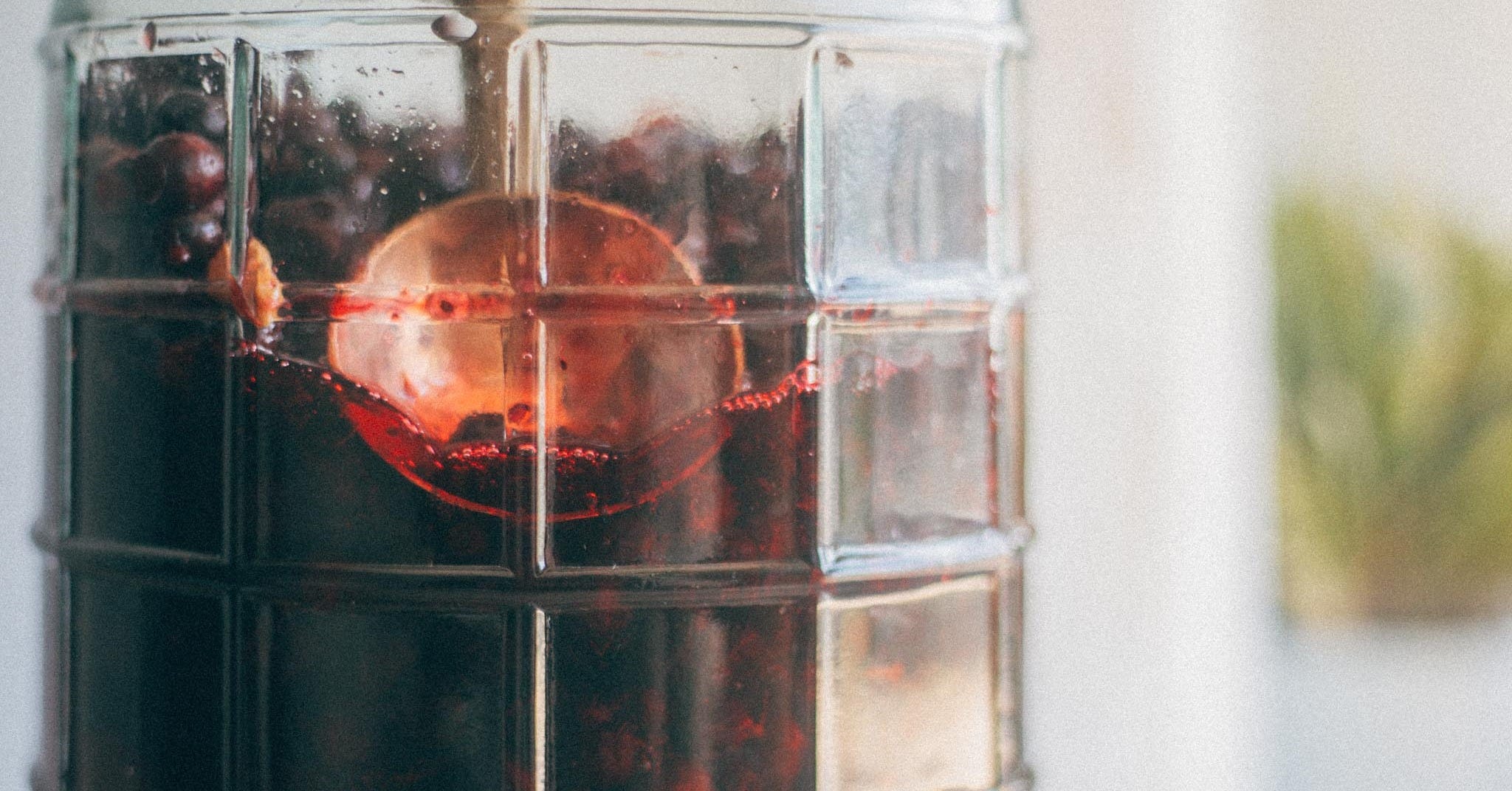
This time I wanted something sweet, and thought I could achieve it by treating the berries much as I had for their salty counterpart, exchanging salt for sugar: the starting point of the Korean method known as cheong. After two weeks of very little happening, the next round of ripe fruit gave me an opportunity to change tactics.
And I’m so glad I did.
The first time I opened the new jar to give everything a stir, once enough liquid had formed, I was hit by such a powerful, mouthwatering aroma of Ribena, the classic British blackcurrant cordial, that my wife could smell it from the room next door. She began calling it Fermented Ribena as a joke, although the flavour quickly outgrew the comparison. With all the deep berry fragrance and acidity I wanted, together with a thicker, glossier consistency than other cheong and fermented syrups I’ve made, fermentation drew it away from the clean simplicity of cordial and towards something darker, more tannic and altogether more mature. It had become a cordial that could comfortably borrow the language of wine: full-bodied and fruit-forward, with bright acidity, a firm structure and a long, gently tannic finish. The skins, seeds, and occasional piece of twig and leaf brought grip which, together with the fruit’s natural acidity, kept the syrup alert and balanced its sweetness in a way Ribena never could.
But by that point, the name Fermented Ribena stuck.
Blackcurrants are deceptive things. Fully ripe, they burst between your fingers with very little encouragement, staining everything purple and releasing one of the most distinctive aromas, far larger than the fruit itself. When harvesting them, I’m forever being covered in the sticky juice of fruits I’ve accidentally pinched too hard, or those which have popped under the weight of their friends in the basket. Yet each berry is held together by a surprisingly resilient skin. My first batch remained almost completely whole beneath the sugar, resisting the extraction for nearly two weeks while only a small amount of juice gathered at the bottom of the jar.
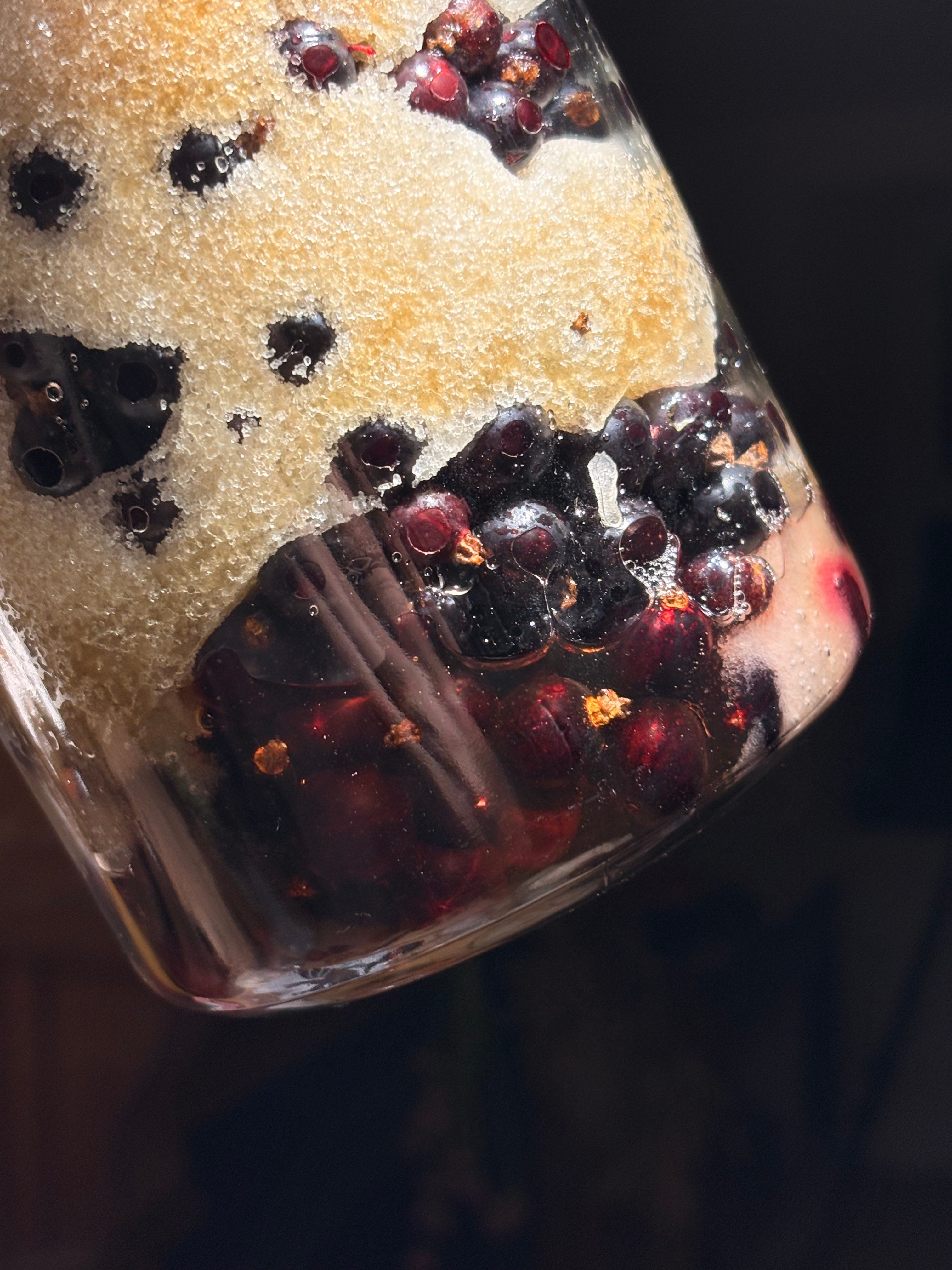
I’ve found that, given time, sugar will eventually draw moisture from intact berries, but this can take so long that my concern was that the fruit might begin spoiling before any meaningful fermentation could take hold, which is something to keep an eye on, especially during the various heatwaves we’ve been experiencing. Softer fruit such as plums and apricots tend to collapse as their juice is drawn out, while chopped citrus immediately offers cut surfaces through which sugar and moisture can move, producing a syrup within the first 24–48 hours. A whole blackcurrant gives the sugar remarkably little access.
For the second attempt, I borrowed an idea from winemaking, where the decision to crush fruit or leave it whole affects the speed of extraction and the amount of colour, tannin and aroma carried into the ferment. I combined roughly half of the blackcurrants (from both the previous batch and the new one) with some of the measured sugar and lightly bashed them in the jar itself using the end of a rolling pin until their skins split and enough juice had formed to wet the crystals, then layered this mixture with the remaining whole fruit and sugar.
On a roll, and inspired by winemaking, I also threw in a few clean twigs and leaves from the blackcurrant bush, which are famous for their intense aromatic oil, usually treated like fresh or oxidised tea.
The difference was immediate. Juice from the broken berries began dissolving the sugar, creating a syrup that could work its way around the intact fruit and draw more moisture from it. My best guess at what’s happening during this process is increased contact with the surface of each currant, encouraging greater osmotic extraction. Sugar might appear as very fine crystals to us, but at the scale of such processes, it’s only in contact with the fruits in specific locations, compared to a liquid which contacts the entire thing. Leaving half of the berries whole also gave me some control over the texture and tannin. Crushing everything into a purée would have released more pectin and broken more seeds, making the syrup cloudier, most probably more astringent and considerably harder to strain.
Pectin is especially abundant in blackcurrants and likely contributes to the finished cheong’s thick, glossy consistency, but it also binds the juice into a viscous mass that can make extraction surprisingly difficult. Commercial blackcurrant-juice processors often use pectinolytic enzymes to break it down, but I wanted to keep the pectin as part of the finished syrup rather than remove it. Research into blackcurrant cell-wall polysaccharides has found more pectic sugars in blackcurrants than in comparable berries such as bilberries, which goes some way towards explaining the difference.
If you want the blackcurrants to soften and release their juice more readily, freeze roughly half of them before making the cheong. Freezing damages the structure of the fruit and can improve extraction, although I wouldn’t promise a thinner syrup without comparing the two side by side; it may also release more pectin. In my winemaking, however, I’ve found that frozen fruit can produce a different, sometimes clearer mouthfeel in summer berry wines like strawberry.
Over the next week, things really started picking up. The blackcurrants shrivelled into tiny prune-like fruits and became increasingly buoyant, rising above the syrup as more juice gathered beneath them. Microbial activity often follows once enough liquid has formed for yeasts to begin working, although it can be remarkably difficult to see. I’ve received plenty of questions from people making cheong who are concerned by the lack of bubbling, so I thought it worth looking more closely at what goes on inside the jar and the signs that are useful to watch out for.
The high concentration of sugar slows most microorganisms considerably, which is one reason these syrups can take so long to ferment and remain relatively stable without salt. Sugar-tolerant yeasts can still work under these conditions, although rarely with the vigour we associate with wine, beer or a lacto-ferment. During the early stages, the concentration also varies throughout the jar: juice surrounding a broken berry may be relatively dilute, while the syrup collecting in the sugar below can become thick enough to resist stirring.
This creates a series of different micro-environments that may favour different kinds or levels of microbial activity. The thinner liquid around the broken fruit contains more available water, while the dense sugar bed will be inhospitable to all but the most sugar-tolerant organisms. Oxygen is more readily available around the floating fruit at the top, whereas deeper in the syrup it is quickly depleted; later, once yeasts have produced some alcohol, that oxygen-rich surface may also favour acetic acid bacteria, introducing subtle vinegar notes. Without examining samples under a microscope, I can’t say exactly which organisms occupy each part of the jar, but it helps explain why fermentation seemingly begins in small regions around the fruit itself, where microbubbles contribute to their buoyancy, pushing them up above the syrup.
An important control in cheong is regular stirring, which brings these different areas back together, redistributing the sugar and floating berries, and replacing the syrup surrounding them with liquid from elsewhere in the jar. It also releases gas trapped within the thick syrup, which is why you might experience a sudden fizz as you stir.
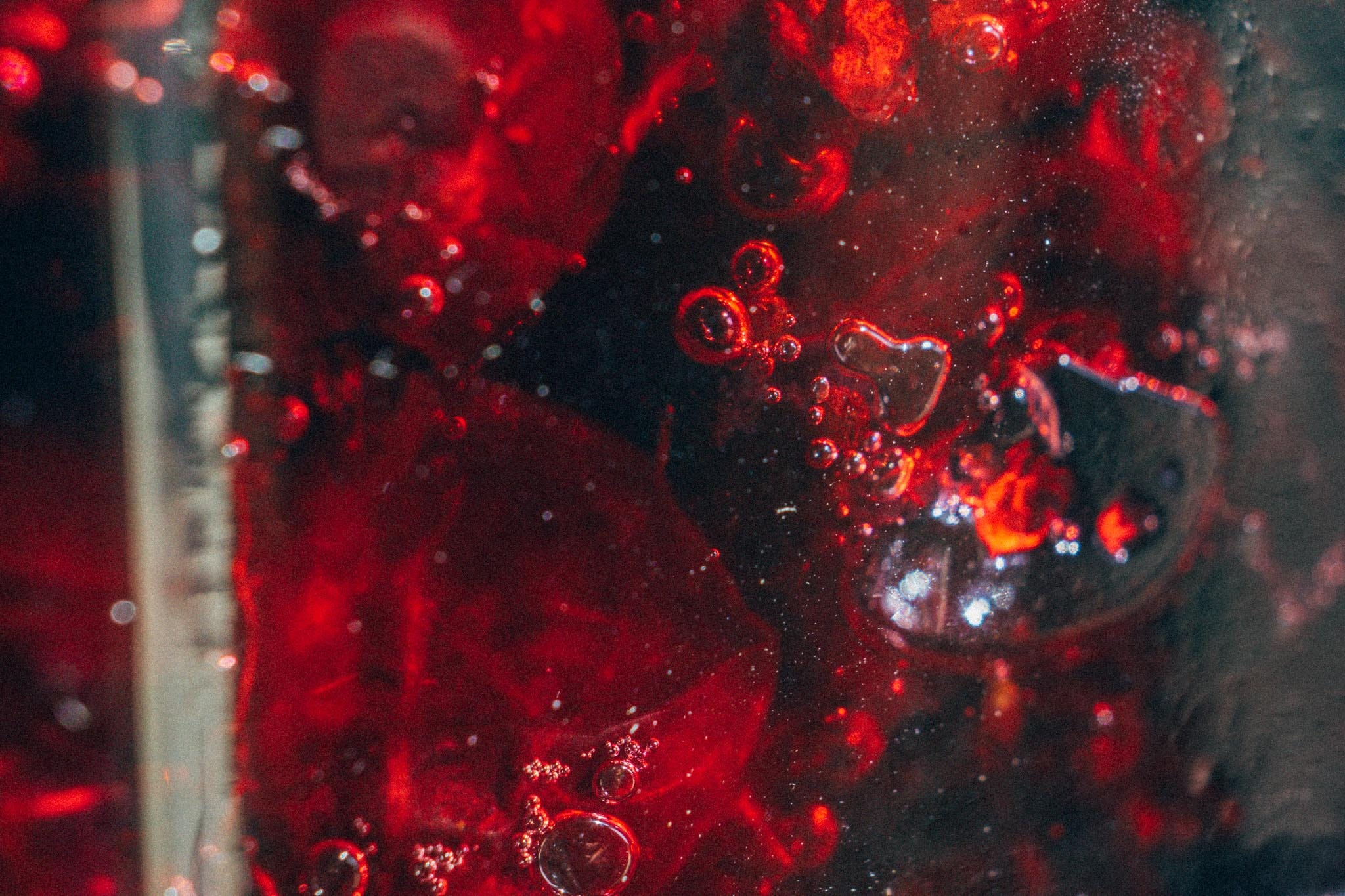
The most convincing signs that fermentation is active and healthy in cheong look quite different to what we’d expect in techniques like wine or lacto fermentation: fine bubbles return after the jar has been left undisturbed, but often remain suspended or moving very slowly through the viscous syrup. Pressure may gradually build beneath the lid, but nothing compared to more active techniques. And the aroma moves beyond sweetened blackcurrant towards a more floral and vinous bouquet. Yeasts produce carbon dioxide, alcohol and a range of aromatic compounds as they work through the available sugars, but the viscosity and sheer darkness of blackcurrant cheong can conceal much of that activity by holding gas within the syrup. So a jar could be fermenting perfectly well without ever producing a lively cap of foam you might expect to see in wine or cider.
Establishing how and when fermentation is taking place answers what’s going on inside the jar, but raises another, more complicated question: was that activity what made it cheong in the first place? After all, the first time I ever made cheong was by accident, when I intuitively made what I thought was a fermented syrup before the online world pointed me in the direction of Korea. And funnily enough, the answer isn’t that simple.
Once I began reading more about cheong, I found its history far less straightforward than many accounts online would have you believe. It is often presented as an ancient Korean method in which equal weights of fruit and refined sugar have traditionally been layered together and left to ferment, although the word itself is much older and broader than that particular technique.
The Academy of Korean Studies describes honey as one of Korea’s traditional sweeteners and explains that it was once known as cheong. A grain syrup made by converting the starch in rice or other cereals with malt was called jocheong, apparently because the finished syrup resembled honey. As it happens, cheong belonged to a family of sweet, concentrated ingredients long before it came to describe the jars of fruit and white sugar now familiar in Korean homes, and increasingly worldwide.
The equal-weight method appears to be a much more modern member of the sticky sweet family, as refined sugar became more readily available in Korea through imports. But it remained expensive and limited as Korea’s modern domestic sugar industry only began in 1953, after which production and access increased enormously. An academic history of the industry records that all sugar consumed in Korea before this point had been imported, which makes it difficult to present a preserve requiring kilos of refined sugar as an unchanged household practice stretching back into antiquity. I’ve included links to various articles, though you may need a translation app if, like me, you can’t read Hangul.
Its relative modernity makes its cultural significance all the more impressive. Foods become embedded in kitchens through repetition, adaptation and usefulness, and the aforementioned maesil-cheong, made from firm green plums, is now a familiar Korean ingredient used as a fragrant sweetener in everything, from marinades and dressings, to sauces, kimchi, and drinks. A harvest gathered during a short season is turned into something that can continue elevating food throughout the year, capturing the distinct acidity and aroma of the fruit alongside a complex sweetness that plain sugar can’t match. One study followed maesil sugar syrup through a full year of fermentation and found that its amygdalin levels declined over time, offering a rare scientific record of how such a syrup continues to change long after its initial extraction. And isn’t that always the dream? To have a kitchen full of seasonal delights we can carry with us throughout the year.
This also helps explain why defining cheong through one exact recipe is so difficult. The word has travelled through honey, grain syrups, fruit preserves and fermented extractions, while its everyday meaning continues to depend on who is using it and what they are making. I first encountered it through the Korean Buddhist nun and cook Jeong Kwan, then later discussed it quite by accident with Johnny Kyunghwo Sheldrick during a video call, who helped refine my understanding further. In Johnny’s experience living in South Korea, the preparation becomes cheong only once fermentation has taken place; without microbial activity, it remains a sugar extraction.
So that’s become the distinction I use in my own work. It acknowledges that fruit and sugar can produce an excellent syrup without fermenting, while giving fermentation its proper importance when yeasts begin introducing gas, alcohol, acidity and new aromas. It also avoids assuming that age alone will turn every sugar extraction into a ferment.
One use that has changed my own kimchi-making is adding cheong to the seasoning paste. I first read about this in Jeong Kwan’s recent book, Korean Temple Cooking, where cheong is a regular ingredient in her kimchi recipe, offering sweetness, fruity notes, and additional sugar for fermentation. I’ve since tried this first hand in my own kimchi, but also in the incredible cauliflower leaf kimchi made by Rebecca and Maylin at The Ferm, who use a pear cheong to balance the sourness and spice of their delicious, zero waste kimchi.
Blackcurrant cheong, aka fermented Ribena, is my own local expression of that evolving practice: a Korean method applied to a Welsh grown fruit, complete with its resilient skins, abundant, somewhat luxurious pectin (words I never thought I’d write together), assertive acidity and familiar British association with cordial. I fully acknowledge that calling it Fermented Ribena may be ridiculous, but it also describes rather neatly what happened when those two food cultures met inside the same jar.
Much of my new book, A Year of Fermentation, grew from working in this way: following seasonal ingredients into jars, paying attention to how they behaved, and allowing the finished ferment to suggest possibilities that I could not always have planned at the beginning. It will be publishing on 27 August 2026, less than 20 days from now!
This is where the investigation ends, with a jar full of cheong and a little more appreciation for the history and culture that led us here. If you have blackcurrants to hand, equal weights of fruit and granulated cane sugar, with roughly half the berries lightly bashed, will give you enough to begin your own experiment. Paid members can continue below for the complete method I arrived at, including preparation, management, signs of fermentation, troubleshooting, straining, ageing and the ways I now use it in the kitchen.
From here, I’ve kept things concise so I can cover as much practical detail as possible without making the email so long that some inboxes cut it off.
Comments
Nothing yet. Say the first thing.
Sign in to join the conversation.