
Every generation chooses its heroes, and in doing so reveals what it values most. We celebrate explorers, athletes, entrepreneurs and adventurers because they embody qualities we aspire to possess ourselves: courage, resilience, determination and the ability to overcome adversity.
They become more than successful individuals, to me they become moral reference points. Parents encourage their children to admire them, hoping that some of their character will be absorbed along the way. Yet every so often, an interview or a passing remark forces us to pause and ask a more fundamental question.
Are we really admiring the right things?
I am fifty-three years old and Bear Grylls is fifty-two so we belong to the same generation, and in many ways we inherited the same kind of worldview. We grew up believing that strength meant conquering nature, that masculinity was demonstrated through dominance, and that animals existed primarily for human use. We were taught that hunting was noble, that eating meat was natural, and that the highest expression of culinary excellence was often found in the flesh of another living being. None of those beliefs seemed extraordinary then, they were simply the air we breathed.
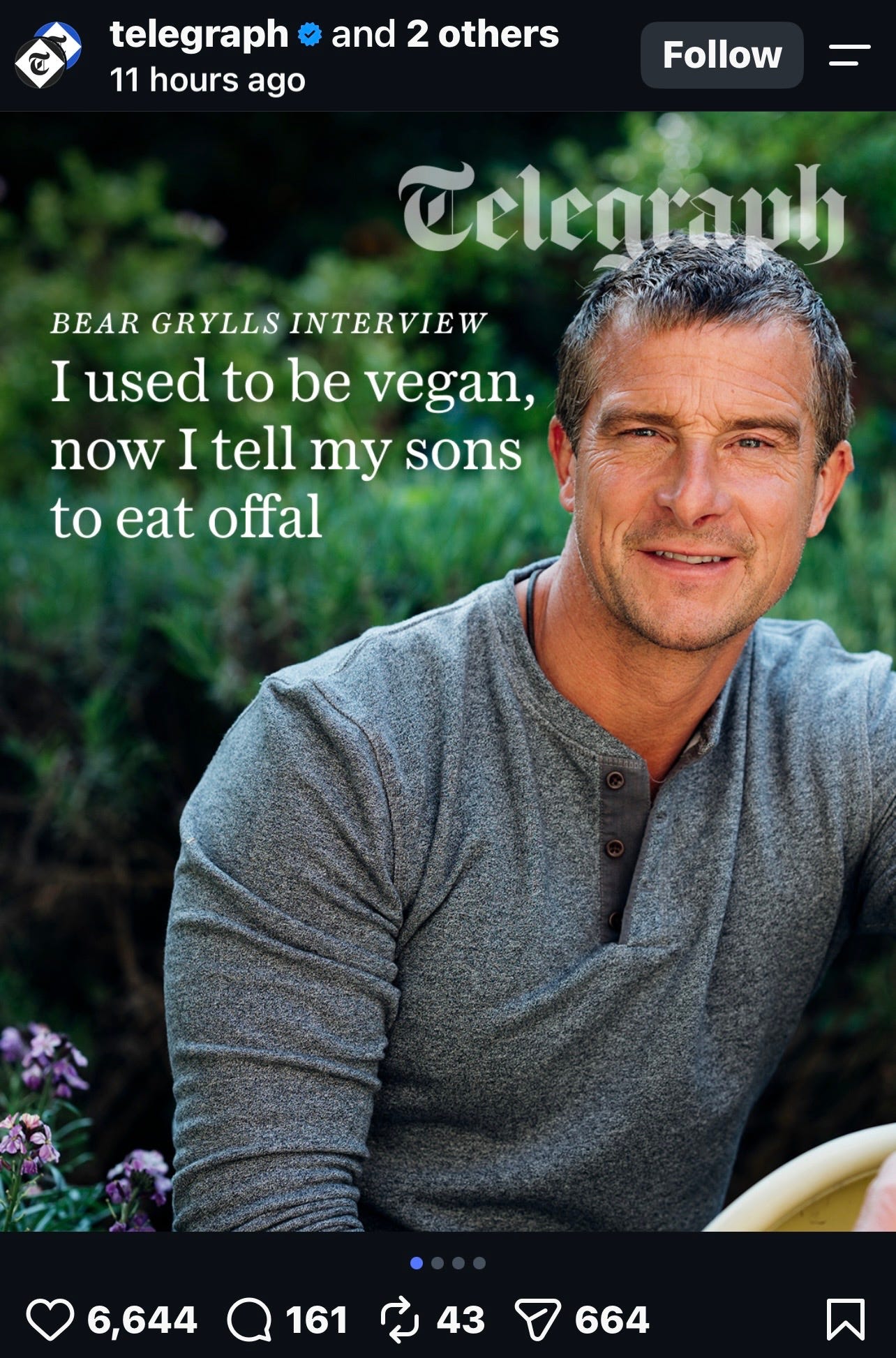
When I read that Bear now encourages his sons to eat testicules , I was not shocked by the food itself. For twenty-five years I proudly cooked foie gras, kidneys, sweetbreads and liver in Michelin-starred kitchens and I spent decades refining techniques that transformed the organs of animals into luxurious delicacies. I admired chefs capable of elevating suffering into gastronomy, because that was the profession I had chosen and the standard by which greatness was measured. Had you met me then, you would have found very little difference between Bear Grylls and me.
The question that remained with me after reading the interview was therefore not nutritional. It had nothing to do with whether liver is rich in vitamins or whether a carnivorous diet improves athletic performance. What lingered in my mind was a far more profound question which I still find difficult answers: what does it mean to be a role model in the twenty-first century?
Every father hopes to leave something meaningful to his children. We all want to pass on courage, confidence and resilience. But there comes a point when physical strength is no longer the most important lesson we can offer. Humanity has entered an extraordinary period of its history because we understand so much about the inner lives of other animals. We now know that pigs solve problems, that cows develop lifelong friendships, that fish experience pain and anxiety, that octopuses display curiosity, memory and playfulness. This is no longer sentimental speculation; it is the product of decades of scientific discovery. Knowledge changes responsibility. Once we understand that another living being experiences fear, joy, attachment and suffering, we cannot pretend that nothing has changed. The animal has not changed. We have.
This is why I have always said that veganism is not a diet.
Diets begin and end with the body. Veganism begins with another individual. It is not driven by the pursuit of perfect health, nor by the promise of longevity, nor by a desire to optimise every aspect of one’s physiology. It begins with a simple moral realisation: that another sentient being’s interest in continuing to live matters just as much to them as mine does to me. From that moment onward, the conversation ceases to be about nutrition and becomes one about justice.
People sometimes imagine that abandoning animal products required me to sacrifice my career. In reality, I sacrificed something far less valuable: an illusion. For years I believed that culinary greatness demanded the death of another creature. I believed my imagination could only flourish if an animal paid the price. Looking back, I no longer see technical brilliance. I see a failure of creativity. The greatest limitation in my cooking was never the absence of meat. It was the absence of moral imagination.
This is why the role of parents matters so profoundly. Around every dinner table, lessons are being taught that go far beyond recipes. Every meal communicates something about our relationship with the living world. Children are not born believing that dogs deserve affection while pigs deserve slaughter, or that horses should be admired while cows should become dinner. These are ideas we patiently construct for them, one meal at a time, until they appear as natural as breathing. Our values are inherited long before they are questioned.
History repeatedly reminds us that morality evolves. Practices once considered obvious eventually become unthinkable, not because human beings suddenly became different, but because compassion expanded to include those who had previously been excluded from its circle. Every generation likes to imagine that it has reached the summit of moral progress. Every generation is wrong.
I do not write this as a criticism of Bear Grylls. In many respects, I recognise my younger self in him. We were shaped by the same culture and taught the same assumptions. The difference between us is not where we began but where our journeys led us. His interview simply reminded me that the qualities we admire are changing, even if many of our heroes have not.
Perhaps the defining virtue of the future will not be physical endurance, survival skills or the ability to conquer the natural world. Perhaps true greatness will belong to those who possess the courage to rethink inherited beliefs, to allow compassion to challenge tradition, and to expand their moral concern beyond the boundaries of their own species. If that is the direction in which humanity is travelling, then the greatest role model will not be the person who teaches a child how to survive in the wilderness.
It will be the one who teaches them that strength is measured not by the power we exercise over the vulnerable, but by the compassion we extend towards them.
That, I believe, is the highest summit our species has yet to climb.
No posts
Comments
Nothing yet. Say the first thing.
Sign in to join the conversation.