
I was told to watch it , so I did. And I suspect I took away something very different from what the programme intended in the latest episode of Clarkson’s Farm
The episode centres around a group of pigs that Jeremy Clarkson has raised on his farm. The animals are no longer commercially viable, and the decision is made to send them to slaughter. As the moment approaches, Clarkson becomes visibly emotional. His voice falters, his eyes fill with tears, and he speaks movingly about how much he loves the pigs and how much pleasure they have brought him over the years.
It is a deeply human moment; one that touched me and I know it did touch a lot of viewers. So for a brief period, it appears as though Clarkson has been forced to confront something that our society works very hard to conceal from us: that the animals we call livestock are not production units or business assets but individuals. They have personalities, preferences, relationships and, above all, a powerful desire to continue living. Anyone who has spent time around pigs knows that they are curious, intelligent and emotionally complex creatures. We often compare their intelligence to that of a young child, yet somehow we are expected to regard their deaths as routine and unremarkable.
Watching Clarkson struggle with the decision, I found myself thinking that perhaps humanity had caught up with him. Perhaps, for a moment, he was seeing these animals not through the lens of economics but through the lens of compassion.
And then he sent them to the slaughterhouse.
What fascinated me was not Clarkson’s sadness itself, but the way the entire episode seemed constructed around it. The cameras lingered on his anguish. Friends reassured him that the pigs had enjoyed a good life. Viewers were encouraged to sympathise with the burden he was carrying. Everything pointed towards a single conclusion: Jeremy Clarkson is a man with a heart.
Yet the more I watched, the more I found myself asking why we were being invited to feel sorry for Clarkson rather than for the pigs.
After all, Clarkson was not the one whose future was being taken away. Clarkson was not the one being loaded onto a truck. Clarkson was not the one facing death.
The pigs were.
What the episode inadvertently revealed was something I find increasingly common in our relationship with animals. We place enormous value on feeling compassion while demanding very little of compassion itself. We celebrate the emotion, applaud the tears and admire the discomfort, even when none of it changes the outcome for the individual who is suffering.
This is why my thoughts unexpectedly turned to Oscar Schindler.
Not because the situations are comparable in scale, history or consequence. They are obviously not. What interested me was something far simpler.
Schindler is remembered because he allowed his humanity to interfere with the system around him. He looked at a structure that reduced living beings to economic value and chose, despite the personal cost, to act differently. His compassion did not remain a feeling. It became a decision.
Clarkson, by contrast, appears to experience a genuine moral conflict. He clearly cares about the animals. He clearly understands, at least on some level, that their lives matter to them. Yet when that moment arrives, when compassion collides with convenience, convention and economic logic, compassion quietly steps aside and the system proceeds exactly as planned.
What makes this particularly striking is that Clarkson is not a struggling farmer trapped by impossible circumstances. He is a multimillionaire television personality with opportunities that extend far beyond the farm. Had he chosen to spare those pigs, it is difficult to imagine that his future would have been affected in any meaningful way. The decision to save them would not have ruined him. It would simply have required him to place the lives of the animals above the logic of the business.
He chose not to.
That, for me, is the real story of the episode; So not that Jeremy Clarkson cried and not that Jeremy Clarkson cared.
This is exactly what happened: Humanity knocked on his door, sat down with him for a while and showed him exactly what was at stake. He listened, he felt the discomfort, he shared it with millions of viewers and then, having experienced all of those emotions, he found a way to get over them.
The pigs received his tears. What they needed was his courage which he clearly had none.
And perhaps that is why I finished the episode feeling so uneasy. We live in a culture that often mistakes emotion for morality. We assume that feeling bad about something is somehow equivalent to doing something about it. Yet compassion has value only when it changes the outcome for those who depend upon it.
The pigs did not need Jeremy Clarkson to cry for them. They needed him to decide that their lives were worth more than the story their deaths would create. By being able to resist against your natural humanity and send those poor piglets to a gas chamber, then Mr. Clarkson, you qualify as an absolute b…..d psychopath.
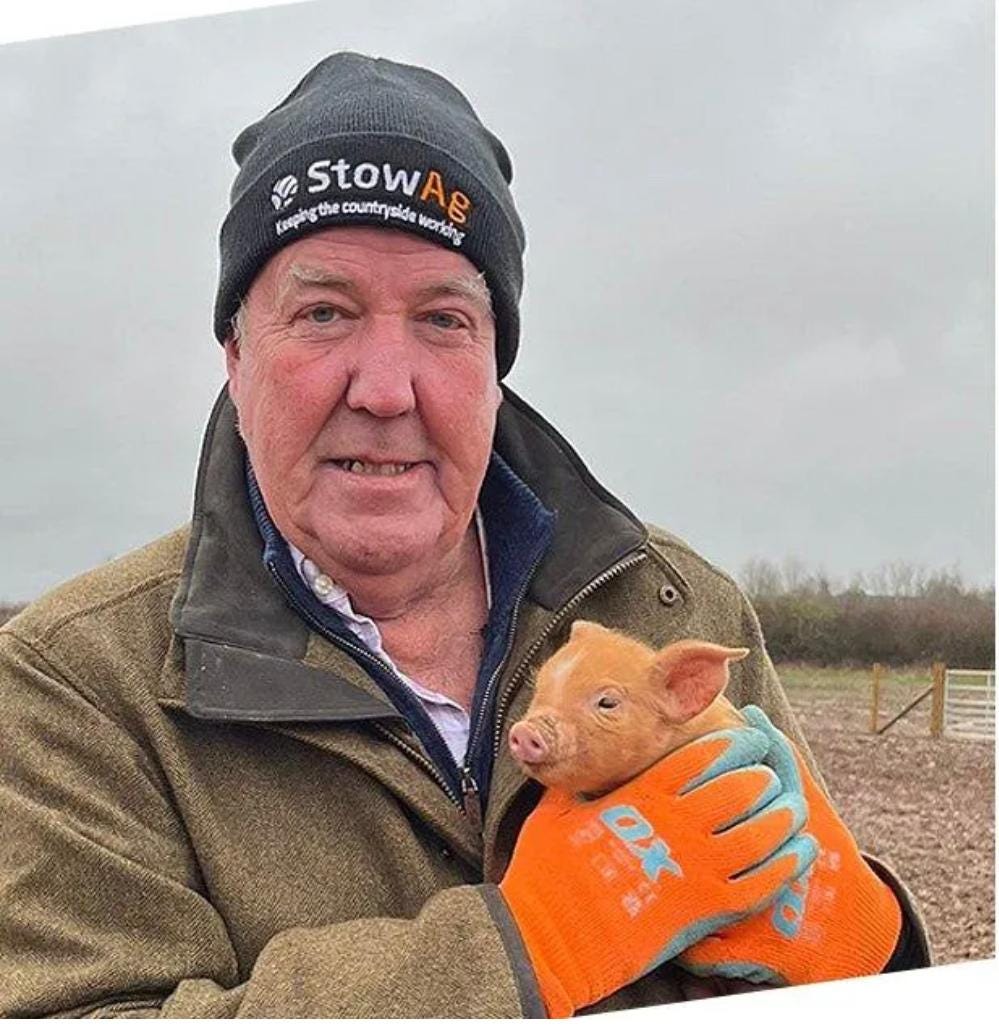
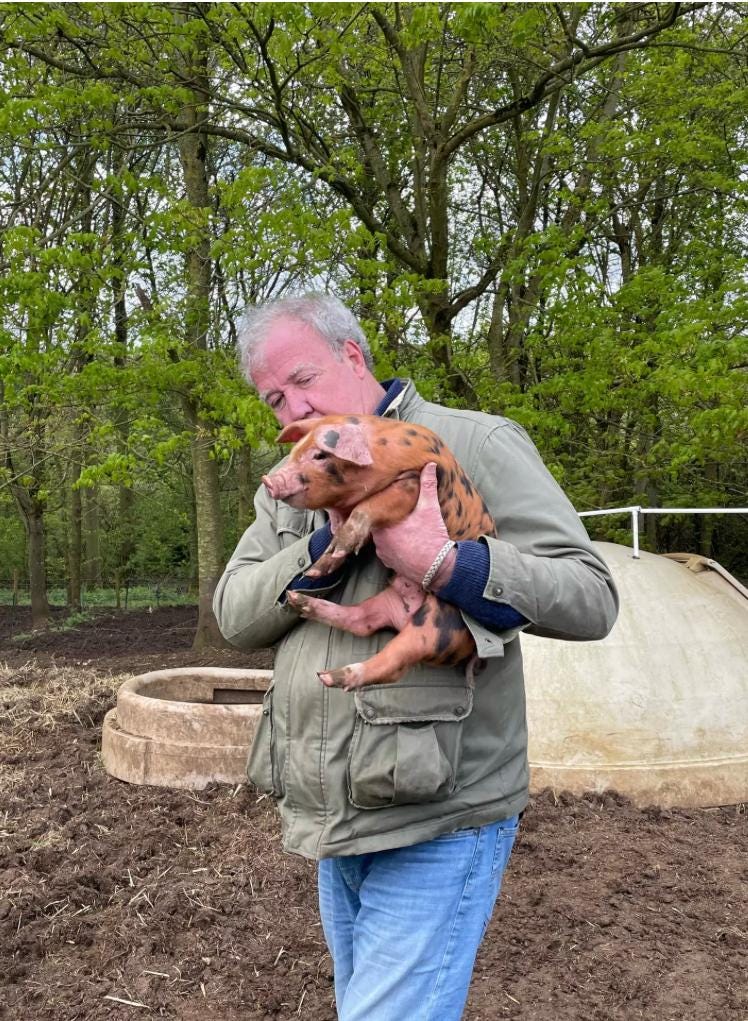
Pictures of a Clarkson holding his future victims
No posts
Comments
Nothing yet. Say the first thing.
Sign in to join the conversation.