
Welcome back to our summer series on Venture Capital. This is Edition #3 on Partnerships. If you missed it, you can read #1 on Financing Risk and #2 on VC as a Financial Product.
“Partenaire particulier cherche partenaire particulière”
Partenaire Particulier
Our last edition landed on a spot that bears some tension: we said that funds were less financial products than extension of the individual(s) running them.
That seemingly innocuous “(s)” that signifies plurality is the entire exploration of today’s essay: in a world where your way of thinking about, underwriting and accessing deals is the be-all-and-end-all, why are groups of individuals called general partnerships the ultimate structure? What’s in it for an individual VC? Are partnerships the reason funds fail similarly to why startups fail (remember we said “VC is to LP what startups are to VC”)?
This is an exploration of the dynamics within GPs.

I have a confession to make. I greedily indulged in the 9 seasons of the TV show Suits that depicts the life of a corporate law firm following attorneys that are charismatic (Harvey Specter), college dropouts with photographic memory (Mike Ross), or borderline psychopathic (Louis Litt).
While I don’t really think this is the best show to follow if you want to get a grasp of what fast-paced haute finance deals are like (I’d rather recommend Billions, Succession or The Industry in that vein), I did appreciate all the shenanigans that led more or less all of the main characters to eventually make it to “name partner”, the seemingly ultimate objective beyond money and success: having your name on the firm’s wall.
Come to think about it, many of the older household names in finance are aggregates of the founding partners’ names - Rothschild, Lazard, Goldman Sachs (Marcus Goldman & Samuel Sachs, J.P Morgan (eponymous), Morgan Stanely (Henry S. Morgan and Harold Stanley), KPCB (Eugene Kleiner, Tom Perkins, Frank Caufield, Brooke Byers), KKR (Kohlberg Kravis Roberts) - or wordplays on it - Blackstone (Stephen A. Schwarzman provides the ‘black’, Peter G. Peterson provides the ‘stone’). Blackrock itself bears that name because it was incubated off Blackstone for a while.
Although you’ll encounter the occasional ‘Andreessen Horowitz’ or ‘Khosla Ventures’, the newer household names - Bridgewater, Sequoia, Accel, Greylock, Bessemer, Lightspeed, Index - are usually more conceptual, which highlights an interesting evolution in financial branding, but also potentially reflects the move from relationships-driven partnerships to the advent of more institutionally-driven asset managers intended to survive multiple generations of partners from inception.
This led me to the interesting idea that Partnership Dynamics, themselves, might have evolved over time and that there were surely things to be learnt in the history of partnerships. Below are a few selected highlights that I found interesting.
Born in 1744 in the Jewish neighbourhood of Frankfurt-am-Main (and owing it his family name - zum roten Schild means ”at the red shield sign”) Mayer Amschel Rothschild built the financial empire that we all know now. The way he did this was - among other things - by strategically placing his five sons in key financial capitals across Europe: Vienna, London, Paris, Naples and Frankfurt. This distributed family network solved one of the hardest problems in any partnership:
If Rothschild’s lesson is that partnerships require trust to scale geographically, Goldman Sachs’s is that they require culture to scale organizationally. The firm evolved from a relatively small Wall Street partnership into a global financial institution by pioneering many financial innovations - among which Discounted Cash Flow (DCF) valuation for companies that did not have hard assets at the turn of the industrial era or block trading to enable liquidity in large market operations -; but the nature of the challenge around people changed with its size.
Decisions could no longer be concentrated in the hands of a few partners sitting around a table. Thousands of bankers, traders, salespeople and investment professionals now had to exercise judgment independently while still acting in the interest of a common enterprise. Left to themselves, the economics of partnerships naturally create centrifugal forces: partners protect their own franchises, “eat-what-they-kill” (2), consensus slows strategic change, and individual stars accumulate influence that may not translate into institutional strength.
Goldman Sachs’ response was to treat culture as infrastructure rather than aspiration. In 1979, John Whitehead, then co-head of GS, wrote his now famous 14 Business Principles to define what the culture of Goldman stood for - which I encourage you to read if you never have. Alongside them, he pushed compensation systems that rewarded colleagues for helping one another as much as generating revenue, and an unusual emphasis on character and long-term fit in recruiting were all designed to answer the same question: how do you make the partnership more valuable than the individuals who compose it? The objective was never to erase personality or independent thinking, but to create an environment where talent compounded through collaboration instead of fragmenting into a competition of egos. In other words, the firm’s competitive advantage would not come from employing exceptional people alone, but from ensuring that those exceptional people consistently made one another better.
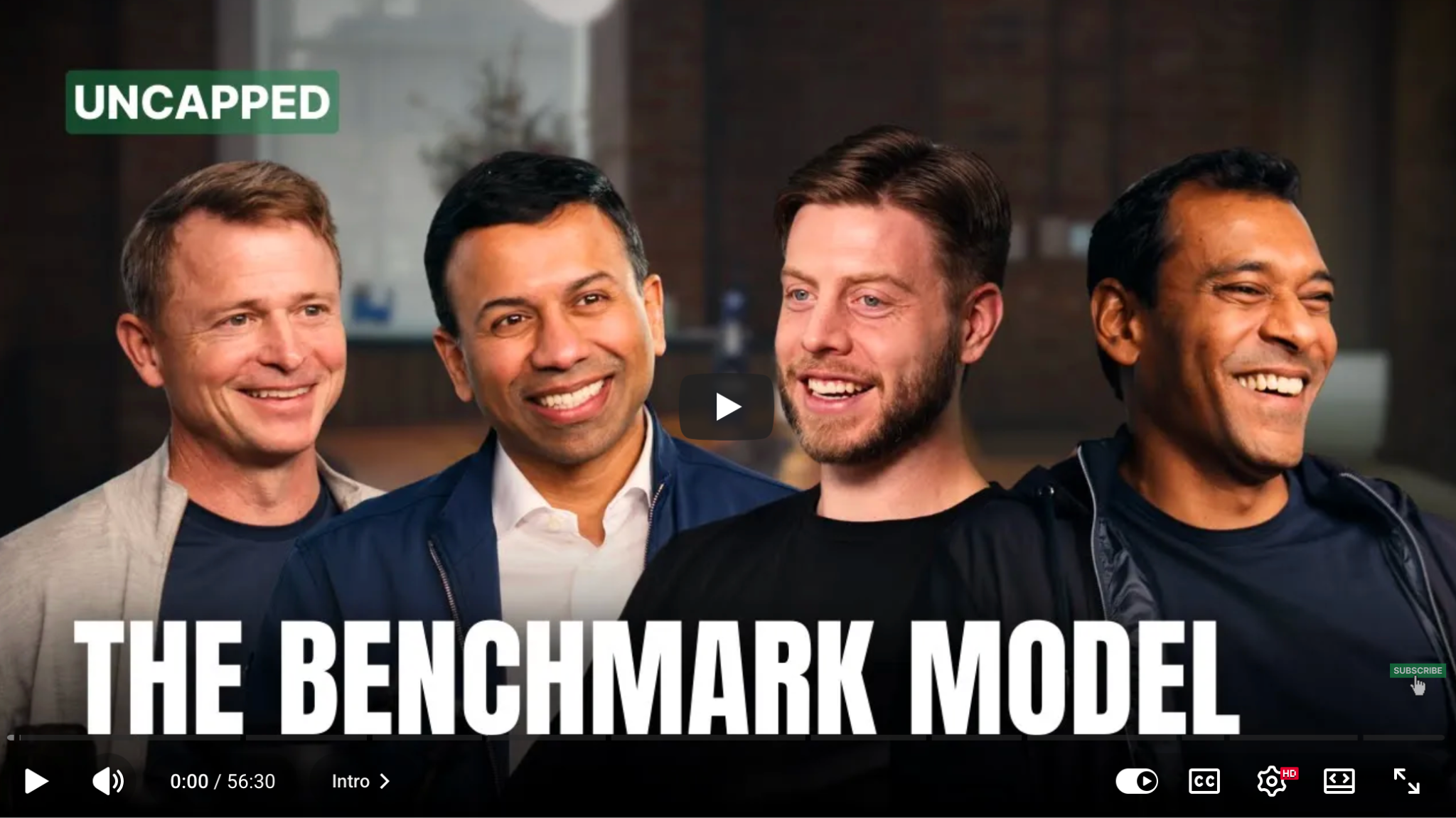
Benchmark provides perhaps the purest modern expression of partnership as organizational design and it’s one that takes a great deal of radicality: instead of building systems to preserve a large partnership at scale, it simply refused to become one.
That sounds almost trivial, but it is a rather radical idea in an industry where success almost always creates pressure to grow if you’re successful: capital flocks at your next fundraising so you raise a larger fund and increase your AUMs. This leads you on a well-trodden path: hire more partners, open more offices, launch more strategies, become a platform. Benchmark deliberately walked away from that playbook. (3)
Nearly three decades after its founding, the firm still revolves around a handful of equal partners investing almost exclusively at the earliest stages. Not because they believe bigger funds cannot make money - they certainly can, perhaps not as much proportionally speaking but that remains arguable - but because they believe that the economics of scale eventually work against the very reason they enjoy practicing venture capital in the first place: spending disproportionate amounts of time with a very small number of exceptional founders. Benchmark is a partnership of craftspeople in an industry that has increasingly become … an industry.
The truly fascinating innovation, however, is not to be found in Benchmark’s size but in its succession model. Most partnerships eventually become prisoners of their own success. The founders built the brand, therefore they keep the economics; new partners join, but never quite as equals. Benchmark broke that chain. Incoming partners receive equal economics (at carry and GP level), equal voting rights and equal responsibility from day one, while departing partners progressively walk away from the franchise they helped build (and do not retain legacy economics). In a way, as the current roster of Benchmark partners discusses it here, every new partner partially refounds the firm. Nobody owns Benchmark forever; everyone merely borrows it from the previous generation before passing it to the next. It is an extraordinary act of institutional humility, and a strong demonstration that the partnership itself - not the individual partner - is the asset worth preserving, at least in their view.
But is it really? Is there a real reason to believe that the partnership is the ultimate form of exercising Venture Capital?
“As I look around, they don’t do it like my clique” Looking back at those three examples, one thing becomes apparent: Rothschild, Goldman Sachs and Benchmark could hardly look more different. They span three centuries, operate in different businesses and embody almost opposite philosophies of scale. Yet all three are, fundamentally, partnerships.
Big Sean - Clique (ft. JAŸ-Z & Kanye West)
That raises a more interesting question than any of their individual stories. What is a partnership, really? More specifically, why does finance keep rediscovering this organisational form when, as we argued in essay #2, investors ultimately back people rather than financial institutions (in VC)?
First of all, partnerships are essentially trying to solve a paradox: as we highlighted in the previous essays, Venture Capital is a deeply artisanal craft, in all that entails. In essence, we back the founders, not the startups. Similarly, LPs may write a check into a fund, but the real underwriting almost always comes down to a handful of individuals. So why do those individuals choose to organize themselves into partnerships at all? Partnerships should not exist by default. They should exist because they create something an individual could not have built alone.
Now that this has been established, at its simplest, I’d say a partnership is an agreement between exceptional individuals to become collectively more valuable than they would have been on their own, the infamous concept of “synergy”: you can be more as a firm than the sum of the parts. That value can take many forms. Capital formation is the obvious one: a group can raise and deploy more capital than any individual. There are other elements: brands compound, networks overlap, information circulates, responsibilities are shared. More importantly when it comes to investing, judgment improves through disagreement. A partnership, in other words, exists because there are things the market rewards more when practiced collectively than individually.

But this also comes at a price, especially in the view of what we said in the previous essay: if LPs are backing an individual with a strategy and access ; the moment that individual is tied to a firm, there are things he/she loses. Consensus partially replaces conviction, incentives become collective, politics emerge …
And this is perhaps the best test of a great partnership: does the institution consistently produce better decisions than its individual members would have reached on their own? If the answer is yes, the partnership has created genuine institutional value, or if you’re a finance dork like me you can call it ‘organizational alpha’. If the answer is no, it is merely awkwardly pooling reputations, splitting economics and introducing politics.
So when exactly does a partnership eventually stop behaving like the synergy-machine it is supposed to be?
I recently read Dan Gray’s excellent The Individual vs. The Firm in the Odin Times and I strongly encourage you to read it too. His main argument is that organisations usually reach a scale where they begin working against the exceptional individuals they were originally built to empower. In it, Gray quotes a paper named Is a VC Partnership Greater than the Sum of Its Partners?
He writes the following about it:
“In fact, the paper is specific in finding that there is very little “organisational capital” in venture capital firms. The firm itself basically represents the combined human capital of the partners, including intangible factors like brand and reputation.
So, the desire to raise (more) capital is essentially what drives an otherwise artisanal and unscalable industry to form scaled organisations.
In an ideal world, this would enable fundraising for the best investors without the firm altering their incentives. However, complications emerge in the form of internal market frictions. The partners have joined together into a firm, so they each now must worry about their relative contribution. Or, more accurately, how that contribution is perceived by their peers.”
So it would seem that, both from an academic research perspective as well as from a first principles one (our own thought exploration), the only reason why partnerships actually exist is to give individual partners more strength at fundraising.
All the rest is (if we accept the premise) just hurdles disguised in asset-clothing: You get a brand? Yes, but your own voice is neutralized or watered-down. You get sparring partners to think deals through? Yes, but you have to reach consensus in a fundamentally non-consensus-driven industry. You get a platform? Yes but this comes with operational and organizational weight. You get a back-office? Yes, but it’s more operations you need to sustain with fees that are distracting you from investing and pulling you towards larger AUM. You get more AUM? Likely yes, but this comes with intense politics and/or not much better economics.
This would also mean that in its purest form, VC is better done in solo-playing mode, pursued by individual investors (or very tight partnerships). One could be tempted to point to the relatively recent advent of “Solo-GPs” (which we’ll discuss in more details in a future edition), but there are older examples with legendary investment results: Ron Conway (known as “the Godfather of Silicon Valley”) at SV Angel, Elad Gil, Chris Sacca at Lowercase Capital I whom we discussed already …
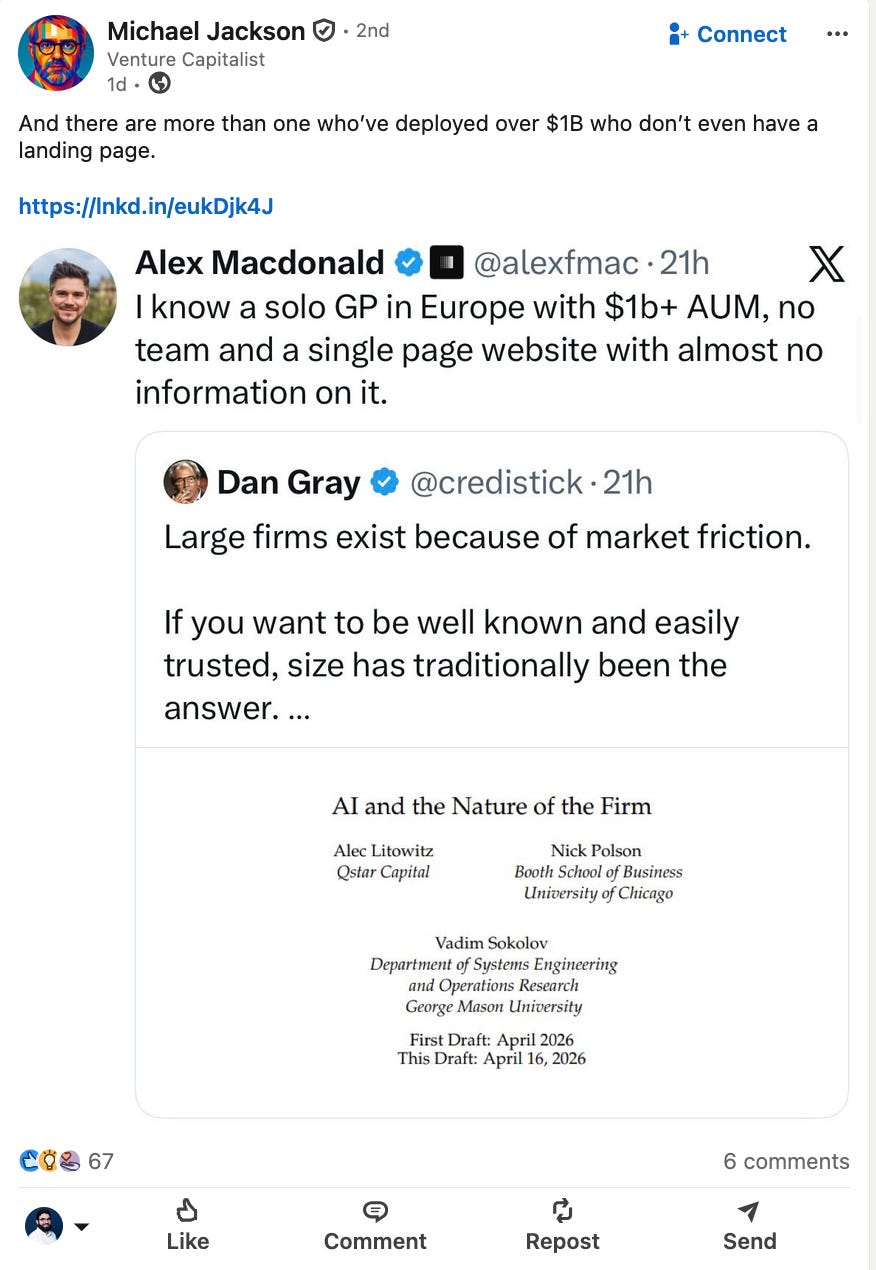
And if you’re tempted to shrug the Solo-GP argument off as a fad, there’s also factual evidence in outcome terms: the study Human Capital in Venture Capital: Evidence from 100,000 Venture Capitalists by Ilya Strebulaev (Prof at Stanford) and Blake Jackson (Assoc. Prof at The Ohio State University) pulls the data from 100k+ individual VCs. Across 30 years and 140k+ investments made in 46k+ by 12k individual VC investors, only ~120 (top 1%) accounted for 56.6% of all net profits and the top 5% accounted for 90% of all net profits. We’re not talking about firms here. We’re talking about individual partners who for the most part work inside partnerships.
And the only reason we could find would be “because that’s how excellent individuals access capital”.
That is a crude read. It’s uncomfortable. To me at least it is - I’m in a partnership, after all. I suspect, if you read this far, that you are too.
Come to think about it, what the Strebulaev study demonstrates is that the returns are traceable back to individual investment decisions. It does not prove that partnerships are some sort of awkward-but-necessary packaging, because it doesn’t distinguish investment decisions from investment access and treatment.
Would those 120 individuals have made the same investment decisions if they had not been trained, staffed, sponsored, and handed dealflow within partnerships? Would they have had access to the same deals or have won the deals if they did not have a brand that carries legacy, a platform that helps founders, an amount of AUM that signals ability to re-invest over rounds?
The study measures who captured the alpha - or more accurately who the alpha can be traced back to ; but it can’t measure whether the alpha-generators would exist without the system that produced and incubated them. And today, most solo-GPs remain mostly partnership alumni (or they’re ex founders/operators leveraging personal wealth, effectively amplifying an angel activity rather than creating a full fledged GP/LP activity).
So I think that saying “partnerships only exist to give individuals fundraising strength” is an incomplete view. I can see two additional reasons why partnerships still make sense and remain the industry Gold standard:
They are the only training infrastructure for VC: an exceptional investor is not made out of thin air. He learns the ropes from seasoned peers, gets challenged, maybe gets frustrated that a couple of deals he believed in didn’t make the cut, then moves somewhere else or starts fresh. The “mercato” of junior investors is part of the business.
They are the OS that wins deals systematically. The structure of a partnership may very well be a hurdle to the craft of VC at individual level, but I’m willing to wager (since I have no proof) that out of the 120 individuals that the Strebulaev study praises for creating 56% of net profits in the industry, many would not have won the deal(s) for which they created the most alpha without the partnership, brand, ops, back-office, AUM amount behind them doing the heavy lifting of convincing the entrepreneur they were the right partner for them at this moment. Meaning that you may be a top tier investor, but if you don’t have the machine that works for you in the background, you’ll end up losing deals to competitors with a more compelling value proposition.
So all in all, partnerships serve a single purpose - which is to enhance the individual - in three different ways: they train better investors, they increase the drypowder of excellent investors, and they maintain the machine that allows the excellent individual to win deals. Not just that, but also
So we can breathe: we saved the partnership from eternal doom. That does not tell us why some partnerships fail while others don’t. This is our final section.
Why partnerships fail
I’m not usually one to skip straight to the punchline (as you’ll surely have noticed), but I’d like to propose the following observation: partnerships fail when they exist by default, only doing the job of pooling capital for convenience, and endure only when they’re designed around actually enhancing exceptional individuals.
The way we just “saved” partnerships from irrelevance was by giving them a purpose: they extend the individual. Therefore, the purpose should be the bar to judge the efficiency of a partnership against. If we go back to our initial test for ‘organizational alpha’, the partnership fails when it stops enhancing individuals and starts taxing them. Or put differently - and I let you imagine the cheeky smile on my face as I’m writing this - if the sum of the part(ner)s trades below 1x NAV.
The one problem we’re facing here is that there is no way to measure this properly. You can, like the studies cited by Dan Gray in his Individual vs. Firm article, point out that there is a U-shaped curve for optimal fund size, i.e make a proxy between AUM, number of humans in the firm and actual results. What you cannot do is across partnerships of the same size measure how well one serves its individuals while another creates a burden for them, and in what dimensions.
This is why, instead of sharing the conclusion to a demonstration, I moved the observation at the top of the section and preferred to expand on it.
First of all, about one thing I asked in the intro: startups die overwhelmingly of people problems, not product problems (my own experience and countless studies put cofounder conflict at the top of the killer list in startups) and in fact so do funds, with one sneaky difference: the fund structure hides it. A startup with a cofounder issue will likely die in 18 months while a broken partnership will survive the full 10-year fund term on management fees, deploying capital the whole way down. It may very well burst into flames before raising another fund, but there remains an echo: the partnership dies while the investment vehicles remain afloat for another 5-10 years. That still doesn’t tell us what kills them exactly.

Following my proposition, I believe that there are several ways in which you can corrupt the partnership’s purpose of enhancing the individual, and each of them signs the death of the partnership sooner or later. Let’s dive briefly into each of them.
This one is the most obvious: the apprenticeship system works until the founding partners decide to hoard economics and attribution. The juniors, having been trained and now excellent individuals contributing equally become permanent apprentices with a partner title but no significant carry, no GP stake, not the same voice in investment committees, never quite equals. The best trainees do what talent does: leave, and become your competitors with your playbook. The mercato we mentioned in section 2 stops being a healthy feature and becomes involuntary talent export (a bit like when a country is proud that its top talent goes studying abroad because it levels up and brings back upskilling home when others complain about “brain drain”).
This is a different flavour of the previous Trap. As we highlighted in the Benchmark section, most partnerships eventually become prisoners of their own success. The founders’ names are on the door (literally or proverbially), the legacy economics are locked and the next generation is offered stewardship without ownership. What do they do? They leave, in an organization that hadn’t planned for them to leave (4), and the firm becomes a brand slowly spending down its reputation. Kleiner Perkins famously lost a generation of talent (Vinod Khosla is the best example, but also Steve Anderson or Aileen Lee) during the John Doerr (who wasn’t a founder btw) era that many described as tightly held, while Sequoia’s successive handovers - from Don Valentine to the Leone & Moritz duo, to Jim Goetz, to Roelof Botha and finally the Lin & Grady duo - serves as the counterexample. I believe Benchmark’s approach is the structural fix, requiring however much humility among founding partners.
Partners sparring improves judgment and increases the need to hold convictions deep before committing but committee-gating destroys individual judgement. Usually,
Ultimately, the platform only exists to win deals for investors. Past a threshold, investors exist to feed the platform. Fees fund headcount, headcount demands AUM, AUM reshapes strategy away from the investment craft that justified the firm. If you’re a16z, the platform doesn’t make a dent for you because you’re unambiguously an investment operation: you can have PR Partner 37, Hiring Partner 16, whatever on payroll and still it will be relatively clear that you’re an investment firm, regardless of your size. There are many other instances of it where the platform creates a tax because the relative contribution is perceived in different lights, leading to internal politics, frictions … all creating burdens for the individual investors, including to bring in fees for more platform purposes.
There are two things here to name separately:
Partnerships should raise because the craft needs it, not because they can. This was tough to write, but I have to admit this is one of the conclusions of this exploration. If fund size decouples from strategy, then the signal LPs respond to (brand, track record, oversubscription) will keep compounding even though the thing it’s supposed to signal (an efficient strategy) degrades. If LP capital chases the logo, refusing it takes Benchmark-grade discipline (and even for them, you can refer to the footnote in that section), but ultimately I believe an efficient partnership sizes the fund to the best possible strategy, not to LP demand.
Partnerships also create an attribution veil: a pooled track record lets the partnership raise on returns that a handful of individuals generated, including individuals who have left, checked out, or aged past their peak. If ~120 people generated 56% of the industry’s net profits across 30 years, then most partnership fundraising decks are, arithmetically, selling proximity to alpha rather than alpha. The fund brand outlives the generators and LPs back a name whose engine has been swapped out if the system did not carefully plan for its succession. Any franchise can run that way for two or three fund cycles before DPI catches up, and this loops back to what we said in essay #2: LPs back people, but the wrapper obscures which people they’re backing. The only virtuous partnerships to that regard are the ones that carefully avoided all other traps and therefore built a virtuous system that not only outlives individual investors, but grows and enhances them.
That last sentence can actually be our wrap-up: all five traps are more or less the same disease. Politics, consensus, hoarding, drift, operational weight are symptoms ; the disease is a partnership existing by default - assembled for fundraising convenience - and then prioritizing the persistence of some individuals over its own (that requires serving the collective of individuals).
If you have not guessed by now, I’m a huge admirator of the Benchmark philosophy and discipline when it comes to partnership. I think this is the ideal form of partnership in VC.
I’d like however to offer a twist on it. Yes, the ideal partnership needs equal partners with rolling rights. Yes, it should also ensure very carefully select excellent individuals who are dedicated to learning the craft of VC and bring them to peak performance. Because funds operate - so far - in fund format ; you still get their freshest ideas and some of the breakouts, the genuinely non-consensus deals on the up-and-coming part of their career. Yes, the partnership should have the discipline to stick to the strategy it deems the best and not yield to the sirens of LP demand. All of that is already very complex on its own.
The twist happens thereafter, once the partnership has brought individual investors to excellence. I believe there’s a fork in the road there, and that it’s an individual choice:
Those partners who want to have, for lack of a better word, a more ‘extractive’ rest of their career can start a solo GP: they have the track record to show for, can raise it on their own and can dedicate themselves to the craft without the burdens of the partnership hindering them.
Those partners who want to work for a legacy, and them only, should stay and enhance the partnership - train new investors, expand the platform, make sure the strategy is revised from time to time, and make sure the firm’s principles are applied. Theses will come, theses will go. Principles should stick around, that’s what legendary partnerships are made of.
The issue with this fork - that looks neat - is that factually, 95% of individual investors won’t be in the upper 5% percentile, the ~600 people in the industry who have created 90% of its net profits across 30 years ; and thus won’t have the choice. This is, finally, Forgive me the truism after such a long article, but It’s tough to create a legendary partnership, and it is for a reason. Next edition, we’ll finally talk about the population that is quintessential to VC: founders. Stay tuned!
(1) Intentionally and unapologetically borrowed to the title of the book by Ben Horowitz covering this exact topic: how culture translated in action shapes organizations and their outcomes.
(2) Another famous example is that this is precisely why Henry Kravis left Bear Stearns and started KKR “Kohlberg, Roberts, and I started with a specific culture in mind, which is one of the reasons we all left Bear Stearns. Bear was very much an eat-what-you-kill culture, and that’s exactly what we didn’t want. We were big believers in working together. We wanted everyone to share in everything we did, whether you worked on a deal or not. We got as far away from eat-what-you-kill as we could and went to the idea of what’s the right thing for the firm. Get the best out of everybody and the best out of the firm. So we started with that 40 years ago, and today our culture remains identical.”
(3) I’ll address it because this is news: Benchmark HAS recently made the choice to depart from its traditional $400-500m fund size and raised its first-ever $2bn growth fund. I view it as an astute, partner-led decision in an environment where getting into the best deals requires more firepower, not a total embrace of the ‘raise more and grow’ approach. Whether this represents a temporary adaptation or the beginning of a deeper evolution remains to be seen, but it is a useful reminder that every partnership is, ultimately, optimized for a particular world. When the world changes enough, even the strongest cultures must decide what they are willing to preserve - and what they are willing to change, at the peril of facing irrelevance and decay.
(4) Important distinction with the one that you’ll find in the final thought: the well-thought out partnership has metabolized that its best elements leave, the others just have to deal with it.
(5) Barring what some have started to call ‘Consensus Capital’: is it a good deal to do Anthropic at Series E, most likely yes and no partnership would disagree on it. More on that in later editions.
No posts
Comments
Nothing yet. Say the first thing.
Sign in to join the conversation.