
Charles Rathkopf
Charles Rathkopf
Live Last read · last published · next check
Latest posts

From Transparency to Reliability: Using AI Responsibly in Science
Is AI deception real?
Research
I am a philosopher working at the intersection of artificial intelligence, neuroscience, and the philosophy of mind. The aim of my research program is to make progress on philosophical problems that crop up when trying to do machine psychology. These include foundational questions about whether a computer program can have psychological properties at all, as well as more applied questions such as…
AI Deception and Safety
As AI systems become more capable and are deployed in high-stakes contexts, the possibility of AI deception becomes a pressing safety concern. This raises both conceptual and empirical questions: What would it mean for an AI system to deceive? Under what conditions might such behavior emerge? And how can we design systems and evaluation frameworks to detect and prevent it? This is an emerging…
From Hallucination to Reliability: Generative Modeling and the Structure of Scientific Inference
Hallucination and reliability
Anthropocentric bias in language model evaluation
Do Large Language Models Believe?
Shallow belief in LLMs
Anthropocentric bias in language model evaluation
Merely virtual virtue? The empathy machine hypothesis and the promise of virtual reality
Functionalism in the Age of Deep Learning
Functionalism holds that mental states are defined by their functional roles rather than their physical implementation. This suggests that sufficiently similar functional organization should give rise to the same psychological kinds, regardless of substrate—a thesis known as multiple realizability. Deep learning systems pose a challenge to this framework. As AI systems become more sophisticated,…
Hallucination, justification, and the role of generative AI in science
Anthropocentric bias and the possibility of artificial cognition
Why its important to remember that AI isn't human
Anthropocentric bias and the possibility of artificial cognition
Extending ourselves with generative AI
Deep learning models in science: some risks and opportunities
Cognitive ontology for large language models
Two constraints on the neuroscience of content
Might deep learning vindicate functionalism?
Culpability and control in BCI-mediated action
Culpability, control, and brain-computer interfaces
Beyond the imitation game: quantifying and extrapolating the capabilities of language models
Strange error and the possibility of machine knowledge
Strange error: Beyond trustworthiness in AI ethics
Mental Content and Brain Data
A central question in both neuroscience and AI is how to understand the relationship between mental content and patterns of activation. In neuroscience, we ask: can mental states be decoded from brain activity? In AI, we ask: what do activation patterns in large language models tell us about what these systems “know” or “represent”? These questions are deeply connected.…
LLM Cognition and Evaluation
Do large language models have beliefs? Can they understand? What would it mean for them to be reliable despite hallucination? These questions require us to develop new conceptual frameworks that take seriously both the achievements and limitations of current AI systems. My work in this area focuses on two interconnected themes: (1) developing philosophically grounded accounts of LLM cognition that…
Some benefits and limitations of argument map representation
Can we read minds by imaging brains?
How network models contribute to science
Knowledge transfer from machine learning to neuroscience
Strange risk in AI ethics
Neural reuse and the nature of evolutionary constraints
What kind of information is brain information?
Modest and immodest neural codes
Mending wall
Culpability and control in BCI-mediated action
Are you responsible for BCI-mediated action? Slide one Here is an idea here is a refinement of it And another idea and another refinement Slide two Smaller heading Smaller still here is some text without a bullet point
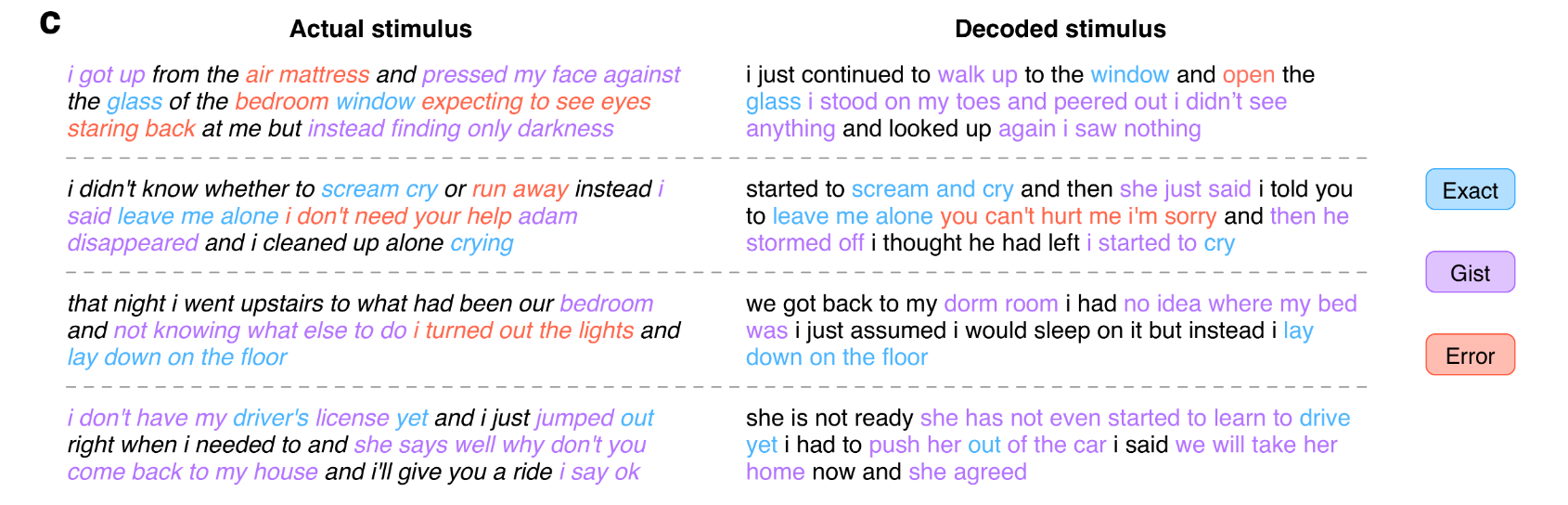
Two constraints on the neuroscience of content
Two constraints on the neuroscience of content Charles Rathkopf Center for Philosophical Psychology March 21st, 2024 What are the theoretical limits on mind-reading? The relevant data is too hard to acquire The relevant data is too hard to interpret The relevant data is not (exclusively) located in the brain here I focus on BELIEF If there are no constraints, then I can work out on the basis of…