
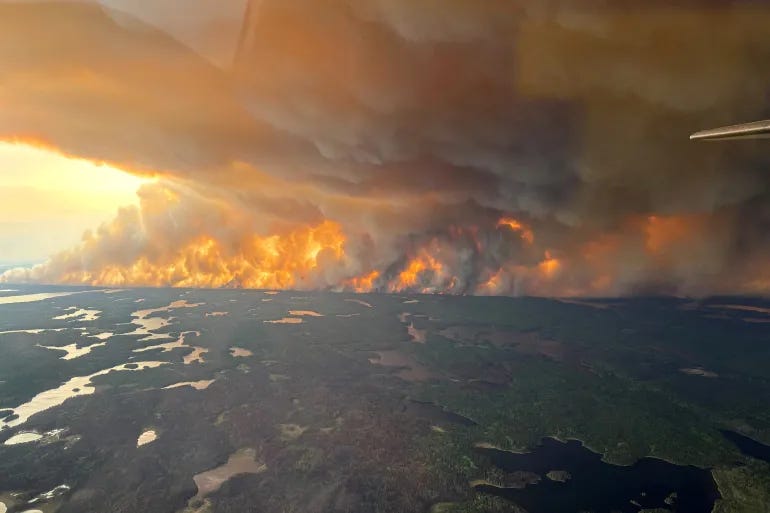
Oh god, massive fucking wildfires are sweeping through Ontario as I write.
Wildfires are nothing new for Canada, but the severity of these fires is alarming. Residents of major cities like Toronto can no longer see the sun. Videos of apocalyptic smoke clouds choking out the horizon have flooded social media, and on top of weeks of heat waves, seem like omens of impending doom.
Climate catastrophe is here, and it’s here to stay.
Importantly, it is already ravaging one of the places that everyone assumed would be something of a climate refuge in the years to come.
With its cold climate, long winters, and massive freshwater reserves, Canada is remarkably well positioned to weather the storm of climate change in the coming century.
Or so we thought.
I can remember with grim recall the many times that Liberal friends have joked to me about fleeing to Canada if things get bad here in the States.
The assumption was always that it would be a safer bet than trying to survive the looming threat of ecofascism and civil conflict that our own nation seems rushing headlong towards.
But with Canada’s forests consumed by flames as temperatures around the world spike to extremes not expected until the mid 2070’s, it turns out that might be a more fraught proposition than previously believed.
You might avoid getting slimed out by some illiterate chud from Arkansas who thinks Gavin Newsom is the second coming of Stalin, but there’s no guarantee you won’t choke to death on wildfire smoke in a commune somewhere in Manitoba.
Still, prospects look less grim for Canada than they do for the United States, and there are some key reasons beyond relative climate resilience that explain why.
I myself have long wondered what it would be like to uproot my life and move North, as a refugee either from state terror, civil conflict, or climate hell.
So two weeks ago I flew to Toronto to meet with someone who did exactly that.
July 3rd, 2026
I’ve been sitting on the Tarmac of the Chicago O’Hare airport drinking for six hours awaiting takeoff, so I figured I would write.
I’m en route to Los Angeles, coming home from Toronto.
O’Hare never fails to try my patience. Ten years of trying to route through this airport to reach various places that aren’t Chicago and nothing to show for it but weeping and gnashing of teeth. Every time.
I don’t know who O’Hare was, but I’m tired of his bs.1
I want to gnash his teeth. If I had a time machine, I’d have to make a stop at the O’Hare household shortly after kirk’ing Baby Hitler, among others I won’t name.
It would be a difficult conversation between me and Mrs. O’Hare, but I think she would understand that the future sanity of millions of travelers depended on as merciful a form of infanticide as I could manage.
But I need not pursue a program of O’Harebortion.
If I was a Catholic, I am sure that I could find a reasonable alternative, like encouraging the Senior O’Hares to engage in “natural family planning,” and providing contraceptives for them when that inevitable failed.
Sorry for letting that get so dark and horny.
Anyway, I am tired of living through the American Century of Humiliations.
That is actually why I was in Canada, which, up to this point, I had assumed was either a winter themed amusement park somewhere in North Dakota, or entirely fictional, or both.
Most people don’t take Canada all that seriously and that really aggravates Canadians.
But when your greatest cultural achievement is that gay hunk from the softcore hockey TV show Heated Rivalry, forgive me if I chuckle when your rosy little Canadian cheeks get all hot and bothered.
Americans can’t get enough of rosy Canadian cheeks.
Enough, I jest.
I love Canadians. Hearty folk, and true. Like the Midwesterners of the great Northeast, Northwest, and Midwest.
And anyway, I’d decided I wanted nothing to do with the ritual celebration of a New World settler-colonial experiment on July 4th, so I figured I’d go to Toronto for Canada Day, which I am sure is unproblematic.
To be honest, I didn’t look into what Canada Day actually is. I presume it is about a longshoreman named Tony Horton who died from poutine scurvy while trying to find the Northwest Passage.
That is what I gathered from the dozen or so Canadians with whom I spent July 1st drinking, watching “football,” and singing sea shanties.
I tend to walk the earth assuming that I alone among these myriad strangers know the secret delights of the shanty. I guard my sacred knowledge like the Biblical virgins who hid the Pearl of Great Price from King Herod in that reed basket.
If our 1775 Revolution united us around the idea that we were not British, 1812 united Canadians under the conviction that they were certainly not, and never would be, American.
The reason is that most Americans are loathe to find themselves in the presence of a real shantyman.
When I try to send one or more of my five separate sea shanty playlists–curated for the more discriminating shantyman, but accessible to the novice–to friends or would-be suitors, their amusement tends to turn to alarm when they realize that this isn’t a bit for me, but actually a lifestyle.
To discover that I am a true Bully Boy, and that they are naught but a landlubber, a knave, a sniveling midshipman, still yearning for hearth, home, and the comfort of a Liverpool brothel… I can only imagine what it must do to their psyche.
But not so the Canadian!
The hearty Canuck knows every line of Stan Rogers’ Northwest Passage, and chokes back tears when he hears Gordon Lightfoot’s solemn voice sing the haunting melodies of The Wreck of the Edmund Fitzgerald.
At one point in the evening, when I worked up enough alcoholic courage to bark out lustily the opening verse of Barrett’s Privateers–
“Weeeeeelll, the year was Seventeen-Seventy-Eight…”
–I found a chorus of voices to meet my challenge, hollering back in raucous reply:
“HOW I WISH I WAS IN SHERBROOKE NOWWWW!”
What glee. What absolute delight. Even the girls chimed in, half-drunk syrens of impossible beauty, robust lungs, and and implausible politeness.
Was this Valhalla?
Had I arrived in that great Pirate Republic in the sky promised by David Graeber to all true anarchist Himbos?
No, I was still in a Toronto suburb, remembering why I love Canadians.
See, I’d wager I actually know more about Canada than the average American. It’s just that most of my knowledge of Canada sits around the period of 1763-1814.
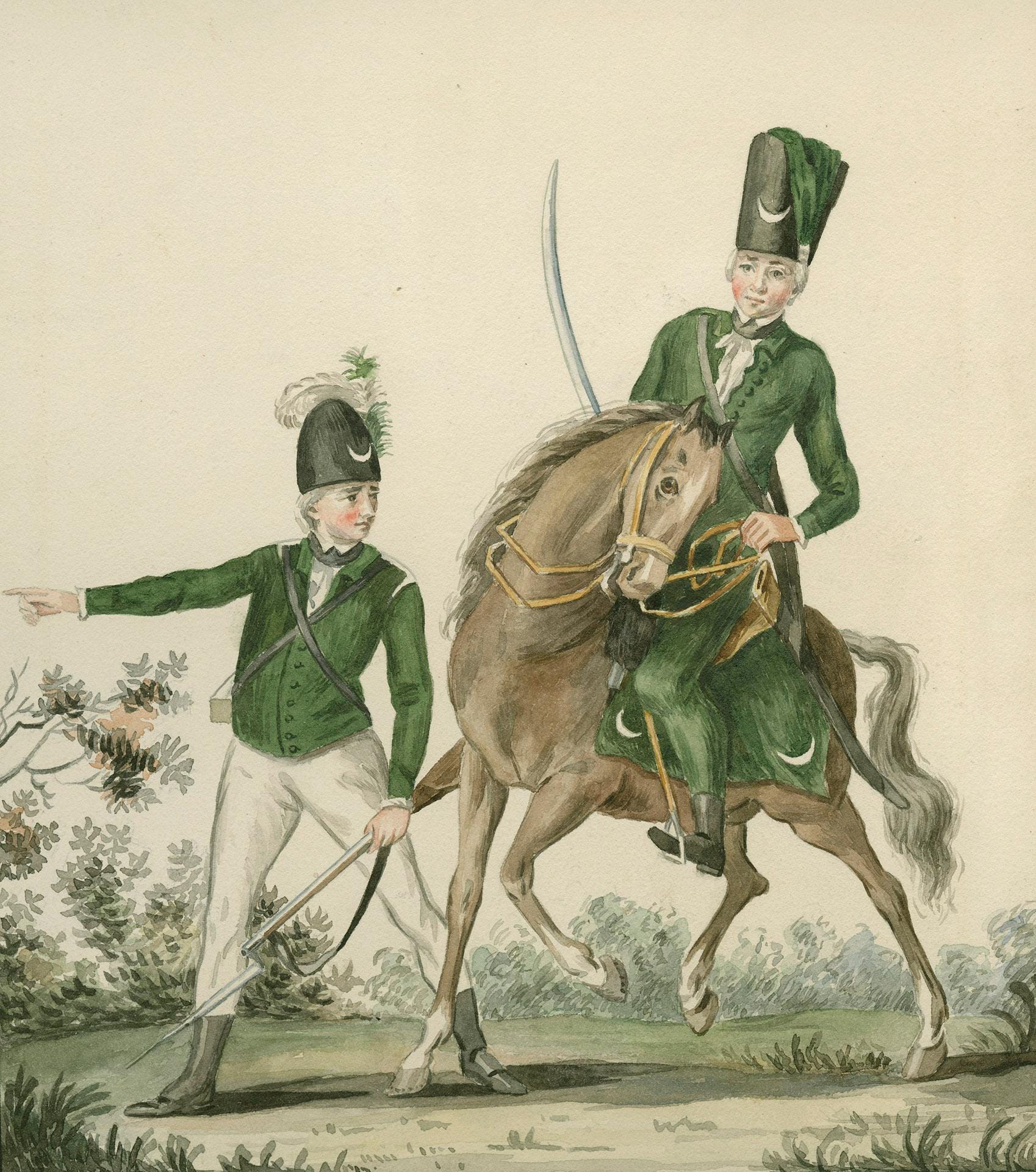
For instance, I know that, somewhere in Toronto, I would find a monument featuring two toy soldiers, one silver, the other gold, with the silver soldier knocked over and the golden soldier standing tall and proud.
And I did find it! Right outside the airport.
Radiant in all its glory.
I also know that this statue commemorates the victory of the Canadians over the United States in the War of 1812.
Oh, you thought we won that war?
Not according to Canada, which we arrogantly invaded and were speedily ejected from by a vastly outnumbered but militarily superior Canadian force that would march its way straight to our capitol and burn it the fuck down.
You see, the reason Canada became the self-conscious butt of every American joke has more to do with American insecurity than Canadian weakness.
Canada survived that war. Their survival was its own kind of victory, one that ensured that the United States’ Manifest Destiny would drive its expansion West, rather than North.
The only time the United States tested the Canadian resolve, we were humbled, and sent home with our tail between our legs.
And in the fires of Châteauguay and Queenston Heights, a new Canadian identity was forged in direct opposition to its American neighbor.
If our 1775 Revolution united us around the idea that we were not British, 1812 united Canadians under the conviction that they were certainly not, and never would be, American.
This divergence was evident from the earliest day of the American experiment.
The American Revolution could more accurately be described as the First North American Civil War, with intense fighting between Loyalists and Patriots occurring throughout the colonies, and particularly in my native South Carolina which, in 1777, boasted more casualties than every other theater of the war combined.
When the war was over, these Loyalists were not viciously persecuted, but neither were they particularly welcome. Many returned to England, but some moved north, to British Canada. There they remained loyal subjects of the Crown, and found a new life among fellow Loyalists.
These included the so-called ‘Black Loyalists,’ escaped American slaves who fled their enslavers and headed North to cross British lines, a reminder that, from its very inception, the fledgeling American nation represented freedom to some, but bondage to others.
The Loyalists were led by men like John Graves Simcoe, the founder of the Queens Rangers, which terrorized Washington’s forces in the Hudson Valley by adopting indigenous ambush tactics and attacking American supply lines.
Simcoe was–and I cannot stress this enough–nothing like the depiction of him in the popular History Channel TV series Turn: Washington’s Spies.
He was, in reality, a devout Anglican and abolitionist who, in 1793 became the first colonial leader in North America to ban the slave trade outright. Yay!
He grounded his opposition to slavery in his Christian faith, declaring to legislative assembly of Upper Canada:
The principles of the British Constitution do not admit of that slavery which Christianity condemns. The moment I assume the Government of Upper Canada under no modification will I assent to a law that discriminates by dishonest policy between natives of Africa, America, or Europe.
It would be fifteen years until the enlightened republic of the United States would follow suit, and three-quarters-of-a century before it ended slavery entirely, and only then not through compromise, but through force of arms.
If you’re curious on the difference between the American and Canadian experience with slavery, I touch on it in this article.

Last night I found myself at dinner with Jason Stanley, the prolific American academic who relocated his family from New Haven to Toronto last year, citing Trump’s re-election and rising fascism as the primary reasons.
Comments
Nothing yet. Say the first thing.
Sign in to join the conversation.