
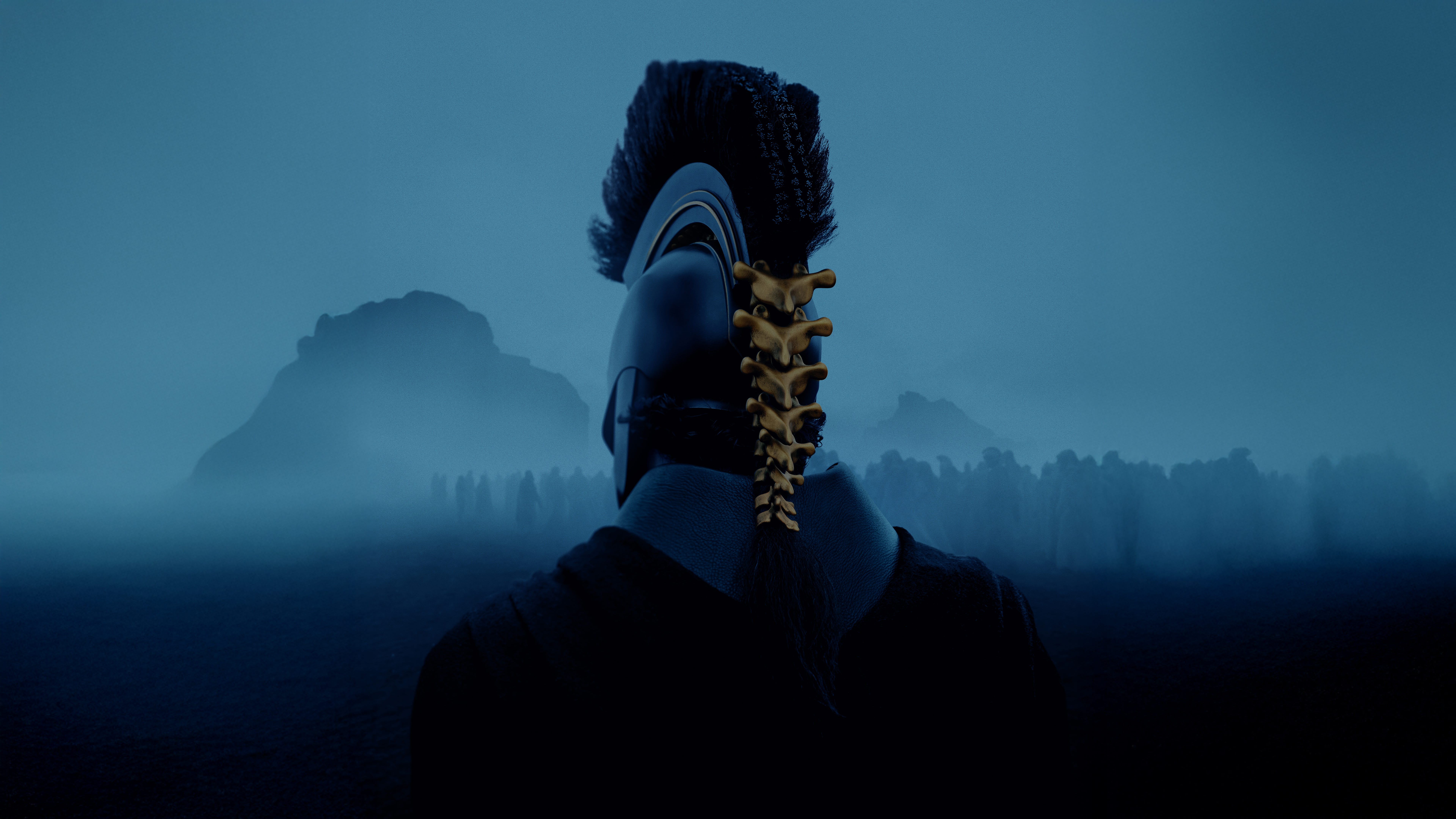
Spoiler Warning: This not a review of the Odyssey, it is a mostly spoiler free discussion of the film’s themes in relation to Greek mythology and modern geopolitics. If you haven’t seen Nolan’s The Odyssey, you might want to check back here once you have. If you haven’t read Homer’s Odyssey, I can’t help you. You’ve only had 2,700 years.
SPEAK, MEMORY—
Of the cunning hero,
The wanderer, blown off course time and again
After he plundered Troy’s sacred heights.
I watched Nolan’s The Odyssey last week, like evidently most of the country. I got to see it in IMAX 70mm before opening day, at the Chinese Theater, thanks to the generosity of my film-obsessed friend Brian.
It was an overwhelming sensory experience, due in large part to the astonishing set pieces and Ludwig Göransson’s incredible musical score. Göransson is fast becoming one of my favorite composers working today, and with his last two Nolan collaborations, has cemented his reputation as one of the greatest film composers of all time.
The filmed opened to a jaw-dropping $264.1 million globally, marking the largest opening of Nolan’s already impressive career.
The Wooden Horse not only enabled the Achaean sack of Troy, it violated the sacred bonds between strangers upon which peace and commerce are built.
I knew enough about Christopher Nolan’s approach to filmmaking to anticipate that the controversies surrounding The Odyssey’s casting, costumes, and themes would largely be put to rest.
I was right.
The costumes look nothing like what Bronze Age Greeks would have worn, nor even what would have garbed their Iron Age descendants of Homer’s day.
The modern American accents are out of place with the Mediterranean backdrops. The appearance of Black suitors in the banquet halls of Ithaca or East Asian and South Asian crew members on Odysseus’ Greek penteconter would be distracting in a faithful Bronze Age historical epic.
But The Odyssey, is not an historical epic, and I strongly suspect that such choices were very deliberate.
When we break our obligations to the stranger, we break the world.
After all, Nolan was the director who started the trend of giving us grounded superhero films, with superheroes themselves serving as the modern equivalent of the ancient epic heroes, changing slightly with each telling, transformed through the very act of remembering.
You see, The Odyssey is not a film about Ancient Greece.
It is a modern lesson about what happens to a civilization when it ceases to recognize its obligations toward strangers.
In this sense, it is very Homeric in character.
Like the guest-host paradox of xenía, the very notion of Greek selfhood implied communal obligation,
With all their manners, mindes and fashions,
He saw and knew; at Sea felt many woes,
Much care sustained, to save from overthrowes
Himselfe and friends in their retreate from home.
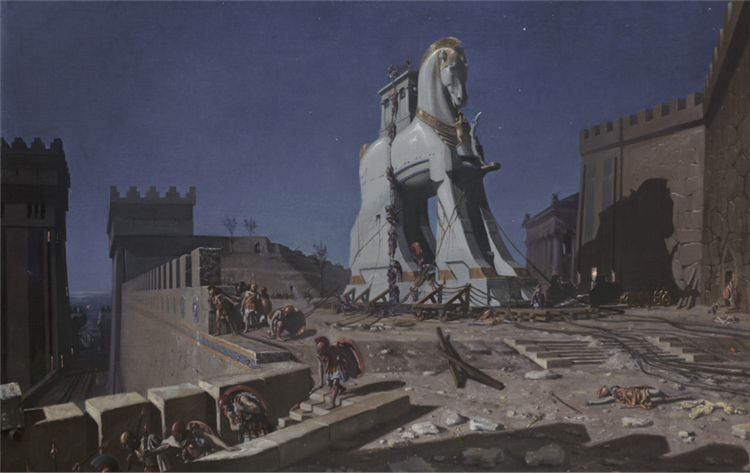
By receiving into its walls the gift of the Greeks, Troy was undone, and with it, an ancient code of conduct between men and nations.
The Wooden Horse not only enabled the Achaean sack of Troy, it violated the sacred bonds between strangers upon which peace and commerce are built.
When men and nations place their lust for power above all over considerations, they bring ruin and disaster upon everyone, including themselves.
This is the core contention of Nolan’s The Odyssey.
And it would be hard to imagine a more timely one.
It is the right of the artist to take creative liberties with his source material, and when it is done with respect for the spirit of that material, it demonstrates the relevance of that material to a contemporary audience.
Nolan bends The Odyssey like its protagonist bends his bow. He does so not with the intent to make a perfectly faithful adaptation of the poem, but to forge its lessons anew for an age of fear and collapse.
The film places a great deal of emphasis on what is invoked throughout the story as Zeus’ Law, a reference to ξενία (xenía), from the Greek ξένος (xénos), meaning stranger or foreigner, but also–somewhat paradoxically in the English–both ‘guest’ and ‘host.’
Xénos implies a reciprocal relationship, one of obligation. The obligation between strangers, guests, and hosts. It is occasionally translated as ‘guest-friend.’
Xenía was an ancient Greek code of sacred hospitality. Hosts were obliged to offer strangers food, shelter, protection, and respect, while guests were expected to honor the household and not abuse its generosity.
When nations place their lust for power above all over considerations, they bring ruin and disaster upon everyone, including themselves.
There are many pro-social benefits to such a code of honor, but the primary justification for it was that any stranger who comes to your door might be a god in disguise. To refuse hospitality to a stranger was to run the risk of spurning divinity.
Mythology aside, it created a culture in which an unknown traveler could become a protected guest through reciprocal obligation. Such a code facilitated commerce, safe travel, and peace.
Nolan’s Odyssey is about what happens when that code breaks down.
I need look no further than my own family history to learn that lesson.
Troy controlled the Hellespont, Iran the Hormuz Strait. This alone served as reason enough to bring war to their shores, not due to insult offered, but to advantage sought.
But not by will or valor could he save them
for their own recklessness destroyed them all—
children and fools, they killed and feasted on
the cattle of Lord Hêlios, the Sun,
and he who moves all day through heaven
took from their eyes the dawn of their return.
As I sat in that dark theater watching Nolan’s latest triumph unfold in all its 70mm glory, I couldn’t stop thinking about the man next to me.
I met Brian nearly four years ago over a cob salad at the Beverly Hills hotel. He wanted to make a movie in Ukraine, and wanted to hire me to figure out how to do that safely.
Years later, he is one of my closest friends.
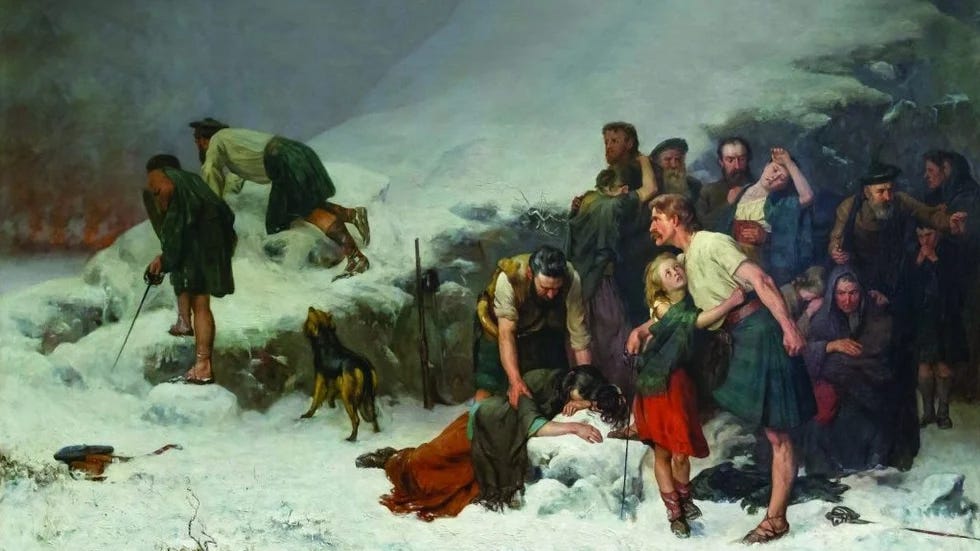
While we were in Ukraine, he was shocked to find out we had some shared family history. More than three hundred years ago, in the winter of 1692, his family invited my family into their banquet halls in Scotland under the law of hospitality.
They housed, wined, and dined us as guest. We drank and played cards with our hosts late into the night.
At around five in the morning, we attacked and slew them all.
We shot their clan chief as he rose from bed to meet the men he regarded as his guests.
We killed thirty men. Our hosts. We were just following orders, passed down from the Scottish government. But the stain of that cold morning has followed my family ever since.
Out, damned spot!
To this day, there are signs across Scotland at inns and pubs that bear the words “No Dogs, or Campbells.”
The Scottish Highlands were a violent place, in the 17th and early 18th centuries. But it was not the violence of our crime that sullied our name. It was the conditions under which it we perpetrated it.
We broke an ancient code of diplomacy and in doing so, ushered in a more dangerous world. We broke Zeus’ Law (xenía), bringing shame to our household and to our social community.
When this lesson was delivered in a different context on-screen, I looked over at Brian to see if his mind was following the same track as my own, but he was mercifully distracted by the sonic assault of Ludwig Göransson’s epic score and Hoyte van Hoytema’s visual feast.
I was left to ruminate alone on my own family curse.
Like the sons of Atreus (yes, that is where we get ‘Atreides’), my own family name is marred by betrayal, kinslaying, and death.
When Agamemnon elevates his egoic lust for power or Odysseus his own cunning over the demands of xenía, they imperil not only their own ‘selfhood’ but that of the broader social community.
Zeus’ Law cannot be understood without examining the particular approach the Ancient Greeks took toward social relations.
The Greeks believed that the ideal state of the household and the social community was αὐτονομία (autonomia), or ‘self-rule,’ combining autos (self) and nomos (law or custom).
The sociologist Murray Bookchin points out that this word does not mean ‘independence’ in the sense of a “free-wheeling, materialistic bourgeois ego,” but rather that it has a “rich ethical meaning in premarket eras.”1
Greek “selfhood” was intimately associated with rule, social rule, the capacity of the individual to directly participate in governing society even before he could manage his economic affairs.
The very term “economics,” in fact, denoted the management of the household — the oikos — rather than society, a somewhat inferior, even if necessary, activity by comparison with participation in the community or polis.2
Selfhood, for the Greeks, was not an egoic individuation, but was “associated with individual claims to power within society rather than [merely] the management of material life.”
“Hellenic selfhood found its fullest expression in the polis rather than the oikos, in the social community rather than the technical. Once we cross the threshold of history, self-management is the management of villages, neighbourhoods, towns, and cities.
The technical sphere of life is conspicuously secondary to the social.3
The Greeks believed that selfhood reached its fullest expression in a social context. Like the guest-host paradox of xenía, the very notion of Greek selfhood implied communal obligation, defying the English meaning of the terms, which increasingly serves as “little more than a euphemism for egotism.”4
This is the logic of fascism. The worship of power for its own sake.
Nolan’s Odyssey is a warning about what happens when autonomia collapses at the level of the household (oikos) and the social community (polis).
It plays out in the intimate banquet hall of Odysseus’ own household, and the broader social community of the Bronze Age Mediterranean.
It even invokes the historically mysterious “sea peoples” as a harbinger of the Bronze Age collapse to drive this warning home.
When Agamemnon elevates his egoic lust for power–or Odysseus his own cunning–over the demands of xenía, they imperil not only their own ‘selfhood’ but that of the broader social community.
The breaking of Zeus’ Law becomes not the discarding of a useless custom, but the announcement of a more dangerous world to come.

Now goddess, child of Zeus,
tell the old story for our modern times.
Find the beginning.
Seven months ago, Canadian Prime Minister Mark Carney climbed the stage at Davos to deliver an address that historians may one day use to definitively mark the end of the American-led post-WW2 global order:
Today I will talk about a rupture in the world order, the end of a pleasant fiction and the beginning of a harsh reality, where geopolitics, where the large, main power, geopolitics, is submitted to no limits, no constraints.
Comments
Nothing yet. Say the first thing.
Sign in to join the conversation.